
What will gas cost for my trip or my year, at my real L/100 km?
Trip cost, a year of gas, or your real L/100 km and mpg. Free, no sign-up, nothing leaves your browser.
Trip cost
Type the kilometres to get there. Pick Round trip and we double them, so the drive home counts too. Your map app gives the distance; we don't look it up.
Everyone chipping in, driver included. We split the rounded total, then tell you if the rounded shares miss it by a cent or two.
Yearly cost
Your usual driving. Pick a week, a month or a year. A year here counts as 52 weeks or 12 months.
Your L/100 km
Reset the trip odometer when you fill the tank all the way, then read it at the next full fill-up.
Write down the odometer when you fill all the way up. At a later full fill-up, write it down again. Tenths of a kilometre count.
Leave out the first fill: it only sets the starting line. Add every litre after it, top-ups included, through the last full tank. Several fill-ups give a steadier number than one.
Every receipt after that first fill, top-ups included, up to the last full tank.
10 receipts is the limit.
Gas for this trip
A year here is 52 weeks or 12 months. The month and the week come from the rounded year.
One tank is a small sample. A winter tank and a summer tank can differ, so a total over a few fill-ups gives a steadier number.
That's outside 3 to 30 L/100 km, our usual-range check. Check the kilometres and the receipts: the first fill's litres don't belong here.
If your L/100 km has gone up and stayed up, a shop can check why. Find Auto Repair Shops or Car Tune-Up near you.
Example: 540 km each way, round trip, at 7.8 L/100 km and 164.9 cents a litre comes to $138.91.
$138.91
1,080 km round trip (540 each way) at 7.8 L/100 km and 164.9 cents a litre
84.24 litres
$12.86 per 100 km
7.8 L/100 km is 36.2 mpg on the imperial gallon and 30.2 on the US gallon.
Km / 100 x L/100 km = litres. Litres x price in cents / 100 = cost in dollars.
Km a year / 100 x L/100 km x price in cents / 100 = dollars a year. A month is the year / 12, a week the year / 52.
Litres pumped / km driven x 100 = L/100 km.
How the fuel cost calculator works
You're about to head out on a long drive, and someone asks what the gas will cost. The arithmetic is short. Kilometres divided by 100, times your L/100 km, gives litres. Litres times the price in cents, divided by 100, gives dollars. What goes wrong is everything around it: the drive home nobody counts, an mpg figure on the wrong gallon, a price typed in dollars when the sign shows cents, and the cent that goes missing when three people split the bill.
Kilometres.
Type the distance to get there. Pick Round trip and it's doubled, because the drive back burns gas too.
Your fuel consumption.
L/100 km is what the EnerGuide label and the ratings from Natural Resources Canada (NRCan) lead with, so it's the default. Got an mpg figure instead? Pick the button for its gallon first, because the same number means two different amounts of gas.
The price on the sign.
Type it the way the sign shows it, in cents to the tenth: 164.9, not 1.649. Type 1.649 anyway and it's read as 164.9 cents, with a note under the field saying so. We never fill in a price. Statistics Canada's monthly figures differ from city to city and month to month, so any number we picked would be wrong for most drivers.
Litres.
Kilometres divided by 100, times L/100 km. Rounded to two decimal places, as the card shows them.
Cost, rounded once.
Litres times the price in cents, divided by 100 and rounded to the cent once, at the end. That's why 540 km each way at 7.8 L/100 km and 164.9 cents comes to $138.91 for the round trip. Round the one-way $69.46 first and double it, and you'd say $138.92.
The split.
The rounded total, divided by everyone in the car. Three people pay $46.30 each. That adds up to $138.90, and the calculator tells you someone owes the extra cent.
Yearly cost is the same arithmetic at a bigger size. Type what you drive in a week, a month or a year. A year counts as 52 weeks or 12 months, and the month and the week come from the rounded year. At 15,000 km, 7.6 L/100 km and 152.9 cents, that's $1,743.06 a year and $145.26 a month.
It's arithmetic on your numbers, not a forecast. NRCan says it plainly: your consumption varies "depending on how, where and when you drive".
Why lower L/100 km is better, and why mpg hides the savings
L/100 km counts litres burned, so it falls as a car gets thriftier, and an equal step down saves the same gas wherever it starts. Going from 12.0 to 10.0 L/100 km saves 20 litres every 1,000 km. So does going from 8.0 to 6.0. In imperial mpg those two changes look nothing alike: about 4.7 mpg for the first, 11.8 for the second. Same 20 litres. That's why the calculator leads with L/100 km and keeps mpg beside it.
Imperial mpg or US mpg: which gallon is yours?
An mpg figure is only half a number until you know its gallon. The imperial gallon is 4.54609 litres. The US gallon is 3.785411784. So the same car scores about 20% higher in imperial mpg.
NRCan's 2026 ratings list a Volkswagen Jetta 1.5 at 7.2 L/100 km and print it as 39 mpg, on the imperial gallon. Every mpg in that 2026 table works out the same way. The same 7.2 is 32.7 mpg on the US gallon, and the difference is money: over 1,080 km at 164.9 cents a litre, "39 mpg" costs $129.00 (78.23 litres) if it's imperial and $107.42 (65.14 litres) if it's US.
So where does your mpg come from? The EnerGuide label prints it in "miles per imperial gallon". NRCan notes that trip computers, beside L/100 km, usually display mpg on the US gallon. US websites and forums use the US gallon too. The calculator never guesses the gallon. It asks before it uses an mpg, and shows the L/100 km under the field as you type.
One more trap. In October 2026 we typed "mpg to l/100km" into Google's search box with Canada as the location, and the first suggestion was its converter's answer: 235.214583. That's the US-gallon number. For a Canadian label's mpg, NRCan's figure is 282.48.
How to calculate L/100 km from your fill-ups
The number on the EnerGuide label comes from a lab. Yours comes from the gas station, and it takes two full tanks. Here's the method, with the part people trip over written in: the top-up in the middle.
Fill the tank until the pump clicks off. Write down the odometer, or reset the trip odometer.
Drive the way you usually do. If you top up along the way, keep the receipt.
Fill until it clicks off again. Write down the odometer and the litres.
Add every litre pumped after the first fill, the top-ups and the last fill, divide by the kilometres, and multiply by 100. Leave out the first fill. It only filled the tank to the starting line.
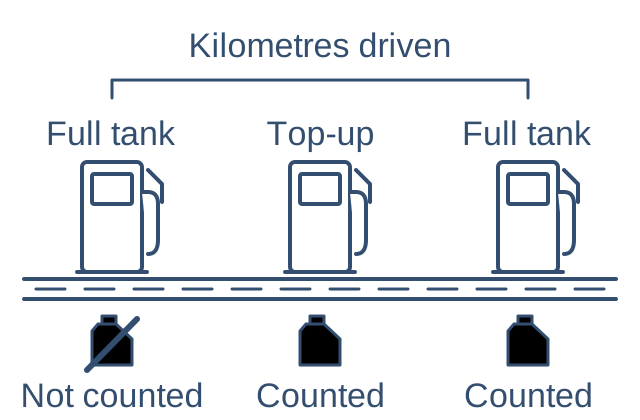
Skip a top-up and the car looks thriftier than it is. 18.250 plus 31.874 litres over 706.7 km is 7.1 L/100 km. Forget the 18.250 and the same car seems to burn 4.5.
For a number worth planning with, measure over several fill-ups and divide once. Don't average each tank. Two tanks can be far apart: say 520 km on 39 litres, which is 7.5, and 180 km on 21.6 litres, which is 12.0. Their average is 9.75, but the car burned 60.6 litres over 700 km, which is 8.7. Plan a 700 km drive at 9.75 and you'd budget 68.25 litres for the 60.6 it really took.
A plug-in hybrid's fill-up figure counts only the gas. Whatever it charged from the wall isn't on the receipts.
The odometer has to be right, too. On a winter set that isn't your original size it can read off, and your L/100 km is off by about the same percentage. Our tire size calculator shows how far, per 1,000 km.
Who this is for
Friends splitting gas on a long drive, and anyone starting a new commute after a move or a job change. A family weighing a thirstier SUV against the car they drive now gets a straight answer too, and so does anyone holding an mpg figure from a US website or a trip computer who needs it in litres.
Driver questions about gas cost, L/100 km and mpg
How do I calculate gas cost for a trip?
Divide the kilometres by 100 and multiply by your L/100 km to get litres. Then multiply by the price in cents per litre and divide by 100 for dollars. A 1,080 km round trip at 7.8 L/100 km takes 84.24 litres, and at 164.9 cents a litre that's $138.91. Count the drive home, use the consumption your car really gets, and round once at the end, not leg by leg.
How do I calculate L/100 km from a fill-up?
Fill the tank until the pump clicks off and note the odometer. Drive, then fill up the same way and note the litres. Litres pumped divided by kilometres driven, times 100, is your L/100 km. If you topped up in between, add those litres too. The Your L/100 km tab does the division and shows mpg on both gallons beside it.
Is Canadian mpg the same as American mpg?
No. Canadian mpg uses the imperial gallon, 4.54609 litres, and American mpg uses the US gallon, 3.785411784 litres. So the same car scores about 20% higher in imperial mpg. NRCan prints 7.2 L/100 km as 39 mpg, which is 32.7 in US mpg. Before you use an mpg figure, find out which gallon it's on.
How do I convert mpg to L/100 km?
Divide 282.48 by an imperial mpg, or 235.21 by a US mpg. Those are NRCan's figures, and the same division turns L/100 km back into mpg. So 39 imperial mpg is 7.2 L/100 km, and 39 US mpg is 6.0. Watch the quick converters: Google set to Canada answered our test with 235.214583, the US gallon's number.
Do I type the gas price in cents or dollars?
Cents, the way the sign shows them: 164.9 means 164.9 cents a litre. Type 1.649 and the calculator reads it as 164.9 cents, with a note under the field saying so. Get the unit wrong and the answer is off a hundredfold, so the note is worth a glance.
What does the EnerGuide annual fuel cost assume?
Two things: 20,000 km a year and the fuel price printed on the label. NRCan's tables say that price is a forecast, $1.50 a litre for regular gasoline, and $1.05 for the 2027 model year. Your year probably isn't 20,000 km, and your station doesn't charge a forecast. Put your own kilometres and price into Yearly cost and you get your number instead of the label's.
Why is my L/100 km higher than the label?
The label is a standard test. Your fill-ups are your car on your roads. NRCan says the ratings "may not accurately predict the fuel consumption you will get on the road", and that yours varies "depending on how, where and when you drive". Measure over several fill-ups before you worry. If your figure has gone up and stayed up, we'd get a good shop to find out why.
What's a good L/100 km?
Good for your car means close to its own combined rating. Look it up in NRCan's fuel consumption ratings search tool, then measure yours over a few fill-ups. Lower is better, and every litre counts the same: dropping from 12.0 to 10.0 L/100 km saves as much gas as dropping from 8.0 to 6.0, 20 litres every 1,000 km.
How do I split gas money with friends?
Work out the whole trip's gas, the drive back included, and divide by everyone in the car, driver too. Set People splitting the gas and the calculator divides the rounded total, then rounds each share. When the shares come to a cent more or less than the total, it says so, and nobody's left wondering where the cent went.
Does anything I type get saved or sent?
No. The arithmetic runs in your browser, on your device. Nothing you type is sent anywhere, nothing is stored, and the next visit starts blank. If you want to keep a result, copy it or print it.
Gas cost per km, per month and per year
A trip, a month of commuting and a year of driving all work out the same way. Gas cost per 100 km is your L/100 km times the price in cents, divided by 100. At 7.8 L/100 km and 164.9 cents that's $12.86 for every 100 km, or about 12.9 cents a kilometre. A year is your kilometres times that, a month is the year divided by 12, and a week is the year divided by 52, so typing your kilometres a week gets you all three. Weighing a thirstier car? Keep the kilometres and the price, change only the L/100 km, and compare the two yearly totals. It's gas alone, and it isn't an employer's per-kilometre allowance.
Sources and last checked
- EnerGuide for vehicles, Natural Resources Canada: the 55/45 city and highway weighting, the label's imperial mpg, and the 20,000 km behind its annual fuel cost.
- Understanding the tables, Natural Resources Canada: the conversion figures 282.48 and 235.21, the forecast fuel prices, and trip computers in US mpg.
- Understanding fuel consumption ratings, Natural Resources Canada: why a lower rating is better, and why your own figure can differ from it.
- Fuel consumption ratings search tool, Natural Resources Canada: look up your car's rating. The 2026 ratings are also open data.
- Monthly average retail prices for gasoline and fuel oil, by geography, Statistics Canada, table 18-10-0001-01: if you want a reference before you fill up. We link it and don't copy it.
- Units: the imperial gallon and the mile as the Weights and Measures Act defines them, the US gallon as NIST Handbook 44 does (unit profile fuel-unit-profiles, version 2026-10-07).
Last checked 8 October 2026.
More free tools for your car
- All free tools
Every free tool we've made for drivers, on one page.
- Tire size calculator: compare a winter set with your size
A different-size winter set changes what the odometer counts, and your L/100 km with it.
- Vehicle bill of sale: a printable form for your province
Selling the car, or buying one privately? Put the deal on paper first.
Planning another drive next month? Keep this page in your bookmarks. It remembers nothing between visits, so copy or print any figure worth keeping.