

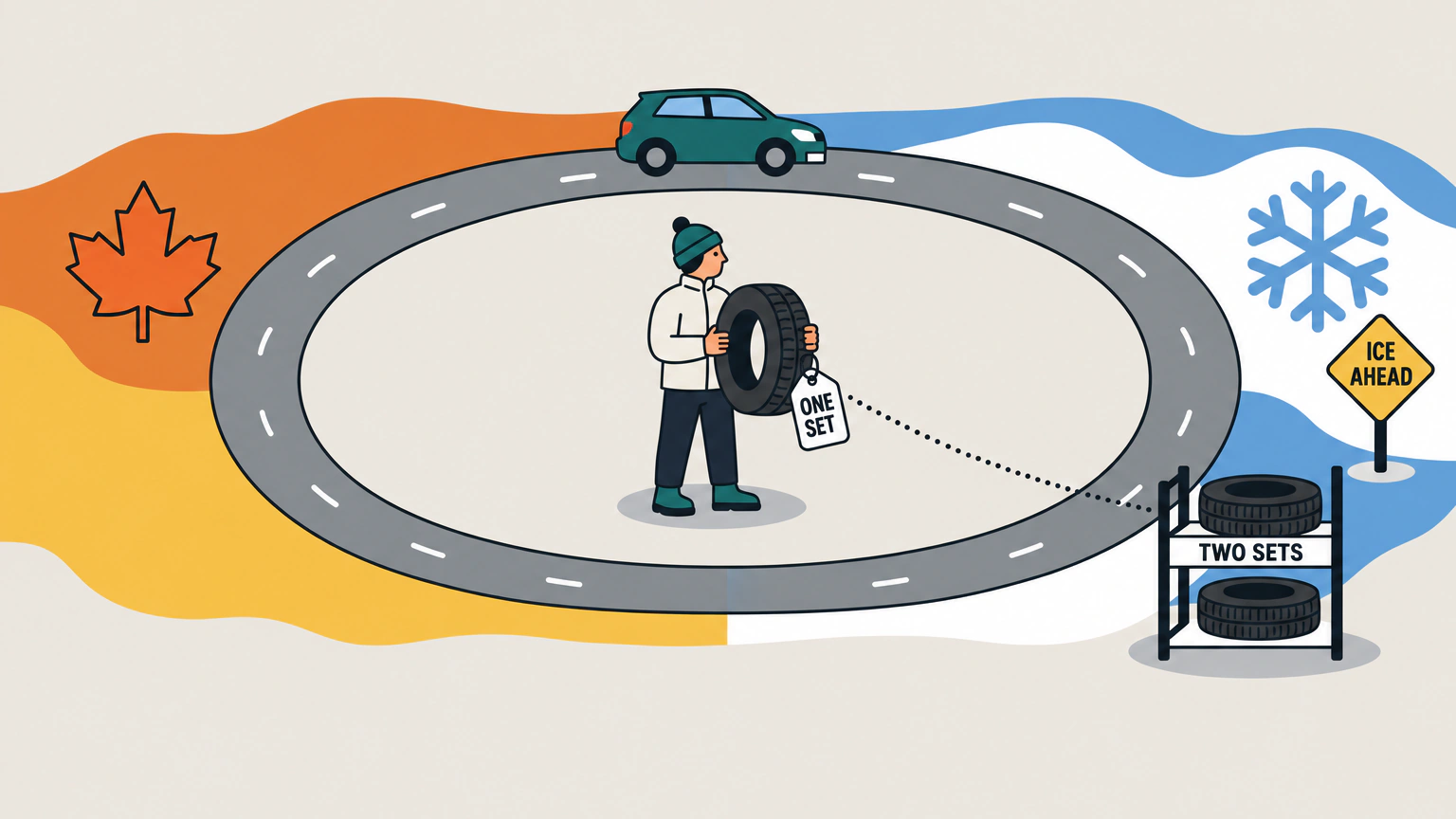
It's fall, the tires on your car are all-seasons or last winter's worn set, and the shop has quoted you two ways out. One set of all-weathers that stays on all year. Or winter tires plus a swap every spring and fall, with storage in between. The right answer isn't the same for every driver, and it turns on three things: what that snowflake actually proves, the roads you drive in January, and whether your insurer or MPI counts an all-weather tire as a winter tire.
On this page
- All-season, all-weather and winter tires, side by side
- What the snowflake on the sidewall actually tests
- Are all-season tires good enough for a Canadian winter?
- Where all-weather tires fall short of winter tires
- What Quebec and British Columbia count as a winter tire
- Insurance discounts and Manitoba's loan don't treat them the same
- How to choose for the roads you drive
- Frequently asked questions
- What to do before the first snow
All-season, all-weather and winter tires, side by side
| Tire type | On the sidewall | Passed Canada's winter snow test | Counts for Quebec's December 1 to March 15 rule | Counts on BC's signed winter routes | Built to run |
|---|---|---|---|---|---|
| All-season without the snowflake | No mountain and snowflake symbol; M+S, if present, isn't a snow test | No | No | Yes, if marked M+S with at least 3.5 mm of tread | Mild weather; the rubber starts to stiffen below about 7°C |
| All-weather with the snowflake | Mountain and snowflake symbol, sometimes beside M+S | Yes | Yes, when the symbol is on the sidewall | Yes, with at least 3.5 mm of tread | All year |
| Winter | Mountain and snowflake symbol; some also carry the ice grip symbol | Yes | Yes | Yes, with at least 3.5 mm of tread | Winter only, then off for the warm months |
The names are marketing. The sidewall is the specification.
A label can say all-weather, four-season or year-round, but those words don't prove that the tire passed the snow test. Manitoba Public Insurance's own rule makes that split plain, because from October 1, 2026 it looks at how a tire is marketed as well as what's moulded into it. So find the symbol yourself before you trust the sticker.
Set the labels aside and the three tire types sort themselves out. All-season tires are mild-weather tires, and Transport Canada says all-season and summer rubber begins to lose elasticity below 7°C. Snowflake-marked all-weather tires are built to stay on for twelve months while passing the snow test, which is why CAA-Quebec calls them "winter-approved all-season tires". Same product, different name. Winter tires are built for winter only, and TRAC says they should come off for the rest of the year.
Quebec accepts studded tires as well. If your winter is mostly ice, whether studded tires make sense is a separate question worth asking.
What the snowflake on the sidewall actually tests
The test behind the symbol is a straight line on packed snow
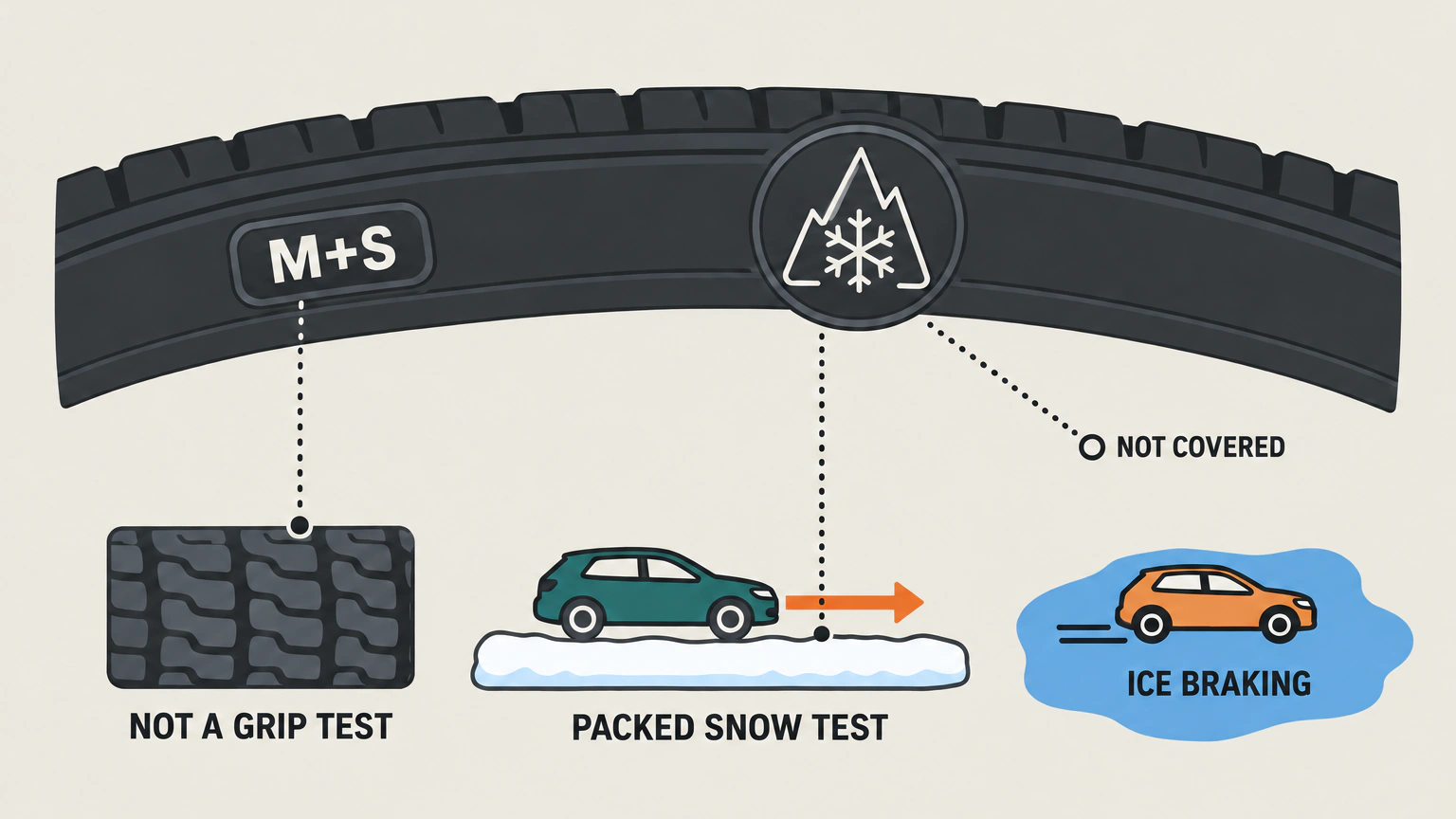
To count as a winter tire under Transport Canada's tire safety rules, a tire has to do one thing: pull away on medium packed snow at least 10% better than a standard reference tire. Against the newer reference tire the bar is 12%. Clear it, and the tire earns the Alpine symbol moulded into its sidewall, the three peaks with a snowflake inside them.
Read the test's own name and the limits show up immediately. It's the "Standard Test Method for Single Wheel Driving Traction in a Straight Line on Snow- and Ice-Covered Surfaces". One wheel. Driving traction. A straight line. The title mentions ice, but Canada's definition runs that test on snow, and snow is what the symbol certifies. Transport Canada says the same thing in plainer words: a tire carrying the symbol "meets specific snow traction performance requirements". TRAC notes that the Canadian tire industry created both the test method and the symbol, which is worth remembering when a sales pitch treats the mark as a grade.
Pulling away isn't the hard part of a Canadian winter. Stopping is.
M+S is a tread pattern, not a test
The other mark on your sidewall is older and proves less. M+S stands for mud and snow, and it comes from a tire industry design specification rather than a performance test. An Oregon transport research review puts it flatly: M+S "is a visual standard, and does not represent a performance standard". British Columbia's regulation treats it the same way, listing the manufacturers' M+S specification as a separate path from the snow traction index.
Plenty of winter and all-weather tires carry both marks, so M+S sitting beside the snowflake is harmless. M+S on its own is the problem. M+S alone doesn't prove that a tire passed Canada's snow test, doesn't satisfy Quebec's rule and won't qualify for MPI's loan. BC's signed routes are different, and they get their own section below.
Nothing in either mark tells you how a tire stops on ice
Neither mark says anything about braking, cornering or ice. M+S involves no test at all. The snowflake's test is a single wheel pulling forward on snow.
The industry knows about the gap. TRAC says a separate ice grip symbol arrived in 2022 for tires that pass an ISO test method on ice, and that a winter tire meeting both the snow and ice minimums carries both marks. No road rule we found asks for the ice symbol, so treat it as a shopping clue rather than a requirement.
Then there's the evidence that the snowflake was never a ranking. A 2012 research review by the Traffic Injury Research Foundation describes a 2008 Transport Canada braking test in which two sets of snowflake-marked all-terrain tires needed longer to stop than an all-terrain set without the symbol. Same mark, worse braking. The symbol is a pass or a fail on one snow test, and that's all it was built to be.
Are all-season tires good enough for a Canadian winter?
Three in four drivers outside Quebec who skip winter tires give the same reason: all-season tires are good enough. That's from TRAC's 2025 survey, and it's the most common belief on the subject.
It stops being true once the cold settles in. Transport Canada says all-season and summer tires begin losing elasticity below 7°C, and stiff rubber grips less however much tread is left on it. The same 2012 research review describes an ice demonstration from 2008: braking from 16 km/h, a car on winter tires stopped in 6.4 metres, and the same car on all-season tires needed 12.1 metres. Nearly double, at parking-lot speed.
In Quebec it isn't your call anyway. The province's winter-tire rule runs from December 1 to March 15, and a plain all-season tire doesn't have the required pictogram.
So for most Canadians the decision isn't all-season against winter. It's all-weather against winter.
Where all-weather tires fall short of winter tires
Ice, deep cold and the tire that stops shorter
CAA-Quebec has the least flattering description of an all-weather tire, and their words are the ones worth carrying into the shop. The rubber compound is harder than a winter tire's and the tread pattern less aggressive. The tire still grips well enough in deep snow to earn the snowflake, but "their braking distance is significantly longer, especially on challenging road conditions such as ice". Their advisory service goes further: "even a low-end winter tire will always outperform any winter-approved all-season tire".
That 2012 research review lands in the same place more gently. All-weather tires beat all-seasons in winter, it says, without reaching the grip of a good ice and snow tire. TRAC recommends dedicated winter tires for the very best winter performance and safety.
There's a real counter-argument, and it holds in one situation. When a second set genuinely isn't possible, an all-weather tire is the next best thing you can buy. For cleared city streets we'd agree with that. For untreated, icy or hilly roads we wouldn't, because those roads are exactly where the braking gap shows up. If ice is most of your winter, read whether studded tires make sense before you decide.
They wear all year, and winter grip wears with them
The sticker says nothing about tread depth. A tire loses traction as it wears, and Transport Canada is direct about the threshold: don't use tires worn close to 4 mm on snow-covered roads. Quebec recommends at least 4.8 mm for winter, against a legal minimum of 1.6 mm, and BC requires 3.5 mm on its signed routes.
Now think about where the kilometres go. A winter set spends half the year on a rack, so it only ever collects winter kilometres. An all-weather set carries every kilometre you drive, July heat included. CAA-Quebec says these tires wear out quickly and need replacing more often, and that drivers forget about rotation once there's no seasonal swap to remind them. So an all-weather tire can reach the 4 mm planning line sooner than a winter-only set, while the symbol stays moulded on the sidewall.
Pro tip: Quebec's quarter test. Push a quarter into a tread groove with the caribou's nose pointing down. If you can still see the caribou's snout, Quebec's government says the tire won't grip well in deep snow. Check a few grooves across the tire, because tread rarely wears evenly.
Age counts too. NHTSA says a tire's rubber and other components change over time, and a low-mileage tire can age before its tread wears out. If you aren't sure what you're running, a tire shop that can measure your tread can check it for you.
What Quebec and British Columbia count as a winter tire
Quebec and British Columbia write different winter tire rules.
Quebec sets a calendar. From December 1 to March 15, most motorized road vehicles registered in Quebec need tires marked with the winter pictogram or studded tires. An all-weather tire with the symbol complies. An all-season tire without it doesn't. The rule doesn't reach trailers. A visiting vehicle registered elsewhere isn't caught, but a vehicle rented out in Quebec is covered regardless of registration. For the dates, the fines and the exemptions in full, what a seasonal changeover costs sets them out by province, and if you're shopping we list shops across Quebec.
British Columbia regulates routes instead. On its signed winter routes, most of them from October 1 to April 30 with some ending March 31, a legal winter tire needs at least 3.5 mm of tread and either the snowflake or the letters M and S. That means a plain M+S all-season tire is legal on those highways, which surprises people. The province still recommends snowflake tires, "which include all-weather tires", for cold-weather driving, and advises carrying chains for extreme conditions.
Outside those two provinces, we didn't find a rule that tells you which tire to run. TRAC's own province-by-province list names no other winter tire mandate.
Insurance discounts and Manitoba's loan don't treat them the same
Legal on the road and counted for your money are two different tests, and this is where all-weather tires lose more often than they win. Insurers change these rules, and your policy wording is what counts, so get the answer in writing before you rely on a discount.
Ontario and Newfoundland and Labrador don't define a winter tire
Ontario's auto insurance regulation covers private passenger auto contracts issued or renewed since January 1, 2016. It requires insurers to build in "a discount in the rate of insurance in respect of an automobile that is equipped with winter tires". Newfoundland and Labrador did the same from January 1, 2020, requiring insurers to offer a rate reduction on a private passenger vehicle equipped with winter tires.
Both rules stop there. Neither rule says what a winter tire is. Neither sets the size of the discount. Neither says when the tires have to be on the car. In Ontario's whole regulation the word winter appears exactly once, in that one sentence.
So each insurer writes its own definition, which is why two quotes on identical tires can disagree by real money. TRAC's 2025 report lists Ontario and Newfoundland and Labrador as requiring insurers to offer the discount.
What four insurers say about all-weather tires
| Insurer | All-weather tires for the winter discount? | What it says |
|---|---|---|
| TD Insurance | No, if they stay on all year | Offers the discount in Ontario and Newfoundland and Labrador for winter tires from December through March, and says all-weather tires that stay on all year "do not qualify" |
| Aviva | No | Told CTV News in November 2025 that its 2% discount is for dedicated winter tires, "not the all-weather tires" |
| CAA Insurance | Yes, with the snowflake symbol | Told CTV News in November 2025 that its winter tire designation means the three-peak mountain snowflake symbol; CAA South Central Ontario lists a 5% discount for four winter tires on by November 20 and kept on until April 15 |
| Sonnet | Not stated | Its Ontario FAQ asks for a full set of winter tires marked with the mountain and snowflake logo and doesn't mention all-weather tires |
A yes from one insurer tells you nothing about the next, and the date windows move too. TD's discount runs December through March. CAA South Central Ontario wants four winter tires on by November 20 and kept on until April 15. Four insurers is four insurers, not the market, so the only answer that counts is the one attached to your policy. Ask by email and keep the reply.
Red flag: when the discount is the sales pitch. If a seller tells you all-weather tires will get you the Ontario winter tire discount, treat it as a question for your insurer, not an answer. Ontario's rule leaves the definition to each insurer, and two big ones have said no. Get your insurer's answer in writing before you pay.
Manitoba's Winter Tire Program drops all-weather tires on October 1
Manitoba helps you pay for the tires. MPI's Winter Tire Program finances up to $2,000 per vehicle at prime plus 2%, repaid by monthly withdrawal over one to four years. It's open to individual MPI customers, not corporate accounts, who own a passenger vehicle or light truck registered in their name and have no outstanding MPI payments or restrictions. Rims, mounting, balancing, alignment, tire pressure monitoring sensors and studding can ride on the same loan.
The rule behind that loan tightens this fall. From October 1, 2026, approved tires "must also be designed and marketed solely for winter driving conditions", and MPI says tires marketed as all-weather, all-season, four-season or year-round "will no longer be eligible", even when they carry the snowflake.
What it means if you're in Manitoba: after that date the loan only covers dedicated winter tires. Your retailer confirms eligibility and sets the loan up, so ask about the tire before you pick it rather than at the till. We list tire shops in Winnipeg, though which shops take part in the program is a question for them or for MPI.
How to choose for the roads you drive
Forget your province for a second and picture the worst road you drive in February.
Buy winter tires if any of this is your winter: untreated, rural, hilly or icy roads, long stretches of deep cold, an insurer's discount you're counting on that excludes all-weather tires, or an MPI loan on or after October 1. Buy snowflake-marked all-weather tires if you drive mostly cleared city routes, can leave the car parked through a storm, have nowhere to store a second set, and already have your insurer's answer in hand. Stay on all-season tires only if you genuinely don't drive the car in winter.
- Find the mountain and snowflake symbol on the sidewall itself. The word on the label doesn't count.
- Think about the worst road you drive each winter: untreated, hilly or icy points to winter tires.
- In Ontario or Newfoundland and Labrador, email your insurer and ask whether all-weather tires earn its winter discount.
- In Manitoba, if you're using MPI's loan on or after October 1, 2026, buy tires sold as winter tires.
- Measure the tread every fall. Near 4 mm, a tire has no business on snow-covered roads.
- Planning two sets? Price the swap and the storage before you compare.
- Heading onto a signed BC winter route? Check for at least 3.5 mm of tread and M+S or the snowflake.
If you're pricing the two-set route, what a seasonal changeover costs covers the swap and the storage, and that number is usually what decides it. When you're ready to buy, we list tire stores near you.
Frequently asked questions
Do all-weather tires count as winter tires for insurance?
It depends on your insurer. Ontario and Newfoundland and Labrador make insurers offer a winter tire discount on private passenger auto insurance. Neither defines a winter tire, so each company sets its own rule. TD says all-weather tires left on all year don't qualify. Aviva told CTV News it excludes them. CAA Insurance said its test is the snowflake symbol. Ask yours in writing before you buy.
Are all-weather tires legal in Quebec in winter?
Yes, as long as the sidewall carries the mountain and snowflake pictogram. Quebec's rule runs from December 1 to March 15. For a vehicle covered by the rule, an all-season tire without the pictogram doesn't comply. A visiting vehicle registered elsewhere isn't caught, but a vehicle rented out in Quebec is covered regardless of registration. CAA-Quebec still advises a dedicated winter tire over an all-weather one for Quebec winters.
Can you use all-weather tires on BC's winter tire routes?
Yes, with at least 3.5 mm of tread. On its signed routes BC accepts either the mountain snowflake symbol or M+S lettering, so a snowflake-marked all-weather tire qualifies. The province recommends snowflake tires, which it says include all-weather tires, for cold-weather driving, and it advises carrying chains for extreme conditions.
Is M+S the same as the mountain snowflake symbol?
No. The snowflake means the tire passed Canada's snow traction test. M+S is a tread-design marking with no performance test behind it, and many tires carry both marks together. BC accepts either one on its signed winter routes. Quebec's rule and MPI's loan program look specifically for the snowflake, so M+S alone won't get you through either of them.
Can I still get an MPI loan for all-weather tires?
Not on or after October 1, 2026. MPI says tires marketed as all-weather, all-season, four-season or year-round won't be eligible from that date, even if they carry the snowflake symbol. The program lends up to $2,000 per vehicle at prime plus 2%, repaid over one to four years, and your retailer confirms which tires qualify before the loan is set up.
Can you leave all-weather tires on all year?
Yes, that's exactly what they're built for. The trade-off is wear. They carry every kilometre of your year instead of half of it, so CAA-Quebec says they wear out quickly, and Transport Canada notes that a tire loses traction as it wears. TD also won't count tires left on the car all year toward its winter tire discount.
How much tread should a tire have for winter?
Transport Canada says don't use tires worn close to 4 mm on snow-covered roads. Quebec recommends at least 4.8 mm in winter, against a legal minimum of 1.6 mm, and BC requires 3.5 mm on its signed winter routes. Measure in more than one groove every fall, because tread rarely wears evenly.
What to do before the first snow
Start with the sidewall of the tires you already own. Find the three peaks and the snowflake, or find out that you don't have them. Then measure the tread in a few grooves, send your insurer one email asking whether all-weather tires earn its winter discount, and in Manitoba, if you're financing, decide before October 1.
Then book it. A tire shop that can measure your tread can check the tread before winter.