

On this page
The short answer
You're at the tire counter in October, and the whole decision comes down to one question: studs or no studs.
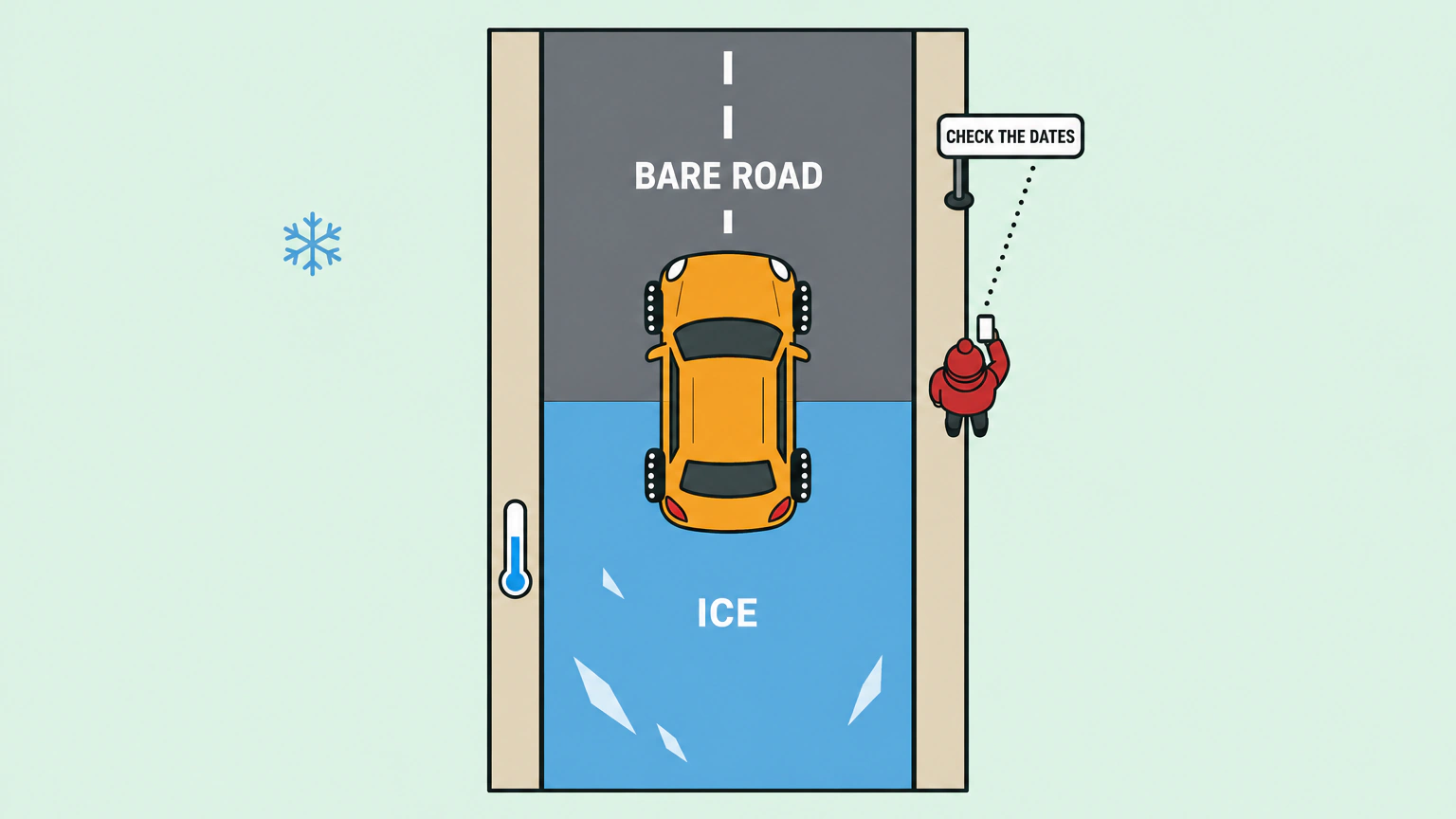
Studded winter tires are legal for part of the year in eight of the nine provinces we checked, while Alberta sets no season. The dates move at each border. Ontario allows them from September 1 to May 31, and only when the permit holder qualifies under its northern Ontario rule or the vehicle is visiting from outside the province. British Columbia and Manitoba run October 1 to April 30. Quebec runs October 15 to May 1. On smooth ice near the freezing mark, studs really do stop you shorter. On packed snow, colder ice and bare pavement, a good studless winter tire does as well or better.
So there are two questions, in this order. May you run studs where your vehicle is registered, and between which dates? Then: would studs do anything for the roads you actually drive?
Where you can run studs, province by province
Find your province, then read across. The season, who the rule covers and the stud limits all have to line up, because a set can be in season and still break the rules.
We've written each rule the way the province publishes it. If your vehicle is registered in one province and you drive in another, check both before the studs go on.
| Province | Studs allowed | Who the rule covers | Stud limits worth knowing |
|---|---|---|---|
| Ontario | September 1 to May 31 | Vehicles whose permit holder lives in northern Ontario (Algoma, Cochrane, Kenora, Manitoulin, Nipissing, Parry Sound, Rainy River, Sudbury, Thunder Bay, Timiskaming), a few public bodies there, and out-of-province vehicles in Ontario for 30 days or less | Studs on every wheel of a vehicle rated 3,500 kg or less, meeting Ontario's stud specifications (no more than 2.0 mm of protrusion in use) or Finland's approved tire-and-stud list; visitors are exempt from both |
| Quebec | October 15 to May 1 | Passenger vehicles, taxis, and commercial vehicles with a total loaded mass of 3,000 kg or less | A studded tire counts as a winter tire for the December 1 to March 15 requirement |
| British Columbia | October 1 to April 30 | Any vehicle; the minister can suspend studs on a highway that is wearing badly | No more than 2.0 mm of protrusion, no hollow centre, installed by the maker or a tire seller; studs on the front only if the back has them too |
| Alberta | No season set | No law specifically bans studs, but damaging a road is an offence | No stud specification in Alberta's equipment rules |
| Manitoba | October 1 to April 30 | Any vehicle | Metal safety studs with an exposed tungsten carbide or ceramic core |
| New Brunswick | After October 15 through April 30 | Motor vehicles | Studded snow tires must be a type approved by the Registrar; the minister can extend the season for exceptional weather |
| Nova Scotia | October 15 to May 31 | Any motor vehicle; fire department vehicles at any time | No more than one-eighth of an inch of protrusion, stud diameter up to half an inch, up to 130 studs a tire under 10,000 lb registered weight, the same number of studs on each side |
| Prince Edward Island | October 1 to May 31 | Any motor vehicle; off-season fines start at $150 | No more than 3.2 mm of protrusion, no more than 5% of the tread surface, never in used or worn tires |
| Newfoundland and Labrador | November 1 to April 30 | Any vehicle; the minister can move the dates for weather | Removal was extended to May 15 in 2026 |
Saskatchewan and the three territories aren't in the table: we couldn't open Saskatchewan's equipment regulation, and we won't print a rule we haven't read. SGI is the place to ask.
Ontario: it's where you live, not where you drive
Ontario's rule lives in Regulation 625 under the Highway Traffic Act, and it looks at the vehicle permit rather than the road. Studs are allowed from September 1 to May 31. The permit holder has to be a resident of northern Ontario, a corporation with a business premise there, one of a few public bodies in the north, or a visitor whose vehicle is in Ontario for no longer than 30 days.
Work it through. You live in Sudbury and drive to Toronto for a weekend on studs: legal. You live in Toronto and drive to a camp outside Sudbury: still against the rule, because it follows where you live.
The boundary trips people up. Parry Sound District is named in the regulation. The District Municipality of Muskoka, right next door, didn't make the list.
If you're covered, every wheel of a vehicle rated 3,500 kg or less needs studs, and the studs have to meet Ontario's specifications or come from Finland's approved tire-and-stud list. Visitors are exempt from both. Plenty of tire-shop pages print the season as October 1 to April 30, and it's wrong. The Act's general fine for breaking any of its rules runs from $60 to $1,000. The tire shops in Sudbury listings are a fair place to start.
Quebec and British Columbia: two calendars, two sets of limits
Quebec allows studs from October 15 to May 1 on passenger vehicles, taxis and commercial vehicles up to 3,000 kg loaded. There's a bonus in that. The province counts a studded tire as a winter tire for its December 1 to March 15 requirement, so one set covers both, and what a seasonal changeover costs has the mandate itself.
British Columbia runs October 1 to April 30 under the Motor Vehicle Act Regulations, and its hardware rules are specific. Studs can protrude no more than 2.0 mm from the tread, they can't have a hollow centre, and they have to be embedded by the tire's maker or by a tire seller. Studs go on the front wheels only if the back wheels have them too. Tires built on or before August 31, 2016 get a grandfathered allowance up to 3.5 mm. The minister can also suspend studs on any highway that's wearing badly, by written order in the Gazette.
Alberta sets no season, and Manitoba sets a firm one
Alberta is the odd one out. Alberta Transportation says the province and its municipalities have no legislation that specifically prohibits studded tires, but they do have a law making damage to a roadway an offence, and a peace officer can charge under section 51 of the Highways Development and Protection Act. There is no fixed spring removal date, but you can still be charged if your studs damage the road.
Manitoba is blunt in the other direction. Metal safety studs with an exposed tungsten carbide or ceramic core are allowed from October 1 to April 30, and Manitoba Public Insurance's driver's handbook says it in one line: "Studded tires are illegal between April 30 and Oct. 1."
Saskatchewan sits right next door with no rule we could read, so ask SGI rather than trust a list you find online.
Atlantic Canada: four provinces, two deadlines, and weather exceptions
New Brunswick normally allows approved studded snow tires after October 15 through April 30. The minister can extend the season for exceptional weather.
Nova Scotia runs October 15 to May 31, with the most detailed stud specification of the nine: no more than one-eighth of an inch of protrusion, stud diameter up to half an inch, up to 130 studs in a tire on a vehicle registered under 10,000 lb, and the same number on the left side as the right. Watch this one. The province's own driver's handbook still prints April 30, in a chapter laid out years before the 2014 amendment. The regulation is what a court reads, and it says May 31.
Prince Edward Island runs October 1 to May 31, caps protrusion at about 3.2 mm, and rules out studs in used or worn tires. Off-season fines start at $150.
Newfoundland and Labrador runs November 1 to April 30, and the minister can move that date for weather. Removal was pushed to May 15 in 2026. Studs went on early in Labrador in October 2018.
Do studs really grip better than a good studless tire?
Here's where the tire counter goes quiet. The clearest independent answer we found is a research review prepared for Washington State's transportation department, which pulled together studded and studless testing from Alaska, Sweden and Pennsylvania. Its verdict is narrower than the sales pitch. Studs win on one kind of road, and a daily commute on plowed, salted streets is a different road.
| Road surface | What the testing found | What it means for you |
|---|---|---|
| Smooth, clear ice near the freezing mark | Studs gave their biggest traction gain here; in one Alaska test, studded tires stopped 15% shorter on ice than a studless winter tire | This is the case for studs: untreated roads that glaze over around zero |
| Colder ice and packed snow | The stud advantage shrinks as it gets colder; on snow, studded and studless tires stopped about equally in one test, and a studless tire braked best in another | A good studless winter tire does the job |
| Bare pavement, dry or wet | Studded tires tend to grip worse, especially on concrete; on asphalt the stopping difference was small | Studs cost you on the plowed, salted streets of a daily city commute |
| Worn studs | Once studs wear down to about 0.6 mm of protrusion, they add almost nothing | Have protrusion checked before each winter |
Where studs win: smooth ice near the freezing mark
Clear, smooth ice around zero is the one surface where the testing found a real gain. In one set of Alaska stopping tests, studded tires stopped 15 percent shorter on ice than a studless winter tire. The review is careful about how narrow that window is, calling the benefit "primarily evident on clear ice near the freezing mark, a condition whose occurrence is limited."
Translate that to Canadian roads and it gets concrete. Untreated rural routes. Shaded hills that never catch the sun. Freeze-thaw mornings where meltwater crosses the pavement at dusk and glazes over by six. If that's your regular winter drive, studs are doing something a studless tire can't.
Where the edge fades: colder ice and packed snow
The gain shrinks as the thermometer drops, and it shrinks on roughened ice too. On snow, those same Alaska tests had studded, studless and all-season tires stopping nearly equally, averaged across several vehicles. In a second set of Alaska tests, the studless tires came first for braking on packed snow and ice, with studded tires second.
Hard-packed snow can sound like a case for studs. The testing points the other way: on packed snow a good studless tire kept up or led. We'd let the ice decide, not the snow. If your winter is mostly hard-pack at cold temperatures, studless is the smarter buy.
Where studs cost you: bare pavement, worn studs and road wear
On bare pavement studded tires tend to grip worse than other tire types, most clearly on concrete. On asphalt the review found little difference in stopping distance. There's a small fuel penalty as well, roughly 1.2 percent on bare roads.
Then there's wear. Once stud protrusion drops to about 0.6 mm, the review says the extra grip all but disappears. An old set can be mostly noise while the tread underneath still looks healthy. Have protrusion measured rather than eyeballed.
Studs also rut pavement, and the ruts bring tramlining, water sitting in the grooves, heavy spray and early damage to lane markings. That's the reason Prince Edward Island gives for its own deadline.
Should you buy studs this winter?
Short version. If you're legal where the vehicle is registered, your roads glaze over near zero, nobody treats them, and you drive them often, studs earn their keep. If your routes are plowed and salted, or your winter ice is mostly the deep-cold kind, buy a good studless tire instead.
Frequency matters as much as geography. A regular route over untreated, near-freezing ice is a different life from one bad Tuesday in February.
- Find your province in the table, and in Ontario check whether the vehicle's permit holder lives in northern Ontario.
- Think about the ice you actually meet: roads that glaze over near zero favour studs, plowed and salted routes don't.
- Plan on studs on all four wheels, whatever the minimum is where you live.
- If you're adding studs, buy new tires: Ontario and PEI both rule out studding a tire that's been driven.
- Ask for the studding charge per tire, itemized on the quote.
- Put your province's removal date in your calendar the day the tires go on.
- Driving out of province this winter? Check the destination's season before you leave.
Studded or studdable, and what to ask the tire shop
Two ways to get there. A factory-studded tire arrives with the studs already embedded. A studdable tire comes with moulded pin holes in the tread and gets studded at the shop.
If you're taking the second route, buy new rubber. Ontario allows studs added after manufacture only in a tire that has never been driven on a vehicle, and Prince Edward Island rules out studs in used or worn tires outright.
Red flag: These four lines deserve a second question. - An offer to stud tires you've already driven on, in Ontario or PEI. - A quote for studs on the front wheels only. - A shop that shrugs off the removal date because nobody checks in summer. - A southern Ontario sale pitched on how often you drive north: Ontario's rule follows where the owner lives.
Plan on four. Ontario requires studs on every wheel of a vehicle rated 3,500 kg or less. British Columbia won't allow studs on the front unless the back has them. Nova Scotia wants the same number on each side. Four gives you even traction. Check the destination's season before you cross a border.
Ask for the studding charge as its own line on the quote, per tire, separate from mounting and balancing. That one request makes two quotes comparable, and it shows you whether a cheap set has an expensive install behind it. Tire stores near you is where to start.
The day the studs have to come off
Treat the removal date as a booking rather than a guess. Put it in the calendar the day the tires go on, and book the spring swap with one of the shops that handle seasonal swaps in the same call as the autumn one.
Weather can move that date under you. New Brunswick can extend its stud season, and so can Newfoundland and Labrador. That's what happened in 2026, when removal there moved to May 15. Check each province's spring advisory rather than assuming April 30.
Crossing a border changes the rule mid-trip. A visiting vehicle gets 30 days in Ontario and no more. A Nova Scotia driver still inside their own May 31 deadline is out of season the moment they cross into New Brunswick after April 30. Work out the destination's last day before you load the car.
Frequently asked questions
Why are studded tires illegal in southern Ontario?
They aren't banned from southern roads as such. Regulation 625 looks at who holds the vehicle permit, so a northern Ontario resident's car can drive south on studs in season, and a southern resident's car can't run them anywhere in the province. The regulation gives no reason for the split. Provinces that restrict studs point to road wear, and Prince Edward Island spells that out in its removal alert.
Can you drive with studded tires in summer?
No, in eight of these nine provinces. Each of those eight closes its season by the end of May at the latest, and most close a month earlier. Alberta is the exception, because it sets no season at all, though damage to a roadway is an offence there. Prince Edward Island's off-season fines start at $150, and Ontario's general Highway Traffic Act fine runs from $60 to $1,000.
Do studded tires damage roads?
Yes. Studs accelerate pavement wear. The Washington State review names rutting as the core problem, and ruts bring tramlining, water sitting in the grooves, heavy road spray and early damage to lane markings. Prince Edward Island says exactly that in its removal alert. British Columbia's minister can suspend studs on any highway that's wearing badly.
How long do studded tires last?
Studded winter tires wear like any winter tire, but the studs can quit earlier than the tread does. Once protrusion drops to about 0.6 mm, the research review found the studs add almost nothing. That's the number worth watching, and a shop can measure it. Have protrusion checked each autumn before the set goes back on, rather than counting winters.
Can you put studded tires on the front wheels only?
Don't. Ontario requires studs on every wheel of a vehicle rated 3,500 kg or less. British Columbia forbids studs on the front unless the back wheels have them too. Nova Scotia wants equal numbers side to side. The testing says the same thing: two studded fronts stopped about halfway between four studded tires and four all-seasons, with stability penalties on top.
Can you put studs in used winter tires?
Not in Ontario or Prince Edward Island. Ontario allows studs added after manufacture only in a tire that has never been driven on a vehicle since it was made or remoulded. Prince Edward Island bans studs in used or worn tires outright. Buy fresh rubber if you're studding, and ask the shop to confirm the tires are unused before they start work.
How much does it cost to stud tires in Canada?
Studding is a per-tire labour charge on top of mounting. The Western Canada Tire Dealers' suggested price sheet lists passenger and light truck studding at $36 a tire and destudding at $30. That sheet was last revised in September 2018 and says all prices are subject to change, so treat it as a starting point and ask your own shop for today's figure, itemized per tire.
What to do before the first hard freeze
Start where your vehicle is registered. Look up that province's season, and in Ontario find out where the permit holder lives, because that's the whole test there. Then look honestly at the ice you meet on the way to work, not the ice you picture during a storm.
If the answer is studs, buy new tires to stud, and book the changeover and the removal in one call. If it's studless, you've saved the noise and a spring deadline. Either way the tires are one line on an autumn list, and whether you need a block heater is the next one.