

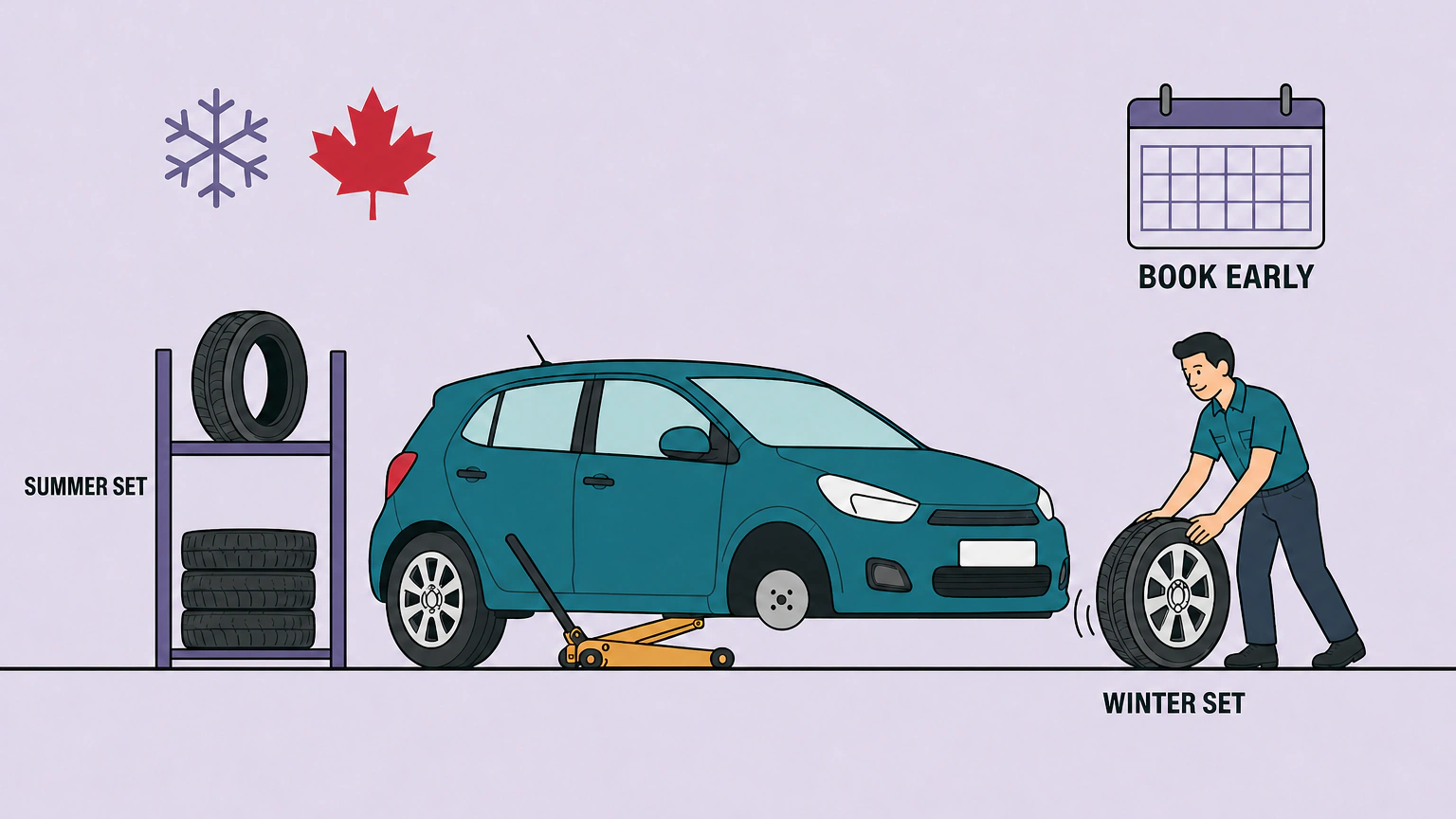
In most of Canada a winter tire changeover costs about $40 to $80 if your winter tires already live on their own rims. If both sets share one set of wheels, so every tire has to come off its rim and go back on, expect roughly $80 to $160. Those are Cansumer's collected Canadian shop prices, and that gap is the whole story. Book before your local rush. Shops fill fast when cold weather arrives, and in Quebec the legal deadline is 1 December.
On this page
- What a changeover actually costs in Canada
- Why the off rim job costs about twice as much
- When to book, and the deadline that applies to you
- Everywhere else there is no law, but there is an insurance rule
- Storing the other set, and what a season of it costs
- Before you drive away: torque, pressure and that light on the dash
- Questions Canadians ask about the changeover
What a changeover actually costs in Canada
Changeover is one word covering two different jobs, and nobody tells you which one you're buying.
The question that decides your bill: are the winter tires on their own rims?
Go and look at the set in your garage. If each tire has a wheel inside it, steel or alloy, you own two complete sets and the shop just takes four off and puts four on. That's the on rim job.
If your winter tires are four bare rubber doughnuts, both sets share one set of wheels, and every tire has to be pulled off its rim so the other one can go on. That's the off rim job, and it roughly doubles the price.
Advisers use those exact words on the phone, or sometimes "loose tires". Answer before they ask and your quote will mean something.
What shops charge, and what our own quote data says
Cansumer collects real prices from Canadian shops. On rim, it found Costco at $40, Kal Tire at $52 and Canadian Tire at $75, with Ontario drivers reporting $40 to $45 at independents. Off rim, the same list runs from $80 up to $150 at Canadian Tire and $160 at 1010Tires.
Compare like with like, though: a $45 quote and a $150 quote usually aren't the same work at all.
Our own listings add a second anchor. Across 856 cost profiles on our tire service pages a typical visit runs $55 to $86, average $65. That figure covers the category as a whole, not the changeover alone. Have a look at tire service shops near you before you phone.
A quote that doesn't say on rim or off rim isn't a quote.
| What you are paying for | Tires on their own rims | Tires that share one set of rims | Where the figure comes from |
|---|---|---|---|
| The changeover labour | About $40 to $80 a set | About $80 to $160 a set | Cansumer's collected Canadian shop prices |
| Balancing | Usually not needed | Inside the off rim price, or $10 to $20 a wheel on its own | Cansumer |
| Sensor service kit | Rarely | Commonly, per wheel; a reset runs about $15 to $30 | Towing Ottawa's city tire guide |
| Our own listings aggregate | $55 to $86 typical, $65 average | $55 to $86 typical, $65 average | PreferredMechanic.ca tire service listings, 856 cost profiles |
| Seasonal storage, if you use it | $60 to $100 a season | $60 to $100 a season | Cansumer's collected storage prices |
| Sales tax | On top | On top | GST, HST, PST or QST by province |
The charges that are not in the advertised price
A "$79.95 seasonal changeover" may be a labour price rather than the invoice total. That difference is where most complaints start.
On an off rim job the valve hardware is a consumable, so a sensor service kit often shows up per wheel. Wheel weights go on when the assembly is rebalanced. Replace a finished tire while the car is up and a disposal or environmental fee may appear. The rules vary: some programs set a tire fee, while elsewhere the retailer decides whether to charge one. Storage may be on this invoice or a separate one. Then tax, where it applies.
None of that is a scam. It's the difference between a headline and a bill, and you can ask for the whole number up front. If a swap turns into a figure you never agreed to, it helps to know what a shop can and cannot do if you dispute the bill.
Bundled deals are the other place the headline slips, and most of them start at tire stores in your city.
Red flag: "Free changeover with purchase" can mean different things. Check whether it covers tires already mounted on wheels, whether it lasts for the life of those tires, and whether sensor work, balancing and storage cost extra. Get the exclusions in writing before the tires are on the machine.
Why the off rim job costs about twice as much
Four extra operations sit between the two prices. The bead has to be broken, the tire dismounted, the winter tire mounted in its place, and the assembly rebalanced. Times four wheels.
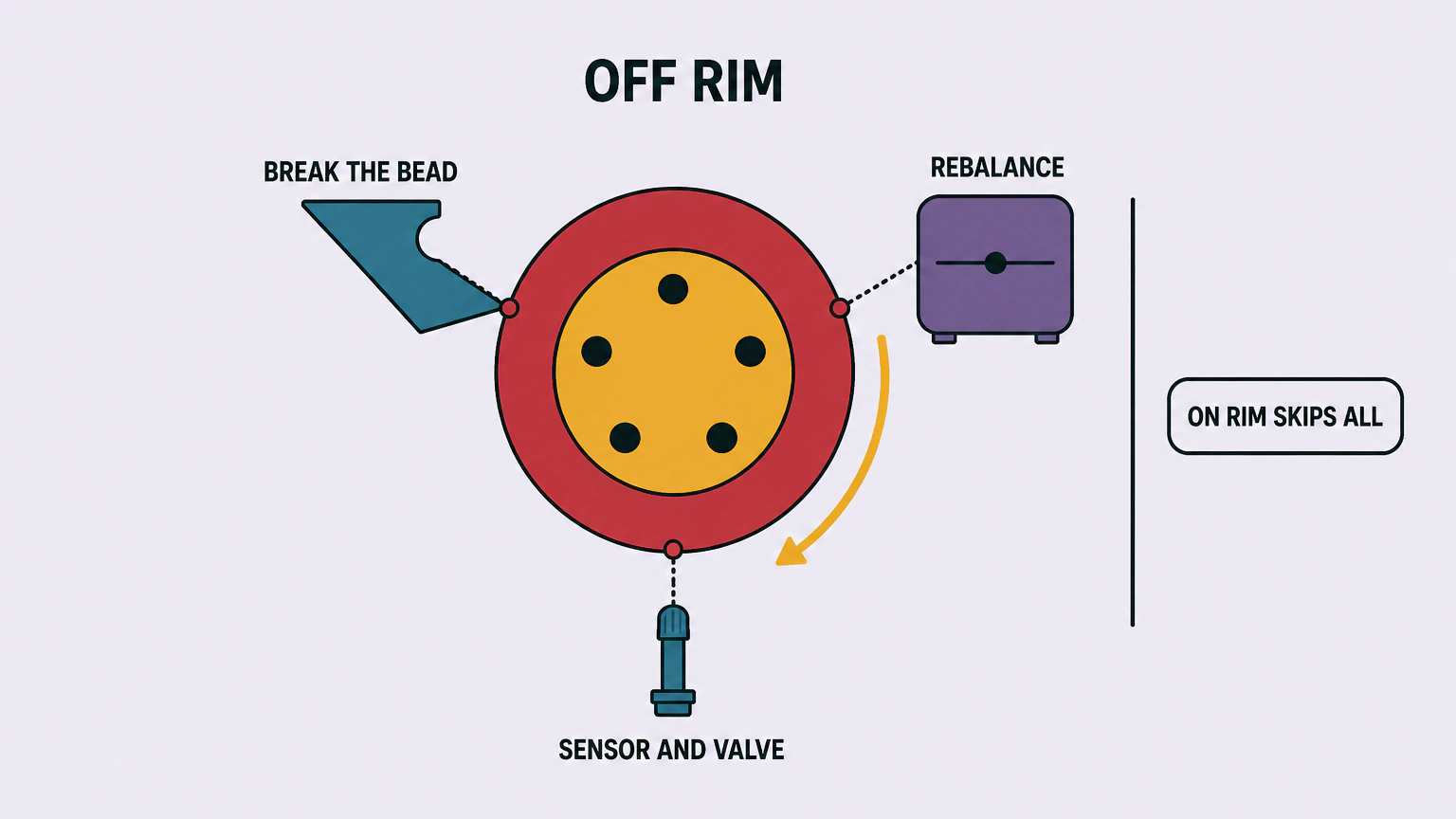
The four extra things a technician has to do
Breaking the bead comes first. The tire's edge is pressed hard against the lip of the rim and held there by air pressure, and a machine has to squeeze it loose before anything else can happen. Then the technician levers the tire off, fits the winter tire in its place, and puts the wheel on a balancer that shows where the small weights go.
That's a tire machine, a balancer and extra handling at every wheel. It's also wear: every mount and dismount stresses the tire's bead and the edge of the rim. If a bead won't seal afterwards, or a tire turns out to have a slow leak, that's a flat tire repair and a separate line on the invoice.
What the sensor inside your wheel has to do with it
If your car has direct tire pressure monitoring, a small sensor lives inside each wheel, usually at the valve. Off rim work disturbs it. The hardware around it is a consumable: the core, the grommet and the nut. That's the service kit you see charged per wheel. Towing Ottawa's city guide puts a reset at $15 to $30.
If your car has direct TPMS and you want both wheel sets ready to install, budget for a second set of sensors, one per wheel. People forget that line when they price out steel rims.
The relearn varies by vehicle. Some lights clear after a short drive; others need a shop procedure. If the light stays on, check the pressure on the door placard and ask the shop to test the sensors and confirm the relearn.
When a second set of rims pays for itself
Take Cansumer's figures. The gap between the bands is about $40 at the cheap end and $80 at the dear end, and you do two changeovers a year, so a second set of wheels saves $80 to $160 a year.
Four steel wheels run about $300, plus roughly $120 to have the winter tires mounted and balanced onto them once. Call the setup $420. That's about three to just over five winters to pay for itself.
Two honest catches. Alloys and big-diameter fitments can cost more than steel, and a second set of sensors goes on top. Wheels aren't universal either: many vehicles need a specific offset and centre bore, so your neighbour's set may not fit.
When to book, and the deadline that applies to you
Find your province before you read another word about timing. In two of them the calendar, not the weather, decides.
| Where | Required by law? | Dates | What counts as a compliant tire | Penalty |
|---|---|---|---|---|
| Quebec | Yes, province wide, on Quebec-registered vehicles except heavy vehicles, tool vehicles and farm machinery; rentals in Quebec are covered regardless of registration | 1 December to 15 March | The mountain and snowflake pictogram, or a studded tire | $200 to $300 |
| British Columbia | On designated routes only, marked with regulatory signs | 1 October to 30 April on most designated routes, ending 31 March on select highways outside mountain passes and high snowfall areas | M+S or mountain snowflake, with at least 3.5 mm of tread | You can be turned away and fined |
| Every other province and territory | No legal requirement | Not applicable | No legal definition; in Ontario all insurers must offer a discount, and elsewhere ask whether yours does | None |
In British Columbia, cities, municipalities and private roads such as ski hills set their own rules on top of the provincial ones.
We're describing the rules as the provinces publish them, not your vehicle or your route. Heading into B.C.'s interior or crossing into Quebec, read the signs and check the province's own page first.
Seven degrees is the point to have winter tires on
The Tire and Rubber Association of Canada puts it in one line: "As soon as the temperature consistently dips below 7°C drivers should change over to winter tires." That number is about rubber, not snow. Below roughly 7°C an all season compound stiffens and gives up grip while a winter compound stays soft enough to work, which is why the threshold arrives weeks before the first flake.
Treat 7°C as the point to have the winter tires on, so phone before your local rush. Towing Ottawa's guide clocks the October and November wait in that city at two to four weeks, and Statistics Canada is blunt about it: "they book up fast". The same cold snap decides whether you need a block heater where you live.
Quebec: December 1, and only one kind of tire counts
From 1 December to 15 March, covered vehicles registered in Quebec have to be on winter tires, and the fine is $200 to $300. Rentals in Quebec are covered regardless of registration. Other vehicles registered outside Quebec aren't caught.
Only two things count: a tire carrying the mountain and snowflake pictogram, or a studded tire. That's been the standard since 15 December 2014, so an old M+S all season doesn't qualify however good it looks. Studs are allowed on passenger vehicles from 15 October to 1 May.
The exclusions and exemptions are narrow: trailers, heavy vehicles, tool vehicles, farm machinery, spare tires, motor homes, detachable dealer plates and temporary registration certificates valid for no more than seven days, plus the seven days after you buy from a dealer and the seven days before a lease of a year or more expires, if you have the paperwork. The SAAQ can also issue a seven-day exemption certificate.
Quebec sets 1.6 mm as the tread floor and recommends at least 4.8 mm for winter. There's a field test worth knowing: stand a quarter in a groove, caribou's nose down. See the snout and the tire won't grip deep snow. Book early, with shops across Quebec.
British Columbia: October 1, two end dates, and a lower bar
British Columbia doesn't regulate your driveway. It regulates routes, marked with regulatory signs, and on those routes winter tires or chains are required from 1 October to 30 April. Almost every consumer page misses the second end date: on select highways outside mountain passes and high snowfall areas the requirement ends 31 March. Get it wrong and you can be turned away and fined.
The bar is lower than Quebec's, too. Under the Motor Vehicle Act Regulations a winter tire needs at least 3.5 mm of tread, and an M+S marking satisfies the law here. An M+S-only all season can be legal on the Coquihalla but doesn't qualify for a covered vehicle in Quebec.
That 3.5 mm figure is also where a widely read booking guide slips: NAPA AUTOPRO prints it as Quebec's requirement. It's British Columbia's. Shops across British Columbia will know which dates apply to your routes.
Everywhere else there is no law, but there is an insurance rule
Statistics Canada names those same two jurisdictions, and adds that every province and territory recommends winter tires anyway.
Ontario does something different. FSRA, the regulator, says: "All insurance companies must offer a discount if you install winter tires on your vehicle. Ask your insurer how to qualify." Note what it doesn't say. No percentage, and the conditions belong to your insurer, so the "2 to 5%" figure floating around consumer pages is somebody's example, not the rule.
Drivers fit them anyway. TRAC's 2025 survey puts national use at 80%, Atlantic Canada at 95% and Ontario at 77%. British Columbia sits last at 64%, which makes sense once you know the law there is route-based and most of its people live where the province itself calls the climate mild.
When you're ready to phone, tire service shops near you are the ones answering these questions. Have this list in front of you.
- Say whether your winter tires are on their own rims. It changes the price before anything else.
- Ask whether the quote is per wheel or per set, and whether balancing is in it.
- Ask what a sensor service kit costs, and whether that's per wheel.
- Ask about a disposal or environmental levy, and whether tax is included.
- Ask what the shop's torque policy is, and whether you need to come back.
- For storage, ask the seasonal price and whether it's bundled or billed separately.
- Ask what happens if a tire fails inspection mid-job, and whether they'll phone first.
Storing the other set, and what a season of it costs
Shop storage keeps four tires out of your condo hallway, but the conditions vary. Ask whether the space is indoors and climate controlled, and whether damage or theft is insured. Cansumer's collected prices run $60 to $100 for a season of six to nine months, from $40 at a storage company to $100 at a dealership.
If you have a dry garage with floor space, keep the money. Two things make that a false economy: a space that isn't really dry and stable, which an uninsulated shed may not provide, and a set you can't lift and stack safely alone.
Watch for the package deal. Storage and changeover can be bundled, which is where price comparison quietly stops working. Ask for both numbers separately. The same call is a good moment to sort out rust proofing, and when to book it, since tires and road salt arrive the same week.
Before you drive away: torque, pressure and that light on the dash
Three things are worth settling at the counter, in the ten minutes before you take the keys back.
Torque is the one people skip. CAA is plain: "After a tire service or installation, be sure to retorque your wheel nuts within 100 kilometres." It's no longer universal practice, though. Kal Tire torque-checks each wheel right after installation and says no return visit is required, a change from its old 50 km rule, and it'll still do a free retorque.
Pressure is second. Cold air takes up less room, so a set that read perfectly in a warm bay reads low on the first hard frost. The figure you want is the manufacturer's, on the sticker inside the driver's door opening, not the maximum stamped on the sidewall.
The third is that dash light, which may clear after a short drive or may need a vehicle-specific relearn.
Pro tip: Ask about torque before you pay, not after. CAA says retorque within 100 km. At least one national chain now torque-checks at installation and does not ask you back. Two shops, two defensible answers. Get whichever one applies to you written on the invoice.
Questions Canadians ask about the changeover
How long does a winter tire changeover take?
About 30 to 45 minutes if your tires are on their own rims, and 45 to 60 minutes if they have to come off and go back on, by Towing Ottawa's timings. The job itself is short. The wait for a slot is the long part, so book before your local rush.
Do I need a second set of TPMS sensors for my winter tires?
If your car has direct tire pressure monitoring and you want both wheel sets ready to install, budget for one sensor per wheel. A shop can transfer your existing sensors instead, but then the tires have to come off the wheels and the car may need a relearn. If both tire sets share one set of wheels, the sensors stay with those wheels and the serviceable valve hardware is replaced.
Do I really have to go back to have my wheels re-torqued?
It depends on your shop, so ask. CAA says retorque within 100 kilometres of any tire service. Kal Tire torque-checks the wheels immediately after installation and says the return trip is no longer required, though it will still do one free. Get the answer written on your invoice before you drive off.
Are winter tires mandatory where I live?
Only in Quebec, province wide from 1 December to 15 March, and on British Columbia's designated routes, from 1 October to 30 April or to 31 March on select highways. Statistics Canada names those two and no others. Everywhere else there's no legal requirement, though every province and territory recommends them.
Can I change my winter tires myself?
If your tires are on their own rims and you own a proper jack, jack stands and a torque wrench, yes, and plenty of Canadians do. Tighten to the vehicle manufacturer's spec rather than by feel, and re-check after 100 km. Off rim work needs a tire machine and a balancer, so that one goes to a shop.
Is it worth paying a shop to store my summer tires?
If you have no dry, stable indoor space, yes, and $60 to $100 a season is the going rate in Cansumer's collected prices. If you have a garage, do it yourself. Tires on rims stack flat, bare tires stand upright, and both want somewhere dark, dry and well away from solvents.
When should I book, and what happens if I leave it until the first snow?
Phone early enough to have the tires installed before daily temperatures consistently fall below 7°C. Leave it until the snow arrives and you join a queue that runs two to four weeks in Ottawa's peak, on summer rubber the whole time. Statistics Canada's own advice to drivers: "they book up fast."