

One thing before you read on. We're not your lawyer, and if a notice of sale has already landed or the disputed amount is large, that's worth a lawyer's hour, or in Ontario a licensed paralegal's.
On this page
The short answer, and the one thing that changes it
Two questions decide whether this shop still has the right to hold your car, and you can answer both from your side of the counter. Did the shop follow the estimate and authorization rules? And which province are you standing in?
What a possessory lien actually is
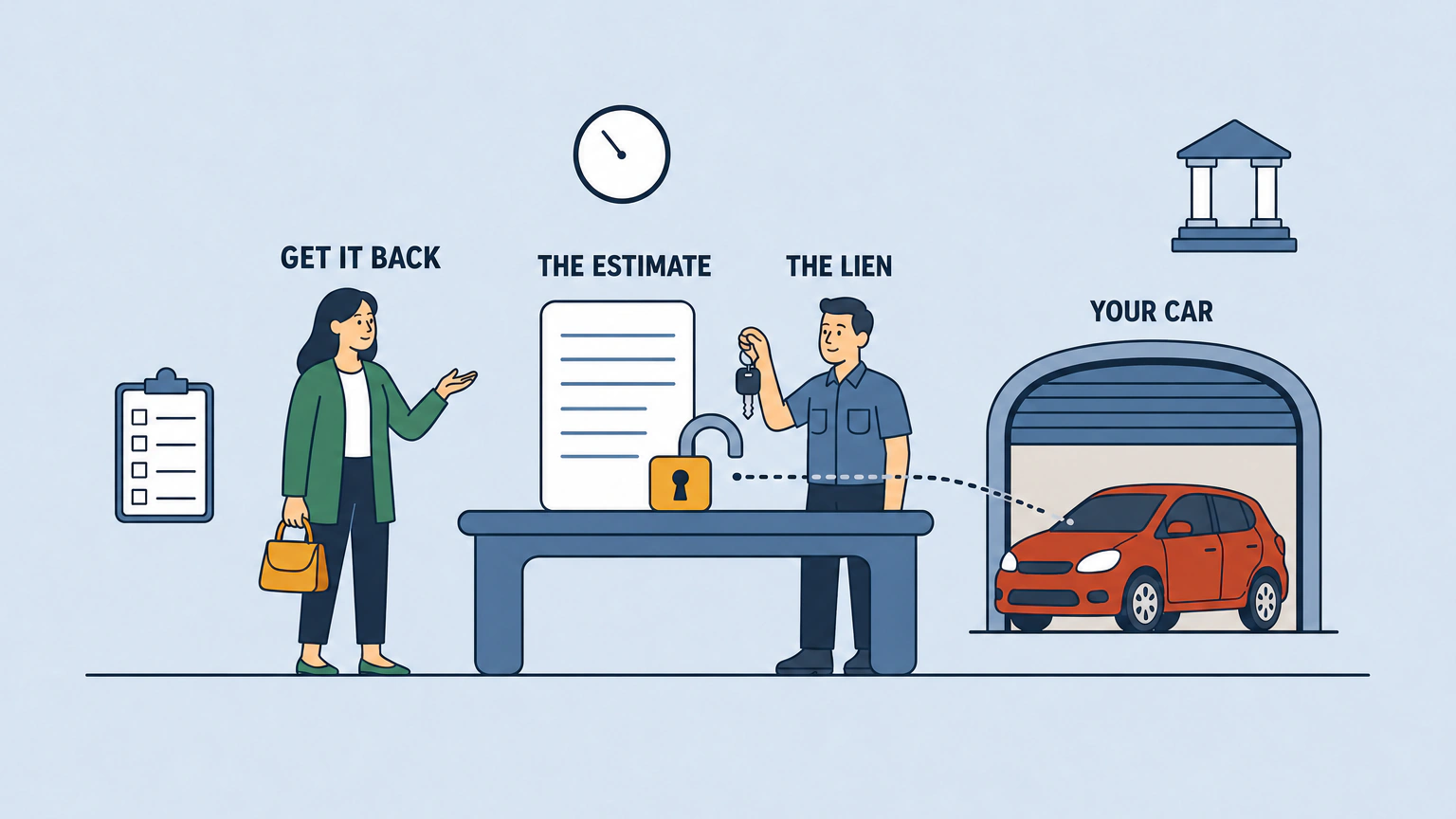
A possessory lien isn't paperwork. It grows out of the repair itself, and in all four of these provinces the shop gets it simply by doing the work and keeping the car. Nothing is registered. Nobody signs. Ontario's Act says the repairer "may retain possession of the article until the amount is paid", and that lien outranks every other interest in the vehicle, including the lender that financed it. That last part surprises people. The bank's claim on your car sits behind the shop's.
The condition most drivers never hear about
Ontario's Act carries one sentence that decides most of these arguments, and almost nobody standing at the counter knows it's there. A repairer's lien "arises and takes effect when the repair is commenced, except that no repairer's lien arises if the repairer was required to comply with sections 56 and 57, subsection 58 (1) and section 59 of the Consumer Protection Act, 2002, if applicable, and the repairer has not done so".
Read it backwards, because backwards is how it helps you. Those sections cover the written estimate you were owed, or a proper offer of one with your waiver and the maximum you authorized, any charge for the estimate itself, your authorization of the work that was actually done, and the record the shop had to keep if you gave that authorization over the phone. Miss one that applied, and the right to hold your car never came into existence at all. Quebec reaches a similar place by a different road: its consumer Act names three situations where the shop may not keep the vehicle, full stop.
Your province decides almost everything
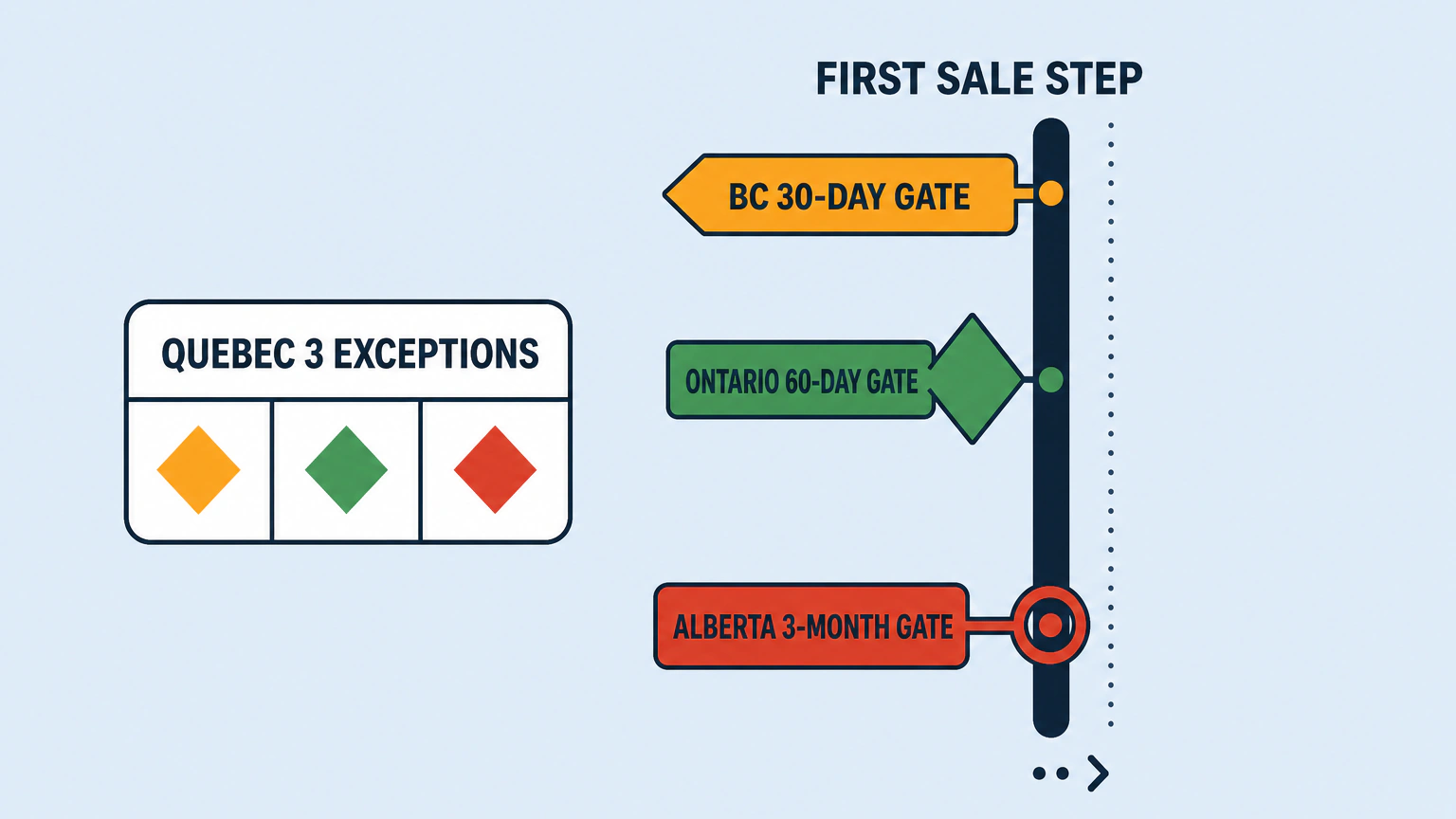
Four provinces, four regimes that genuinely disagree. What changes most is how long the shop must wait before it can start selling your car, and what you can do to get it out sooner. Find your province and read across.
| Province | Can the shop hold the vehicle? | What removes that right | How long before it can move to sell | How you force a release |
|---|---|---|---|---|
| Ontario | Yes, until the amount is paid (RSLA s. 3(1)) | No lien arises where the shop had to comply with Consumer Protection Act, 2002 ss. 56, 57, 58(1) or 59 and did not (s. 3(2)) | After 60 days from when the amount comes due, and with at least 15 days' notice of sale (ss. 3(3), 15(2)) | Pay into court or provide permitted security; release within three days of the initial certificate unless the shop objects (s. 24) |
| Quebec | Yes, by the Civil Code right of retention (arts. 974, 1592) | No estimate given, or the bill tops the estimate and you pay the estimate price, or the estimate plus authorized changes and you pay that (LPC s. 179) | No sale clock in the repair rules | Pay the amount s. 179 names; your claims survive it (s. 178) |
| British Columbia | Yes, from the moment work starts (Commercial Liens Act ss. 4, 5, 11) | After control of the car is given back, the lien is not enforceable against the owner without a signed authorization or acknowledgement (s. 7) | After 30 days from default and normally with at least 20 days' notice; s. 38(4) lists exceptions to notice (ss. 37(1), 38) | Petition, pay the written lien amount into court and serve the petition; the lien is discharged and the goods must be released (s. 45) |
| Alberta | Yes, until the debt is paid (Possessory Liens Act s. 8) | Losing possession, essential to the lien (s. 5), or a written waiver supported by valuable consideration (s. 7) | For a vehicle worth at least $300: notice after three months unpaid, then a court date at least 30 days after service and a court application; s. 12 permits sale without that application when total market value is under $300 | No Ontario-style pay-into-court release. Pay; if the lienholder applies under s. 10 and the amount is disputed, the court may fix it (s. 10(6)) |
Ontario: the lien that never arises
Ontario hands you a defence, not just a deadline. The lien is conditional. While it lasts it beats every other claim on the car. And once the vehicle is lawfully back in your hands, the possessory lien is discharged for good and cannot be revived.
Two traps sit behind that. The first is thinking that driving away clears the debt. It doesn't: a non-possessory lien takes the old one's place, and the shop can enforce that one only if it got your signed acknowledgement that you owe the money, which can be nothing grander than a line on the invoice. The second is assuming the whole bill runs on the repair rules. Towing and vehicle storage sit under Ontario's separate Towing and Storage Safety and Enforcement Act, and there too no lien arises for those services if the shop didn't follow what that statute prescribes. If you want a second opinion on the work itself, start with shops across Ontario.
Quebec: three situations where the shop cannot hold your car at all
Quebec is the outlier, and it tilts your way. The Civil Code gives the merchant a right of retention, and then the consumer Act takes it back in three named situations: where no estimate was given before the repairs; where the total price tops the estimate, provided you pay the estimate price; and where it tops the estimate plus any change you authorized, provided you pay that total (LPC s. 179). Pay what that section says you owe and the shop has to hand over the keys.
The rules feeding it are just as firm. An accepted estimate binds the merchant, and no additional costs may be charged for the repairs it covers, so Quebec runs no percentage cushion at all. Extra work needs your express authorization. Give that authorization by phone and the shop must record it in the estimate, with the date, the time, the name of the person who gave it and the number dialled. The repair itself is guaranteed for three months or 5,000 kilometres, whichever comes first.
British Columbia: a different statute since 30 June 2025
If a page answers this question for B.C. by citing the Repairers Lien Act, close the tab. That Act no longer exists. It was repealed by the Commercial Liens Act, effective 30 June 2025, and the replacement handles repair, storage, towing and salvage in one place.
Here's how the new one runs. The lien attaches the moment the work starts, and holding the car is what keeps it alive. You're in default once the amount is payable and any written grace period the shop gave you has expired. Thirty days after that, the shop may dispose of the vehicle. It normally has to give you at least 20 days' notice first, setting out exactly what you would pay to redeem the car, but the Act does list exceptions to that notice, including where storage expenses have grown disproportionately large next to what the vehicle is worth. Get the car back and the claim doesn't automatically follow it either: without your signed authorization or acknowledgement, the lien is not enforceable against you as owner. Unlike Ontario's Act, none of this turns on whether the estimate rules were kept.
Alberta: a dollar ceiling on overruns, and usually a court application before sale
Alberta splits the job between two rulebooks. One keeps your car at the shop: a lienholder may detain the property until the debt is paid, and losing possession loses the lien. Where your contract says nothing about storage and the property is a motor vehicle, the shop may still make ordinary and reasonable storage charges and add them to the debt.
The other one caps the overrun, and Alberta does it in dollars as well as percentage. A repair may run no more than 10%, to a maximum of $100, above the estimate, unless you expressly consented beforehand or agreed in a consumer agreement to amend the estimate. On a large job that hundred-dollar ceiling is far tighter than a flat tenth would be.
Selling your car is more work for a shop in Alberta than in the other three provinces. Where the vehicle is worth at least $300, notice can be served once the debt has gone unpaid for three months, counted from when the repair created the debt, and the court date named in that notice must be at least 30 days after service. Then the shop applies to the Court of King's Bench. The court can keep that informal, and unless it directs otherwise no formal order need be taken out. Under $300 in total market value the picture changes: after three months unpaid, the shop may sell by reasonable means for a reasonable price, with no court application at all.
If you are not in one of these four provinces
We read four provinces' statutes for this, and we're not going to tell you how the others work when we haven't read them. Saskatchewan, Manitoba, the Atlantic provinces and the territories each run their own rules. Start at your provincial King's Printer or legislature site, search "possessory lien", "garage keeper" or "commercial lien", and read the currency date at the top of the page before you rely on a word of it. Then phone your provincial consumer-affairs office and ask.
Four ways to get your car back
These run from fastest to most formal. Authorized storage charges may keep accruing while you decide, so the slow route costs money as well as time.
Pay the bill, and dispute it afterwards
The quickest way out of the shop is usually your chequebook. Pay, then argue. If you go that way, put in writing that you dispute the charge, do it before you hand over the money, and keep every copy: the estimate, the invoice, the payment record, the message where you said you disputed it.
Quebec and Ontario both protect that move. In Quebec, accepting the estimate or paying the bill doesn't cost you your recourse for unauthorized repairs, bad workmanship or a price above the estimate. In Ontario, once the car lawfully comes back to you the possessory lien is discharged, permanently.
Redeem the vehicle before anything is sold
A notice of sale is frightening. It's not the end of the road. Right up until the shop has sold the car or contracted to sell it, you can redeem it. In Ontario that means paying the amount required to satisfy the lien. In British Columbia it means the amount secured plus the shop's reasonable expenses in holding and preparing the vehicle, which is the bigger of the two numbers.
Challenge whether the lien exists at all
In Ontario this is often your strongest hand, and it comes down to four questions about paper.
Did the shop give you the prescribed written estimate, or first offer one, take your waiver and get your authorization for a maximum amount? Did you authorize the work that was actually done? If you gave that authorization by phone, was it recorded the way the rules require? And if there was an estimate, is the final charge more than 10% above it?
The first three can end the argument outright. A failure on any of them, where the section applied, means no repairer's lien arose, and a shop with no lien is just a business holding property that isn't its own. The fourth question works differently, and the difference matters more than most guides admit. Going over the estimate doesn't erase the lien. It caps it: the lien is limited to the amount the Consumer Protection Act actually requires you to pay. In Quebec, s. 179 does the same job in its own three-part way.
Pay into court and force the release
Ontario built a procedure for exactly this moment, and it's quick. You apply to the court in the prescribed form, with an offer of settlement if you want to make one, and you pay the full amount claimed into court or deposit security. The clerk issues an initial certificate. From the moment the shop receives it, the shop has three days to release your vehicle, unless it files a notice of objection inside the same window. If it objects, paying the additional amount produces a final certificate and immediate release.
A shop that neither releases the car nor objects can have it seized by a sheriff or bailiff. And if it doesn't accept your offer or start an action within 90 days of your getting the car back, your money can come back to you too.
British Columbia now has its own version. Pay into court and serve the petition properly, and the lien is discharged and replaced by a charge on the money. The shop must release the goods. That charge lapses if the shop doesn't apply for payment out within 60 days of being served with the petition.
Pro tip: Ontario sets this procedure out in its own words under the heading "Dispute of the amount of the lien", on a business-services page called "Register a security interest or search for a lien on Access Now" that almost no driver would ever think to open. Read it before you file.
What it is costing you while you argue
Two clocks are running. One is the storage meter and one is the sale deadline, and neither pauses while you wait for the shop to call you back.
Storage charges, and when a shop may add them
Alberta states the position most plainly. Where the contract provides for storage, the lienholder may make lawful charges during the detention and add them to the debt, and where the contract says nothing at all about storage on a motor vehicle, ordinary and reasonable storage charges are still allowed. Ontario treats storage as a separate lien with its own rules, and towing and vehicle storage fall partly under that separate towing statute.
So ask, in writing, what is being charged per day and from what date. If a tow is what started all this, compare towing companies before you authorize the next move.
What a disputed repair bill usually looks like
Before you spend a day of your life arguing about a number, it helps to know whether the number is out of line. These are our own figures, aggregated across PreferredMechanic.ca's cost profiles in Canadian dollars, not an industry survey, and the panels adapt to location. Read them as scale rather than as a quote for your car.
| Service category | Minimum | Maximum | National average | Based on |
|---|---|---|---|---|
| Auto repair | $311 | $2,577 | $476 | 730 cost profiles |
| General mechanic work | $265 | $2,628 | $579 | 768 cost profiles |
| Brakes | $43 | $579 | $160 | 834 cost profiles |
| Transmission repair | $818 | $3,572 | $1,430 | 686 cost profiles |
| Towing | $54 | $262 | $116 | 874 cost profiles |
A $2,300 charge for general mechanic work sits a long way above that category's $579 average. That gap on its own is reason enough to ask for the estimate in writing before you pay anything. For a second quote, browse auto repair shops near you.
What to do in the first 48 hours
Work through these in order, and in writing wherever you can. Written records are what turn "they never gave me an estimate" into something a court or a regulator can act on.
- Ask the shop, in writing, for a copy of the written estimate and the final invoice.
- Write down whether you ever authorized the extra work, when, and to whom.
- Photograph the odometer reading and the vehicle where it now sits.
- Ask in writing what storage is being charged per day, and from what date.
- Tell the shop in writing that you dispute the amount and are not abandoning the vehicle.
- Get a written assessment from a second shop if the dispute is about workmanship, and compare mechanic shops that can inspect the work.
- Check your province's row for the sale clock that applies to you.
- Decide between paying under protest and applying to the court, and do it before the clock runs.
Where to complain, by province
Ontario. The Ministry of Public and Business Service Delivery and Procurement lists auto repair among the complaints its consumer laws cover. It also names its own limits: it may not be able to help with events more than two years old, or with damages beyond a refund or a cancellation. OMVIC handles extended-warranty and dealer complaints, and CAMVAP handles manufacturer-warranty disputes.
Alberta. AMVIC licenses automotive repair businesses and takes complaints through its online portal. An officer gathers information from both sides, and alternative dispute resolution sometimes follows.
Quebec. The Office de la protection du consommateur takes complaints by telephone, online or at its offices, checks whether the subject falls within its jurisdiction, and records the complaint in the merchant's file.
British Columbia. Consumer Protection BC enforces the Business Practices and Consumer Protection Act, but vehicle repair is not one of the sectors it licenses. It tells consumers outright that BC consumer protection laws may not apply to their situation and that some complaints belong in court.
Now the part nobody warns you about. The OPC says it plainly: "You are responsible for undertaking the procedures with the merchant. Office personnel cannot intervene on your behalf." A regulator's powers are investigation, discipline and licensing. It generally cannot order your car released or your money refunded. That's what paying into court is for.
What will not get your car back
Red flag: five moves that make things worse.
- Taking the vehicle without permission. In Ontario the lien is lost only where possession is surrendered to the owner, or lawfully comes into the owner's hands. Helping yourself is neither, so the possessory lien survives it. Use the payment-into-court route instead.
- Going quiet and hoping the shop gives up. Authorized storage charges may accrue and the sale clock keeps running. Dispute the amount in writing instead, and date every message.
- Paying without keeping a record of the dispute. If you pay under protest, say so in writing and keep the invoice and the payment record.
- Signing an acknowledgement of indebtedness just to get the car out. In Ontario that signature is exactly what makes a non-possessory lien enforceable. The same Act keeps your right to dispute the amount later, so read the paper first and write your dispute on it before you sign.
- Relying on a guide that cites British Columbia's Repairers Lien Act. It was repealed on 30 June 2025. Work from the Commercial Liens Act instead.
If the fight is really about workmanship, an independent second opinion is worth more than another argument at the counter. PreferredMechanic's satisfaction guarantee separately promises to work in good faith with you and the technician to address concerns.
Frequently asked questions
Can a mechanic keep my car if I refuse to pay?
Generally yes, in these four provinces. An unpaid repair gives the shop a possessory lien, and it can hold the vehicle until the amount owing is paid, with no court order and no separate lien agreement. Ontario is the exception worth knowing. Where the shop was required to comply with the Consumer Protection Act estimate and authorization sections and did not, no lien ever arose.
Can a mechanic hold my car if it is unsafe to drive?
Being unsafe isn't what creates the shop's right to keep it. That right comes from the unpaid repair, nothing else. Treat the safety question as its own question and answer it honestly, because driving off in something unsafe is the worse outcome. In Ontario, new or reconditioned parts and the labour to install them carry a minimum warranty of 90 days or 5,000 kilometres, whichever comes first.
How long can a mechanic keep my car before they can sell it?
It depends on the province. Ontario permits a sale only after 60 days from when the amount comes due, and only with at least 15 days' written notice. British Columbia permits disposition after 30 days from default, normally with at least 20 days' notice, subject to the Act's exceptions. Alberta takes longest: for a vehicle worth at least $300, three months unpaid, then notice and a court application.
Can a mechanic charge me storage while they are holding my car?
Often, yes. In Alberta the Possessory Liens Act lets the lienholder make ordinary and reasonable storage charges on a motor vehicle even where the contract never mentioned storage, and add them to the debt. That's the best argument against letting a repair dispute drift for weeks. The amount you are fighting about can grow while you fight about it.
Can a mechanic put a lien on my car after I have driven it away?
In Ontario, yes. The possessory lien is discharged once the vehicle lawfully comes back to you, but a non-possessory lien arises in its place for whatever is still unpaid. It is enforceable only if the shop obtained your signed acknowledgement of the indebtedness, and that signature may be sitting on an invoice or a statement of account you barely read.
What happens if I never pay the mechanic at all?
Eventually the shop sells the vehicle under your province's procedure and applies the proceeds to authorized expenses and the lien debt. What happens to any shortfall depends on where you live. Ontario deems a sale under its Act to satisfy the lien debt in full. British Columbia generally leaves the person who owed for the services liable for a deficiency. Ontario requires advance written notice, and British Columbia normally does too, with the exceptions its Act sets out.
Can a mechanic sell my car if I do not pay?
Yes, subject to the notice and timing rules of your province. You keep a right to redeem the vehicle at any time before it is sold or contracted for sale. In Ontario you pay what the lien secures. In British Columbia you pay that amount plus the shop's reasonable expenses. Redeeming is almost always cheaper than watching the car go.
Two things cost you nothing tonight and change everything later: ask for the written estimate and the final invoice, and put your dispute in writing today, dated.