

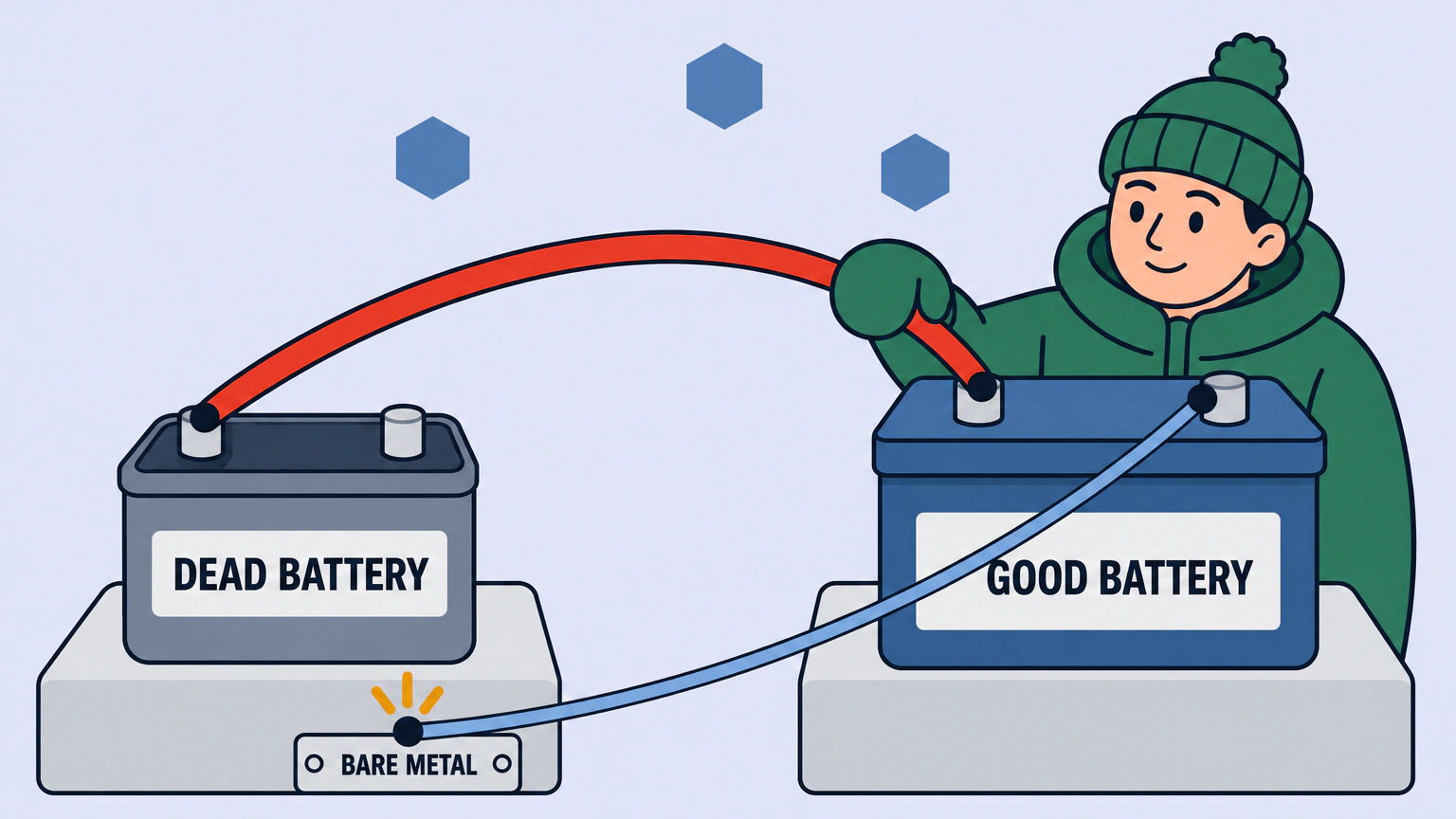
On this page
- Boost it in this order, and check two things first
- The two times you should not boost it at all
- Find the battery before you find the cables
- What the cold changes about the procedure itself
- Hybrids, EVs, and cars with stop start
- It started. Now do not just drive around for half an hour
- When to stop and call somebody
- What to keep in the car so this never happens twice
- Frequently asked questions
Boost it in this order, and check two things first
It's a January morning, the car won't turn over, and you're standing in the cold holding jumper cables and a phone. For a conventional 12-volt lead-acid system, when the owner's manual allows it, CAA-Quebec's sequence is red on the dead battery's positive post, red on the good battery's positive post, black on the good battery's negative post, and the last black clamp on the approved ground point or bare engine metal at least 30 cm from the battery. Stop before you start if the case is bulging, cracked or leaking, or if a battery that sat for days in deep cold may be frozen.
Learning how to boost a car battery is the same lesson under another name. CAA-Quebec says so on the record: "boosting" is the everyday word in Quebec, and booster cables are jumper cables.
The four connections, in order
Set up first. Park the good car nose to nose with the dead one, close enough for the cables to reach. Don't let them touch. Switch both engines off, put an automatic in Park or a manual in Neutral, and set the parking brakes. Turn off the heater, lights and radio. Put on gloves and safety glasses, and take off rings and bracelets.
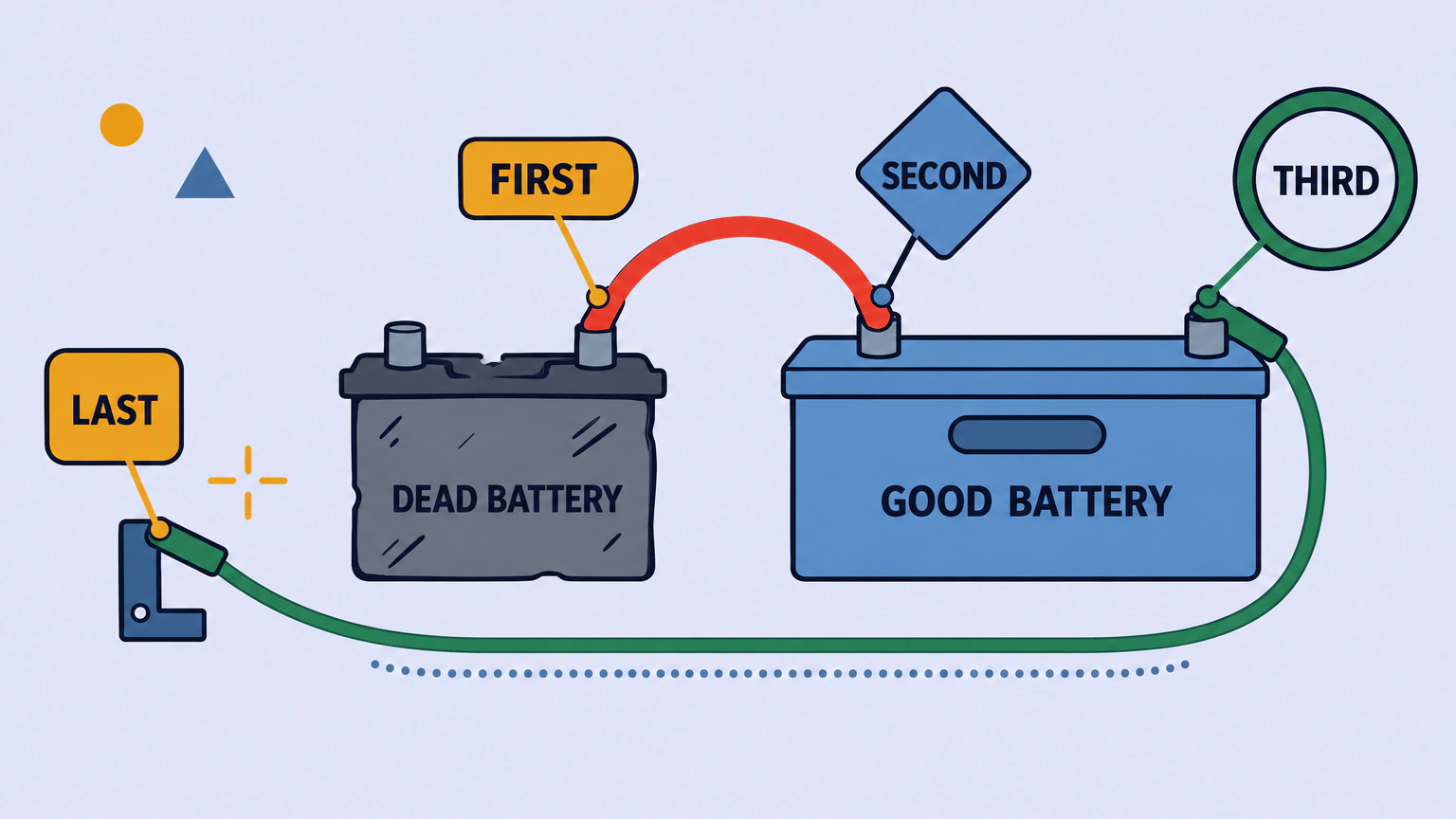
Then connect, in this order:
- Red clamp on the dead battery's positive (+) post.
- The other red clamp on the good battery's positive (+) post.
- Black clamp on the good battery's negative (-) post.
- The last black clamp on bare, unpainted metal on the dead car's engine.
That's CAA-Quebec's order for a conventional setup. Taking the cables off usually runs the same four points in reverse. Here's how it looks between two batteries.
Why the last clamp goes on bare metal, not on the post
A lead-acid battery can give off hydrogen gas, which CAA-Quebec calls highly explosive. The fourth connection completes the circuit, so it's the one most likely to spark. That spark belongs well away from the battery.
CAA-Quebec research analyst Sylvain Légaré puts the rule plainly: "Avoid the negative terminal of the dead battery and body panels. Keep the connection at least 30cm from the battery." Use the engine block, a solid bolt on it, or a metal bracket such as the alternator's. Paint doesn't carry current, so pick clean, unpainted metal.
Get it wrong and the bill isn't small. CAA-Quebec warns that clamping to the wrong terminals can fry the on-board computer, a part it says costs at least $1,000 to replace.
The two times you should not boost it at all
A damaged case, and a battery that may be frozen. Both look like a car that just needs a boost. Either way, the right move is a phone call.
A case that is bulging, cracked, or leaking
Red flag: stop right there. A bulging or wavy case, a crack, leaking acid or a smell like rotten eggs means the cables go back in the trunk. Don't warm the battery where it sits, don't pour hot water on it, and don't try again. CAA-Quebec says jumping a swollen battery risks an explosion. If anything about the battery looks wrong, stop and let someone with a proper tester look at it.
Interstate Batteries says a battery frozen solid most likely has a cracked case. Optima Batteries warns that a cracked battery may be damaged beyond repair, and belongs at a battery retailer to be checked and replaced.
A discharged battery may recover after testing and a proper charge. A cracked battery needs professional inspection and usually replacement.
If the case looks whole but you suspect ice, Optima says to move the battery somewhere warmer and let it thaw on its own, with nothing to hurry it along. That means pulling the battery out in a parking lot. We'd make the call.
How discharge changes a lead-acid battery's freezing risk
As a flooded lead-acid battery discharges, the electrolyte's specific gravity falls and its freezing point rises. Discover Battery publishes one reference table for that relationship.
| Resting voltage | Roughly how charged | Specific gravity | The electrolyte freezes at |
|---|---|---|---|
| 12.65 V | Full | 1.265 | -59.4 °C |
| 12.45 V | About three quarters | 1.225 | -48.3 °C |
| 12.24 V | About half | 1.190 | -36.7 °C |
| 12.06 V | About a quarter | 1.155 | -26.7 °C |
| 11.89 V | Discharged in this table | 1.120 | -23.3 °C |
Freezing points from Discover Battery's published flooded lead-acid reference. Other manufacturers publish materially warmer freezing points for fully discharged batteries. The voltages assume a battery at about 27 °C, so one tested outdoors in January will read lower.
A full lead-acid battery can resist freezing near -60 °C, but the danger rises sharply as it discharges. Discover's 11.89-volt row freezes at -23.3 °C. Interstate says a discharged battery can freeze around -9 °C, and a current Ford manual warns it can happen around 0 °C. Charge level matters, but battery design and condition matter too. If deep cold is common in your driveway, read up on whether you need a block heater.
Find the battery before you find the cables
Two minutes with the owner's manual in October saves ten in a snowbank. CAA-Quebec tells drivers to check any guide on how to jump start a car against their own manual. On some cars, that's where you learn the battery isn't under the hood at all.
When there is nothing under the hood but a red cap
Interstate Batteries names Audi, BMW, Jeep, Mercedes-Benz and Volvo among the makes where you can open the hood and find no battery. It sits under the back seat, in the trunk or behind a wheel well, on a growing share of cars. Nothing's wrong with the car. The designers planned for boosting and left a remote positive terminal, a direct line to the battery's positive post.
Look for a red cap with a plus sign, though Interstate notes some caps aren't red. On some plug-in hybrids it hides inside the underhood fuse box. A stud labelled for jump starting is often right beside it, and that's your ground.
For a car with remote terminals, use only the specified posts. In Interstate's conventional example, the order is red on the remote positive terminal, red on the good battery's positive, black on the good battery's negative, then black on the labelled ground stud or approved unpainted metal. Clamp nothing else under the hood.
One more rule from Interstate: if your own car has only a remote terminal up front, don't offer anyone else a jump from it.
What the cold changes about the procedure itself
On a conventional 12-volt lead-acid setup, cold does not change the approved clamp points. At 0 °F (-18 °C), Interstate says a lead-acid battery can lose up to 60 percent of its strength while an engine can need nearly twice the starting power.
Fifteen seconds of cranking, then stop
Give the flat battery a head start. CAA North & East Ontario says to run the good car for a few minutes before you try the dead one. Then crank for no more than 15 seconds. That's CAA-Quebec's limit, set to protect the starter, the electric motor that spins the engine to life. If it doesn't catch, let the good car run a few more minutes and try again.
If a slow crank still won't become a start, switch everything off and confirm that the last black clamp is on the manual's approved clean ground point. Do not move live clamps around. If it still will not start, another problem could be at play. Call a mechanic or roadside help rather than keep grinding.
Disconnect when the owner's manual tells you to
Once the engine starts, follow the owner's manual for disconnect timing. Current CAA North & East Ontario and Interstate instructions say to remove the leads after the start, while CAA-Quebec publishes a five-minute wait. Because current guidance conflicts, do not assume five minutes applies to every vehicle, and never use jumper cables to recharge the battery.
When it is time to disconnect this conventional setup, unclip in reverse: black on the dead car's ground point first, then black on the good battery, red on the good battery, and red on yours. Hold each clamp clear so it cannot touch metal or its partner. If the clock or power windows act up afterwards, CAA-Quebec says some of those need a reset after a dead battery.
Hybrids, EVs, and cars with stop start
A hybrid or electric car has a separate low-voltage system that can go flat, but it is not always a standard 12-volt battery. Current Tesla Model 3 vehicles use a low-voltage lithium-ion battery, and Cybertruck uses a 48-volt architecture. The owner's manual decides where to connect and what external power source is safe.
Check the manual before you boost or lend power
CAA North & East Ontario says most hybrids have a separate 12-volt battery and warns never to touch the high-voltage traction system, usually marked with orange wiring. The exact procedure still varies by model. Tesla's current Model 3 manual, for example, uses dedicated low-voltage jump points. If the low-voltage procedure is not clear, call a technician. If the trouble looks bigger than the low-voltage system, check what your EV battery warranty covers before you pay for anything.
Do not use an EV or hybrid as the donor unless its owner's manual explicitly allows it. Current Tesla Model 3 and Ford Kuga plug-in hybrid manuals both forbid using those vehicles to jump another vehicle.
Stop-start cars, which shut the engine off at red lights and restart it, need a tougher battery. Energizer says they require an AGM or EFB battery (absorbed glass mat or enhanced flooded), and that an AGM gets replaced only with another AGM. VARTA adds that the workshop programs the new battery into the car's battery management system with a diagnostic tool. Ask whether that step is in the quote.
It started. Now do not just drive around for half an hour
CAA North & East Ontario suggests driving for 20 to 30 minutes before shutting the car off. That keeps the car running long enough to reach help and may add some charge, but it will not fully recharge a deeply discharged battery.
Your alternator is not a battery charger
A conventional alternator runs the car's electrics and maintains a healthy battery after the engine starts. It is not a proper charger for a deeply discharged battery. In its example of a battery starting at 50 percent, Interstate says even eight hours of highway driving may bring it only to about 75 to 80 percent, never a full charge. CAA North & East Ontario warns that repeated boosts in a short stretch strain the alternator.
The better move after a boost is a compatible proper charger, which is Optima's advice for a battery that has just been brought back. If a second boost has you doubting the charging system, an auto electrical shop can test the battery and charging system.
Get it tested before the next cold night
A voltmeter shows what the battery has this minute. It won't show how much life is left. Interstate Batteries says a voltmeter or multimeter can't measure internal resistance, but a technician's battery tester can. Interstate also warns that a jumped battery could fail again in less than two weeks.
"Even with good care and maintenance, the life of a car battery only ranges from three to five years," CAA South Central Ontario says. CAA North & East Ontario says to test yearly once a battery turns three, and that one needing more than one boost in a short period is likely failing. If yours fits either description, have the battery tested before the next cold snap.
When to stop and call somebody
Calling isn't failing. CAA North & East Ontario says dead or dying batteries bring the biggest wave of roadside calls in a cold spell. CAA-Quebec calls a fully dead battery safest left to roadside assistance. In 2017, CAA South Central Ontario alone answered more than 264,000 calls for battery service. The first ten seconds at the wheel usually tell you which camp you're in.
| What happens when you turn the key | What that usually means | Boost it, or call? |
|---|---|---|
| A fast, healthy crank that never fires | Not the battery. Fuel, spark or an immobilizer | Do not boost. Book a diagnostic |
| A slow, dragging crank | A weak or badly chilled battery | Boost it |
| One loud clunk, then silence | A very low battery, or a failing starter | Boost once. If nothing changes, call |
| Rapid clicking and the dash lights dimming | A flat battery | Boost it |
| Nothing at all after days in deep cold | Possibly a frozen or open-circuit battery | Do not boost. Look at the case first |
What a boost or a tow actually costs
What the call costs: Our own cost profiles put a roadside assistance call at an average of $108, typically $87 to $118, and a tow at $116, typically $80 to $131. Each is our aggregate across every job in its category, several hundred profiles apiece. Read it as a snapshot rather than a fixed national price.
If you'd rather not handle the cables yourself, find roadside assistance near you. When the car won't take a boost at all, a local tow to a shop is the next step.
A membership changes the math. CAA North & East Ontario makes emergency roadside assistance a member benefit and throws in a free battery test. CAA-Quebec adds a point most drivers miss: a professional boost is covered by the provider's liability insurance if something goes wrong.
What to keep in the car so this never happens twice
- A booster pack rated for your vehicle. CAA North & East Ontario says most cars need at least 400 amps of peak current, and trucks and SUVs may need 1,000 amps or more.
- Reverse-polarity and spark protection on that pack. These features can reduce the risk from a mistaken connection, but they do not replace the owner's manual.
- Cables long enough to reach a car parked nose to nose. You can't always park alongside.
- Gloves and eye protection in the glovebox. Not in the garage at home.
- A phone photo of the jump start page of your owner's manual. Take it before you need it.
- The pack charged to full in October. Top it up again in January.
- Your roadside assistance number and membership number in your phone. Not on a card in the console.
Two habits remove most of the problem. Buy the booster pack in October, before the first cold snap. And have the battery tested when the winter tires go on. CAA South Central Ontario puts it as a question: "When you are getting winter tires on, why not ask your mechanic to check the health of your car battery?"
Frequently asked questions
Which terminal do you connect first when boosting a car battery?
In CAA-Quebec's conventional 12-volt procedure, the red clamp goes on the dead battery's positive terminal first, then red on the good battery's positive, then black on the good battery's negative. The last black clamp goes on the dead car's approved ground point or bare engine metal at least 30 cm from the battery, not on the dead battery's negative post. Check the owner's manual because some models use dedicated posts or a different sequence.
How long should you leave the jumper cables on after the car starts?
There is no single safe time for every vehicle. Follow the owner's manual and disconnect promptly once the car starts unless it tells you to wait. For CAA-Quebec's conventional sequence, remove the clamps in reverse, starting with the black clamp on the dead car's ground point, and keep each one clear of metal and the other clamp.
How long do you have to drive after a boost to recharge the battery?
CAA North & East Ontario suggests driving for 20 to 30 minutes before you switch off, but that will not fully recharge a deeply discharged battery. Use a compatible proper charger when you can, and have the battery and charging system tested before the next cold night.
Can you jump start a frozen car battery?
No. Optima Batteries says never to jump start or charge a battery that may be frozen, and CAA-Quebec says to rule out a frozen or swollen battery before any boost. Published thresholds vary with the battery and how deeply it is discharged: Interstate says a discharged battery can freeze around -9 °C, while a current Ford manual warns it can happen around 0 °C. If the car sat through deep cold and will not light the dash, check the case and call for help.
Can you boost a hybrid or an electric car?
Only if the owner's manual gives a procedure for the vehicle's low-voltage system. Never connect to the high-voltage traction system, which usually has orange wiring. Low-voltage architecture varies: current Tesla Model 3 vehicles use a low-voltage lithium-ion battery, and Cybertruck uses 48 volts. Do not use an EV or hybrid as a donor unless its manual explicitly allows it.
Why does my car need a boost every cold morning?
Most often, the battery is failing. Cold cuts what any battery can deliver, and a worn one crosses the line first. CAA North & East Ontario says a battery that needs more than one boost in a short period is likely on its way out. Short trips that never let the alternator catch up make it worse. Get it tested.
Do you need another car, or is a booster pack enough?
A compatible booster pack can be enough. CAA North & East Ontario notes that a pack does not need a second vehicle. Follow the vehicle and pack manuals for the connection points and voltage, then size the pack to the vehicle: CAA suggests at least 400 peak amps for most cars and possibly 1,000 or more for trucks and SUVs. Look for reverse-polarity and spark protection, and keep the pack charged.