

On this page
- What your EV battery warranty actually promises
- Winter range loss is not battery wear
- Hybrids and plug in hybrids play by different rules
- How to prove your battery is below the line
- Buying a used EV, and the warranty that rides along
- When the dealer says no
- Common questions about EV battery warranties in Canada
What your EV battery warranty actually promises
A capacity-loss warranty can turn on three numbers. The first two are clocks, in years and kilometres, and they tell you when coverage ends. If your warranty prints a capacity floor, that third number tells you when gradual loss has crossed it.
The two clocks everyone quotes
Eight years is common in the documents we opened, but the kilometre limit varies by brand and model. The clock stops when either limit arrives first.
The catch is in "whichever comes first". Drive 15,000 km a year and an eight-year limit arrives before 160,000 km. Drive 30,000 km a year and you'll pass 160,000 km in about 5.3 years, roughly 2.7 years before the eight-year mark.
Kia counts differently again. Its 2022 manual sets the term at 96 months or 150,000 km. It starts the clock on the original retail delivery date or the date the vehicle was first placed into service, whichever came first. Confirm that date on the warranty record.
The third number, and why it decides your claim
Getting weaker isn't the same as qualifying. Where the warranty sets a floor, the pack has to drop below it under the carmaker's own measurement. A defect in materials or workmanship is a separate route to a claim.
The capacity floor is measured against original capacity, not against the range on your dash. Toyota is blunt about the difference in its own supplement: "the range in your display monitor doesn't show the capacity reduction condition." Range moves with weather, speed, tires and the heater. Capacity is the energy the pack can still hold.
So the floor is the number to know, and it isn't the same in every document. Cadillac's 2026 Canadian electric-vehicle booklet says the pack gets replaced or repaired "if the capacity falls below 75% of its original value". Kia's 2022 manual, Genesis's page and Toyota's 2026 supplement set theirs at 70%. Cadillac's floor sits five percentage points higher than the other three.
Two brands print no floor at all on the pages a Canadian owner would find. That's a fact about their pages, not a claim about their contracts.
| Brand, and the document we read | Battery or system coverage | Capacity floor | What a claim gets you |
|---|---|---|---|
| GM Canada, 2026 Cadillac electric vehicle booklet | 8 years or 160,000 km on the propulsion battery pack, transferable at no cost, no deductible | 75% of original value | Battery replaced or repaired "with a battery appropriate for the age and mileage of the vehicle" |
| GM Canada, 2025 Chevrolet, Buick and GMC booklet (hybrids) | 8 years or 160,000 km on the hybrid propulsion battery pack | No percentage in this booklet. "Gradual capacity loss is expected and not covered" | Repair or replacement only where there's a defect in materials or workmanship |
| Kia Canada, 2022 warranty manual (electric) | 96 months or 150,000 km on the EV system | 70% of original capacity | "Repairs needed to return battery capacity to 70% of original battery capacity" |
| Kia Canada, 2022 warranty manual (hybrid and plug-in hybrid) | 96 months or 150,000 km on the hybrid system | No percentage. Coverage runs off an onboard diagnostic trouble code | The manual ties capacity coverage to onboard diagnostic information. It does not state a percentage or threshold. |
| Genesis Canada, warranty page | 8 years or 160,000 km from the Date of First Service | 70% of original capacity | Repairs back to 70%, which Genesis says "may not return your Lithium-Ion Battery to an 'as new' condition" |
| Toyota Canada, warranty page and 2026 Owner's Manual Supplement | 96 months or 160,000 km, on both the battery warranty and the battery capacity warranty | 70% of original capacity | Toyota decides whether to repair or replace. A replacement pack must have at least the capacity the original had before failure, allowing for age and kilometres. |
| Nissan Canada, EV service page | 8 years or 160,000 km | Nissan's EV service page prints no figure | Review of the EV Battery Usage Report is required as a condition of coverage before model year 2023 |
| Hyundai Canada, warranty page | 8 years or 160,000 km on the hybrid and EV system | Hyundai's warranty page prints no figure | Its page doesn't say |
Those figures are each document's own words, and they cover six carmakers, not the whole market. Ford and Tesla aren't among them. The warranty supplied with your own vehicle governs, and terms can change by model and model year. Read yours before you argue with anyone.
What a successful claim actually gets you
Not one of these carmakers promises a factory-fresh pack. Kia and Genesis specify a return to 70% capacity. Cadillac and Toyota describe different repair or replacement standards.
Kia's manual covers "repairs needed to return battery capacity to 70% of original battery capacity". Genesis says the same thing and then says the quiet part out loud: the coverage "may not return your Lithium-Ion Battery to an 'as new' condition with the original 100% battery capacity." Toyota promises a replacement pack whose energy capacity is at least equal to the original's before the failure, weighed against the age and kilometres of the car. GM fits "a battery appropriate for the age and mileage of the vehicle".
These are contract remedies, not a promise of a new pack. Read the remedy clause before you walk up to the counter.
Winter range loss is not battery wear
A range readout that collapses in a cold snap and a warranty claim are two different subjects. One is weather. The other is a measurement of stored energy. Owners who confuse them either panic in January or miss a real problem in July.
What CAA measured on a winter drive to Mont Tremblant
CAA sent 13 EVs from Ottawa toward Mont Tremblant for its February 2025 range test and drove them until they stopped. A fourteenth vehicle, the Kia EV6, joined only the charging test. CAA says seven of Canada's ten top sellers took part, with temperatures between -7 and -15 degrees.
CAA found the cars drove 14 to 39 percent less than their official range. The spread is wide. Two vehicles came in 14 percent short, and one came in 39 percent short.
| Vehicle | Kilometres driven in the test | Official range | Difference |
|---|---|---|---|
| Chevrolet Equinox EV | 337 km | 513 km | 34% less |
| Chevrolet Silverado EV | 456 km | 724 km | 14% less |
| Ford F-150 Lightning | 296 km | 515 km | 35% less |
| Ford Mustang Mach-E | 334 km | 483 km | 31% less |
| Honda Prologue | 334 km | 439 km | 24% less |
| Hyundai IONIQ 5 | 262 km | 410 km | 36% less |
| Kia EV9 | 349 km | 435 km | 20% less |
| Kia Niro EV | 285 km | 407 km | 30% less |
| Polestar 2 | 384 km | 444 km | 14% less |
| Tesla Model 3 | 410 km | 584 km | 30% less |
| Toyota bZ4X | 255 km | 406 km | 37% less |
| Volkswagen ID.4 | 338 km | 423 km | 20% less |
| Volvo XC40 Recharge | 248 km | 409 km | 39% less |
CAA adjusted the Silverado EV and F-150 Lightning results because those two started the drive part charged. The Kia EV6 joined the charging test but missed the range test, so 14 vehicles took part and only 13 ran for distance. Official range is the figure Natural Resources Canada publishes.
Why the range comes back in spring
Two things reduce winter range, and both ease as temperatures rise.
Cold can cut the energy available for driving, and the cabin heater draws on the traction battery. A gas car reuses heat the engine is already making, while an EV warms the cabin out of the pack. That winter dip alone doesn't show the battery is wearing out. For the wider version, here's what a Canadian cold snap does to a car.
You can claw some of it back. Precondition the cabin while the car is still plugged in, so the heat comes off the wall instead of the pack. Drop the cabin a couple of degrees on the highway leg and let the heated seat do the work. Compare again in mild weather, but don't delay service for a warning light or a severe new symptom.
What Geotab found about charging, heat and battery wear
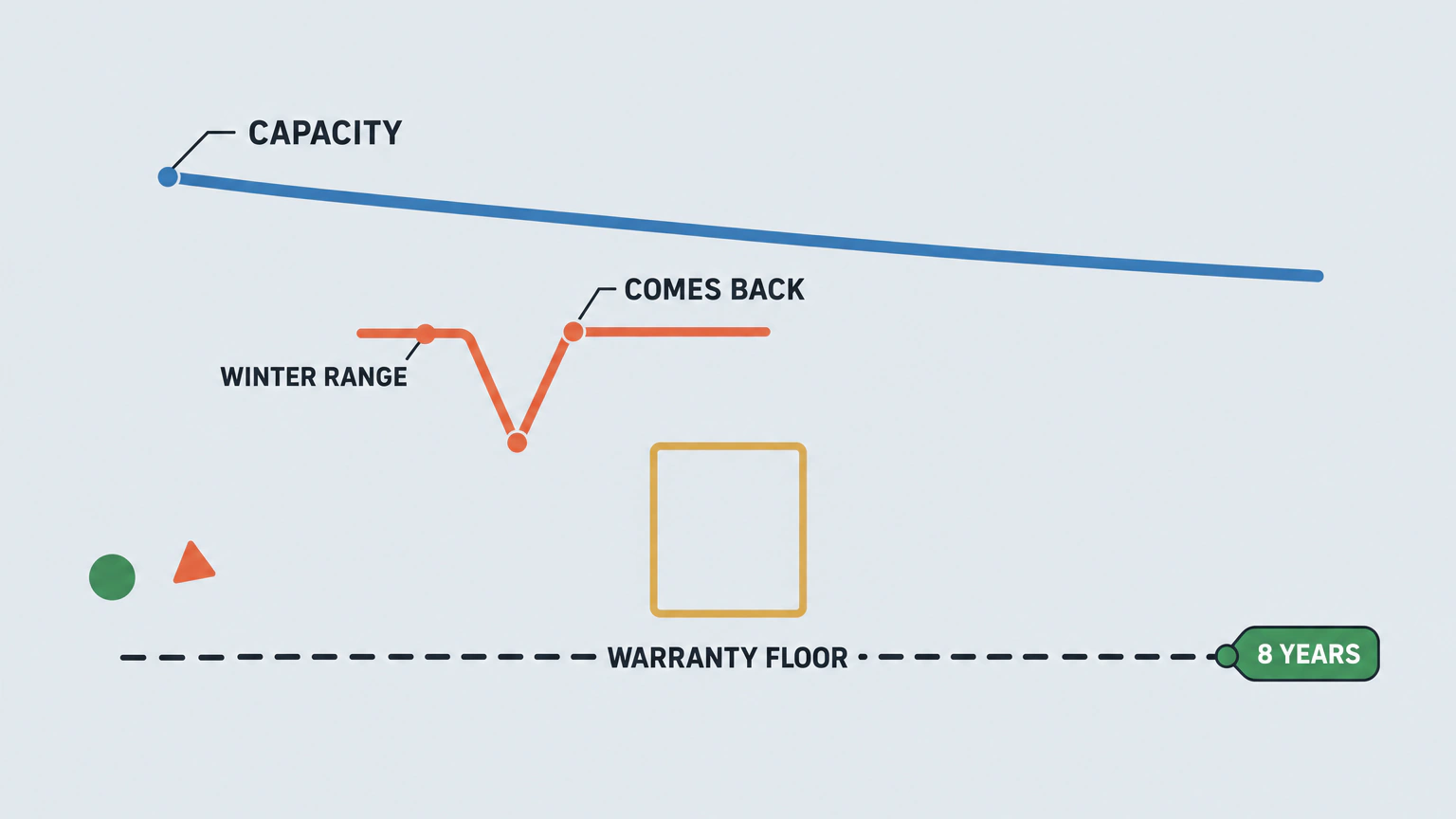
Geotab's 2026 update analyzed 22,700 electric vehicles across 21 models. Average capacity loss came out at 2.3% a year, which projects to 81.6% of original capacity after eight years. That average sits above the 70% floors in the documents we opened, but it doesn't tell us how many owners end up making a claim.
Two factors stood out in Geotab's comparison. Its high-use group ran DC fast charging on more than 12% of sessions, with more than 40% of those sessions above 100 kW. That group averaged 3.0% annual loss, against 1.5% for the low-use group. Vehicles in hot climates degraded 0.4 percentage points a year faster than vehicles in mild climates.
Geotab says it didn't have enough vehicles in cold-only climates to isolate what deep cold does over the long run. It ties wear to how often and how fast a car is charged, plus heat, charge level, use, battery type and model. A January range drop isn't the same measurement as capacity loss. Charge on Level 2 at home when you can, and use high-power charging when the trip calls for it.
Hybrids and plug in hybrids play by different rules
A hybrid owner reading a page about EV battery warranties is reading somebody else's contract. Same brand, same dealership, different clause. The gap shows up in the exact place it hurts: capacity.
What GM tells its hybrid owners in writing
GM Canada publishes two booklets, and they answer the capacity question differently.
The 2026 Cadillac electric-vehicle booklet carries the 75% floor. The 2025 Chevrolet, Buick and GMC booklet has no battery-capacity floor for hybrids. It gives the pack 8 years or 160,000 kilometres. Under "Hybrid Vehicle Propulsion Battery Warranty Coverage," it says, "Gradual capacity loss is expected and not covered under your vehicle's warranty."
Read those together and the split is clear: a GM hybrid owner still has eight years of cover against a defect, but no percentage to point at when the pack simply gets tired.
What Kia tells its hybrid owners in writing
Kia draws the same line in a different place. Its EV owners get 70% of original capacity, in writing, and Kia owes the repair that gets them back there.
The Kia manual uses a diagnostic rule for hybrids and plug-in hybrids. It says capacity coverage "is based on onboard diagnostic system information (OTC-Diagnostic trouble code)." It gives no percentage, and the page doesn't explain where that threshold sits. That puts you in a different conversation from a neighbour with the electric model.
What to do if you drive a hybrid or a plug in hybrid
Find your own booklet and read the battery section for your powertrain, not the EV page on the brand's website. Ask one question of it: does this document give me a percentage, or does it give me a defect test?
If the answer is a defect test, that's the route you have to work. Report the symptom early, get it written down, and keep every visit on the record. A stored code on a dated work order is your evidence. A memory of a bad winter isn't.
How to prove your battery is below the line
The floor is a measurement, and measurements have to come from somewhere. This is where most claims are won or lost, and it costs you nothing to get it right.
State of health, and who can actually measure it
State of health, or SOH, usually means how much capacity the pack still holds against what it held when new. Each carmaker measures it its own way, against its own threshold. Nissan lists an "EV Battery Health / System Scan," but its public page doesn't say that scan produces a claim-ready percentage.
For a claim, the reading that counts is the dealer's. GM puts the decision with a certified dealer. Toyota is blunter still: it decides how battery capacity gets measured, at its sole discretion.
An independent reading can still help with a used-car check. Ask an EV-qualified shop whether it has the model-specific equipment to produce a usable battery report. Don't expect that report to settle a warranty dispute on its own. Before you book one, here's how we rate the shops we list.
What to ask the dealer for, in writing
Ask for the number, ask what it was measured against, and get it on paper. A service adviser telling you "it's within spec" over the phone is not a reading, and it can't be checked later.
- Ask the shop or dealer to run a state of health reading and to write the percentage on the invoice.
- Ask what the reading was measured against, since the number that matters is capacity against original capacity.
- Ask which document governs your vehicle, by model year, and get the coverage clause in writing.
- Ask whether your vehicle is a battery electric, a plug in hybrid or a hybrid, because the rule is different for each.
- Ask what the warranty pays for if the reading sits just above the floor, and get that answer in writing too.
- If you drive a Nissan built before model year 2023, ask for the EV battery usage report review on the record.
- Keep every service record and every reading, because a claim years from now turns on the paper you kept.
Keep the records your own warranty requires. Nissan, for example, makes the EV Battery Usage Report review a condition for vehicles before model year 2023.
The condition Nissan attaches to its own coverage
Nissan Canada's EV service page carries a line most owners have never read. Under "EV Battery Warranty Coverage" it states the eight years or 160,000 km, and then this: "Review of the EV Battery Usage Report is required as a condition of EV Battery warranty (prior to MY23)."
A condition is not a suggestion. If your Nissan is a 2022 or older, a review of that usage report is part of what you owe under the deal, and the page tells you to check your warranty information booklet for the details.
The good news sits on the same page. Nissan says the 12-month and 24-month inspections are performed by a certified EV dealer "at no cost to the vehicle owner". So book them, ask for the usage report review by name, and make sure it lands on the invoice. Free is a good price for a condition you have to meet anyway.
Buying a used EV, and the warranty that rides along
A four-year-old electric car may still have battery coverage. How much is left depends on the warranty start date, the kilometres, the model's terms and its exclusions. Check before the money moves.
Transferability, and what it is worth to you
GM and Kia both put it in writing: coverage follows the car, not the first owner. GM is explicit that the warranty is "transferable at no cost to any subsequent person(s)" who takes ownership inside the term, and that "No deductibles are associated with this warranty." Kia's manual says any remaining portion is fully transferable to later owners.
A 2022 EV bought in 2026 may have roughly four years left on an eight-year term, but kilometres and the original start date can end it sooner. GM says the transfer costs nothing. Kia says the remaining warranty transfers, without stating a transfer fee on that page. Confirm the applicable start date first.
The model year trap
Here's the finding that pays for the whole inspection. Kia's 2022 Canadian warranty manual sets the EV system and the capacity coverage at 96 months or 150,000 km, not the 160,000 km figure that floats around. That's 10,000 km of difference on the same badge.
Your coverage follows the warranty issued for your vehicle, not the brochure on the lot today or a comparison page describing current terms. Warranty terms can change by model and model year.
So find the booklet for your year. It's in the glovebox on most used cars, and on the brand's owner site otherwise. If the seller can't produce it, that tells you something about the rest of the paperwork.
Checking the battery before you sign
Ask for a battery-health report before the deal, not after. First confirm that the shop has EV training and model-specific equipment, and ask what the report can measure. A seller who won't permit the check has given you useful information.
Then read the report against the warranty clock and the method your carmaker accepts. Geotab's 2.3% a year would put the average car in that dataset near 89% after five years. It still isn't a diagnostic curve for the one car in front of you. A reading near a stated floor deserves a closer look only if the vehicle still has time and kilometres left.
Take the odometer into account too. A car at 140,000 km has 20,000 km of coverage left on a 160,000 km term, which is about 16 months at 15,000 km a year, whatever the calendar says.
When the dealer says no
Refusals usually turn on one of three things: a reading above the floor, an exclusion in the booklet, or a service history with holes in it. Ask which one it is, and ask for it in writing. A refusal you can read is a refusal you can answer.
Get the state of health figure and the date it was taken. Get the clause the dealer is relying on, by name. If the answer is a missing record, ask the shop that did the work for a duplicate.
Then remember who the contract is with. Your dealer performs the warranty, but the manufacturer wrote it, and those are two different desks. If the manufacturer holds the line, CAMVAP may offer binding arbitration when the manufacturer, vehicle, dispute and timing meet its rules. We've set out what happens when a manufacturer says no separately.
If your range dropped in January, compare it again in mild weather unless a warning light or severe symptom calls for service sooner. For a battery-health report, ask a dealer or EV-qualified diagnostic shop what it can measure on your model.
Common questions about EV battery warranties in Canada
Does my EV battery warranty cover losing range in winter?
No, and it isn't designed to. Winter range loss is a temperature effect and it reverses when the weather does. Capacity coverage measures the energy the pack can store, not how far the car goes on a cold morning. Toyota says as much in its own supplement: the range on your display doesn't show a capacity problem. If the range is still short in July, book a reading.
What happens if my battery drops below the capacity floor?
The carmaker decides whether the pack crosses the floor under the warranty's accepted method. Kia's 2022 manual covers repairs needed to return capacity to 70%. Cadillac's 2026 booklet allows repair or replacement with a battery appropriate for the vehicle's age and mileage. Toyota decides whether to repair or replace it.
Does the battery warranty transfer if I sell the car?
Often, if coverage remains. GM's Cadillac booklet says the warranty transfers at no cost and has no deductible. Kia's 2022 manual says the remaining warranty transfers, but that page doesn't state a fee rule. Confirm the original warranty start date and kilometres before you buy.
Do hybrids and plug in hybrids get the same capacity coverage?
No. GM's hybrid booklet covers the pack for 8 years or 160,000 km and then says gradual capacity loss is expected and not covered. Kia gives hybrid and plug-in hybrid owners capacity coverage that runs off an onboard diagnostic trouble code instead of a percentage. Same brand, different rule. Read the booklet for your powertrain rather than the brand's EV page.
How do I find out what my own vehicle's warranty says?
Find the warranty booklet for your model year, in the glovebox or your owner account, and read the battery section. Model year is the part people miss. Kia's 2022 manual sets EV capacity coverage at 96 months or 150,000 km, and a booklet from another year can read differently. Your coverage follows the warranty issued for your vehicle.
What does an EV battery cost to replace outside the warranty?
Two Canadian insurers publish their own bands. Optiom puts small EVs at $5,000 to $10,000, mid-size at $10,000 to $15,000, and long-range models at $15,000 to $25,000 or more. BrokerLink says $10,000 to $20,000 or more. Those are insurers' figures rather than a market survey, which is exactly why the capacity floor is worth knowing before year eight.