

On this page
- The short answer, and the two doors you are standing in front of
- CAMVAP, the route available across Canada
- What an arbitrator can order, and what they can never order
- What actually happened in CAMVAP's own 2024 awards
- Quebec's anti-lemon route, in plain terms
- Arbitration or court, because you cannot have both
- The file you build before you apply
- Frequently asked questions
The short answer, and the two doors you are standing in front of
Fourth trip to the dealer. Same fault, same shrug at the service desk. Around visit three you typed "lemon law" into your phone, because that's the phrase everyone uses, and got a wall of American pages about states you don't live in.
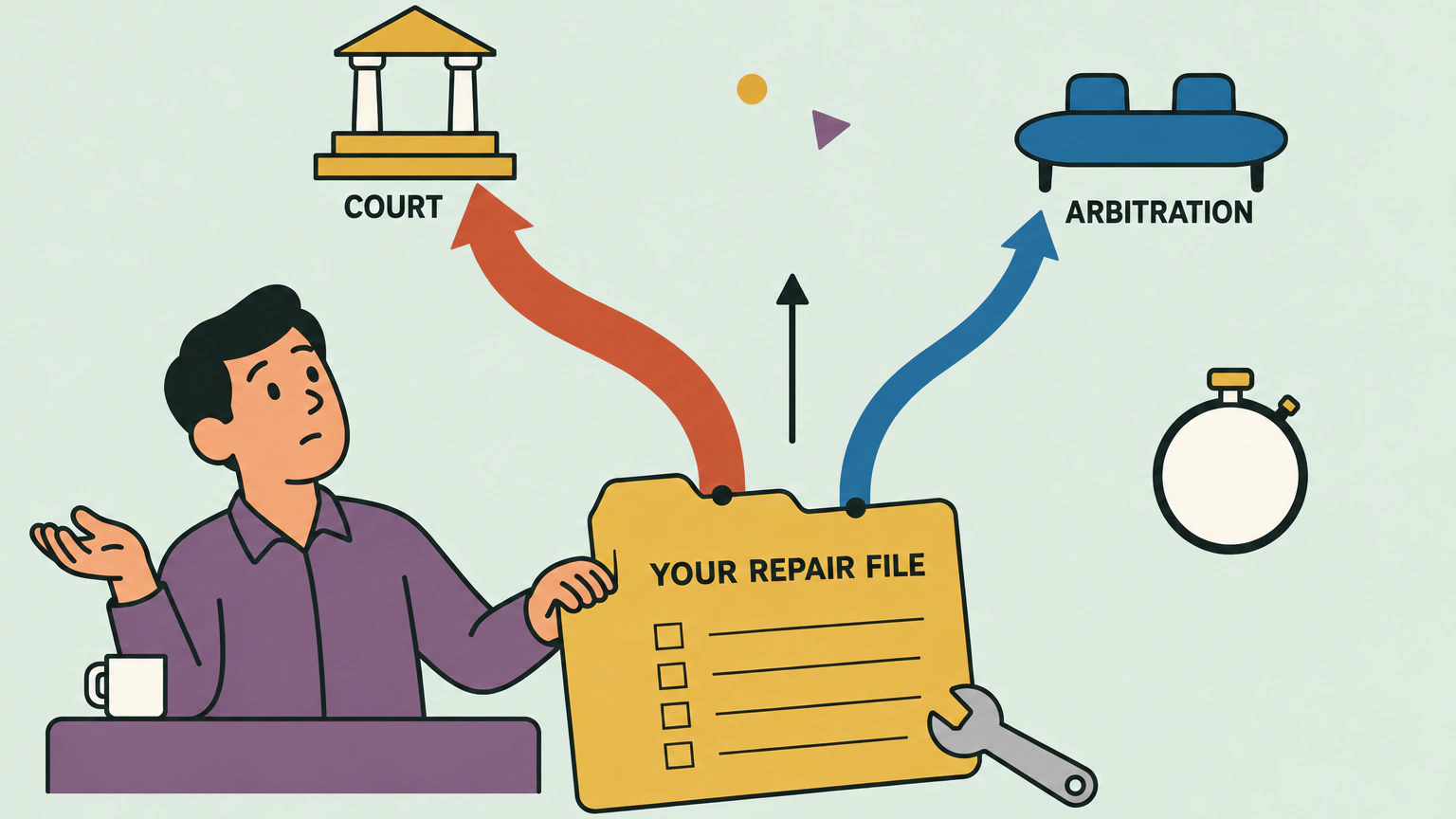
So here's the straight answer. Most of Canada has no lemon law. Quebec is the exception: since 2023 a Quebec court can declare a car seriously defective after three failed repairs for the same fault, and order the contract cancelled. Elsewhere, eligible drivers can use CAMVAP. It's a free national arbitration program that can order the manufacturer to buy your car back. At the hearing, a buyback is available only if the car has been in service for no more than 36 months and has travelled under 60,000 kilometres.
One fact decides whether CAMVAP will hear you: the claim must be against the manufacturer, not just the shop. CAMVAP resolves disputes over the new vehicle warranty or a covered defect. A claim only against the dealer is outside the program. If your problem is really with the people holding your keys and your invoice, that's your rights at the repair counter.
Now look behind each door.
| What it is | Who decides | What triggers it | Age and distance limit | What you can get | What it costs you | Can you still go to court |
|---|---|---|---|---|---|---|
| CAMVAP (every province and territory): binding arbitration | an independent arbitrator | the manufacturer and dealer had "a reasonable amount of time and opportunity", with no repair count prescribed | heard at current plus four previous model years and no more than 160,000 km. At the hearing, buyback only when the vehicle has been in service no more than 36 months and has travelled under 60,000 km | repair at the manufacturer's expense, a buyback set by formula, reimbursement of previous repairs, capped expense reimbursements | free, but you give up the court route | no, the award is final and binding |
| Quebec's anti-lemon measure: a court declaration that the car is seriously defective | a judge | repairs under the manufacturer's warranty: 3 failed attempts for the same defect, 1 to 2 attempts plus more than 30 days in the shop, or 12 attempts for unrelated defects | the defect appeared within 3 years and 60,000 km of first sale or long-term lease | the contract cancelled, the price reduced, damages, and punitive damages | a court process, with a formal notice first | yes, this is the court route |
Why searching for a lemon law in Canada goes nowhere
American lemon laws count. So many repair attempts, or so many days out of service, and the manufacturer has to take the car back. Outside Quebec, Canada never wrote that rule. The country built an arbitration program instead, and it asks a softer question: did you give both the dealer and the manufacturer "a reasonable amount of time and opportunity to resolve the problem"? No number is attached. There's no magic fourth visit, only an arbitrator weighing what was reasonable in your case.
So the borrowed phrase keeps failing you. The federal Office of Consumer Affairs still opens its page on vehicle defects with "while there are no 'lemon laws' in Canada", and that page carries a 2022 date. True when it was written. Not quite true now, and every page that copied it inherited the gap.
What changed in Quebec in 2023
British Columbia's Vehicle Sales Authority, the regulator that licenses car dealers there, puts it flatly: "Quebec is the only province in Canada with a lemon law, which was effective in 2023." Notice who's saying it. A regulator in one province, telling you a different province has something it doesn't.
What Quebec added is a court route, not a program. A recent car can be declared "seriously defective", and it's the owner or the long-term lessee who petitions the court for it. Once a court grants that, the car is deemed to have a hidden defect, and that phrase opens the remedies. The conditions are exact.
CAMVAP, the route available across Canada
CAMVAP is the Canadian Motor Vehicle Arbitration Plan. It's binding arbitration between you and the company that built your car, it has run since 1994, and it is "available at no charge to the consumer and can be accessed in all Provinces and Territories in Canada." An in-person hearing happens in or near your home community, often in a hotel meeting room, business office or community centre rather than a courtroom. The whole thing takes about 70 to 90 calendar days, and you don't need a lawyer.
It does cost you something, and the currency isn't money. You're handing over your right to sue. CAMVAP says it in one line: "the choice is yours. You can file a claim with the courts or you can use CAMVAP, but you cannot do both."
The two clocks, and why the second one decides everything
People get hurt here, and it isn't their fault. CAMVAP publishes its entry rules on one page and its buyback rules on another, and the two carry different numbers.
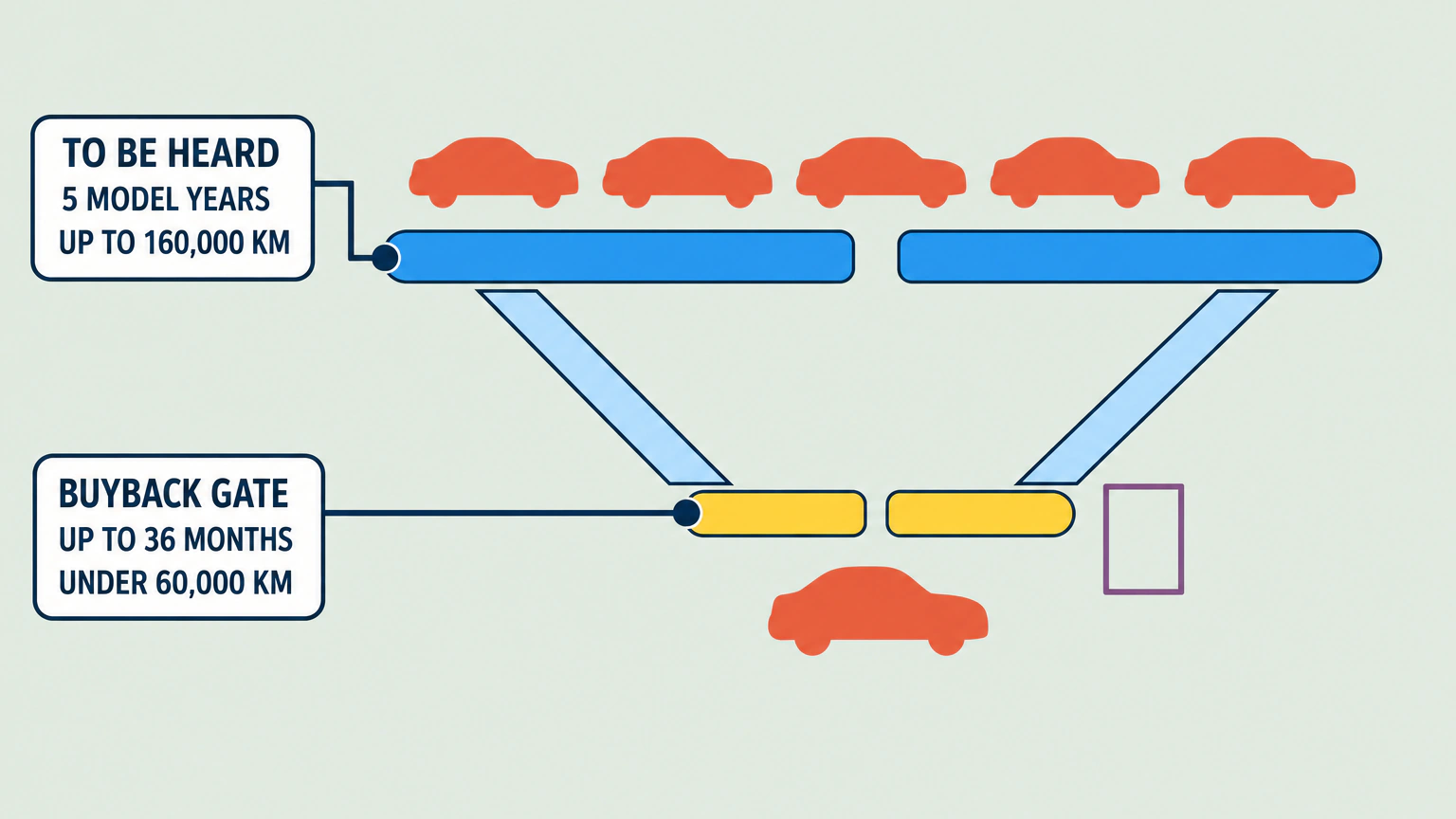
Clock one gets you a hearing. The car has to be from the current model year or one of the four before it, and to have travelled no more than 160,000 kilometres. It can't weigh more than 4,536 kg, and it must be used mainly for personal or family use unless it meets CAMVAP's owner-operated business rules. It has to have been bought originally from a manufacturer authorized dealer in Canada.
Clock two decides what you can win. CAMVAP states it in nine words: "Vehicles in use over 36 months, or 60,000 kilometers, are ineligible for a buy-back."
Read those together and say the consequence out loud. A car that's been in service for more than 36 months with 90,000 km may still be heard if it fits the model-year deadline. An arbitrator can still order it repaired at the manufacturer's expense and reimburse previous repairs that were part of the claim. That car can't be bought back. Not if the fault is dangerous, not if the arbitrator agrees with every word you say.
There's a third date, and it's the sharpest. CAMVAP's Provincial Administrator must receive your claim form by the last filing date for its model year. Every date in the current table is 30 September. For the 2022 model year that's 30 September 2026, for 2023 cars 30 September 2027, and so on down the table. Waiting for one more repair attempt can push you past it.
Who gets turned away at the door
CAMVAP publishes the full list of disputes it can't take. These are the ones that bite:
- Your dispute is only with your dealer rather than the manufacturer.
- You're claiming a design defect rather than a defect in assembly or materials. A part built wrong is in, a part that works exactly as drawn is out.
- You want money for inconvenience or loss of use. Not available, at any stage.
- Your claim is already being litigated, by you or as part of a class action.
- The car was written off, or a provincial ministry has it registered as salvage or rebuilt.
- It's a tire complaint, even where the manufacturer warrants the tires, unless the tire issue is directly tied to another covered defect in workmanship or materials.
- It's about rustproofing the manufacturer didn't apply, or a defect caused by or related to an aftermarket part.
- It's a service contract or extended warranty rather than the new vehicle warranty itself.
And one that catches people flat. You have to let the manufacturer finish recall work you were notified about in writing when the work will be done at no cost. The condition applies "whether or not the recall or service campaign relates to your claim." Binning a letter about a seatbelt bracket can cost you a claim about a transmission.
What an arbitrator can order, and what they can never order
An arbitrator's power is a fixed published list, not a matter of persuasion on the day.
The caps that come with each remedy
An arbitrator can order the manufacturer to repair your car at its own expense, to buy it back at a price set by a formula, and to pay you back for repairs you've already covered. Then come the capped items: up to $500 for diagnostic testing done before your hearing, up to $1,000 for certain out of pocket expenses, up to $100 for summonsing witnesses, and up to $200 to remove and refit an aftermarket part the arbitrator finds wasn't the cause.
Now the wall. An arbitrator can't award punitive or exemplary damages. They can't set aside your purchase or lease agreement, and they can't order an extended warranty. And they can't order "the repair, removal or addition of any computer software."
Hold that $500 cap against a real invoice. Across 746 of our own cost profiles for car electrical and diagnostic work, the typical range runs $135 to $228, with a maximum of $723. Those figures carry no time period, so read them as the size of a bill rather than a rate. The typical range sits well inside the cap. The intermittent fault you're probably fighting is the kind that doesn't.
What a buyback is actually worth
This part decides whether chasing a buyback is worth your autumn.
For a car you own, the formula starts with the price you actually paid, as shown on your retail sales contract. It adds manufacturer approved options fitted at purchase, then a specific list of documented items if they aren't already in that price: freight, the pre-delivery inspection, acquisition fees, the tire levy, regulatory fees, administration and documentation fees, federal excise and air conditioner tax, and government mandated environmental fees.
Then comes the line that does the damage, called Reduction for Use. For a car you own, CAMVAP calculates it as the purchase price multiplied by the odometer reading at the hearing, divided by 200,000 kilometres. The arbitrator may waive all or part of that amount only if two conditions are met. The car had been in service for no more than 365 days when CAMVAP received your completed application. It also has to be at no more than 25,000 kilometres at the hearing.
What's left out is most of what the finance office sold you at delivery. Fabric and paint protection, rustproofing, vehicle etching, fuel charges, remote starters, licensing and registration fees: none of it comes back.
One more piece of money. Settle with a buyback rather than run to a full hearing. CAMVAP says you'll likely need a Consent Award to claim a prorated provincial or territorial sales-tax refund where one is available. Its buyback form excludes Alberta. Ask for the Consent Award before you sign the settlement.
What actually happened in CAMVAP's own 2024 awards
CAMVAP publishes every award it issues, case by case, with the manufacturer, the model year, the model, the complaint and the remedy. 2024 is the most recent year published and holds 173 awards. One award can name more than one outcome, so these are counts of outcomes named across 173 awards, not 173 separate verdicts. It's one year of CAMVAP's own list, and it says nothing about how often Canadian cars go wrong.
| Outcome | Awards naming it |
|---|---|
| No Liability | 66 |
| Repairs | 54 |
| Buyback | 48 |
| Out-of-pocket expense | 8 |
| Reimburse repairs | 7 |
| Other, unknown or no jurisdiction | 6 |
Here's the fair reading. 105 of the 173 awards ordered the manufacturer to do at least one thing for the driver, and 63 were No Liability and nothing else. About three claims in five got the driver something, about one in four a buyback. Worth doing, then. Not a lottery ticket, and not a rubber stamp.
The complaint side is where the planning value sits. Computer/Electric was named in 73 of the 173 awards, Engine in 42, Exterior in 33 and Transmission in 20. If your fault is a big mechanical one, that's good news for your paperwork: engine repair specialists and transmission specialists can put a failure on paper in terms an arbitrator can weigh.
When a software complaint falls outside CAMVAP
Computer/Electric leads the 2024 awards by a distance, at 73 of 173, up from 29 the year before. The published table doesn't say how many of those cases involved software.
CAMVAP excludes a claim about software itself unless it is directly related to another defect in workmanship or materials. An arbitrator also can't order "the repair, removal or addition of any computer software."
That doesn't shut out every electronic fault. CAMVAP's 2024 table shows Computer/Electric cases ending in repairs and buybacks.
So this is where you spend money before the hearing rather than after. A written diagnosis from car electrical and diagnostic specialists who have never met your car beats a fifth dealer visit ending in "no fault found". Nobody can pay their way onto our lists, which is the point of the guarantee we publish.
Quebec's anti-lemon route, in plain terms
Quebec's route differs in two ways that change everything. A judge decides it, not an arbitrator. And it counts repair attempts instead of weighing what was reasonable. Read it even if you live elsewhere: it shows what a statutory route looks like.
The three ways a car hits the threshold
Quebec's consumer regulator, the Office de la protection du consommateur, publishes the conditions plainly. We're stating them carefully, because we kept meeting the same two errors.
Two conditions apply no matter what. One or more defects must have appeared while the car had travelled at most 60,000 kilometres, and within three years of its first sale or long-term lease. And the defect has to make the car "unfit for the use for which it is normally intended" or significantly cut its usefulness.
Then one of three repair histories under the manufacturer's warranty has to fit:
- Three unsuccessful repair attempts for the same defect.
- One or two unsuccessful attempts for the same defect, made while the manufacturer or dealership had the car for more than 30 days. Days the shop can show it lost to a parts shortage don't count, as long as you were given a replacement car free of charge.
- Twelve repair attempts for unrelated defects, whether or not any of them worked.
Two corrections. The 30 day branch isn't a threshold on its own. It only works alongside one or two failed repairs for the same fault. And the measure isn't limited to new cars: the OPC says you may have bought the automobile from a merchant, new or used, or from an individual.
What you can ask a court to do
Start before court, because the law expects you to. Tell the dealership and the manufacturer, in writing, that the vehicle has a hidden defect. Then ask for one of three things. Your obligations reduced, which in practice means money off the price. The contract cancelled. Or damages, if you can prove what this has cost you.
If negotiating gets you nowhere, you send a formal notice. Only then do you petition the court to have the car declared a "seriously defective automobile" and put those same requests to a judge. Punitive damages are available in Quebec, which they never are at a CAMVAP hearing.
Miss the thresholds and you aren't finished. The OPC is clear that the law's other warranties still let you demand a car fit for normal use, lasting a reasonable time given what you paid.
Arbitration or court, because you cannot have both
CAMVAP is blunt: "the choice is yours. You can file a claim with the courts or you can use CAMVAP, but you cannot do both." Once the arbitrator rules, "A CAMVAP award is final and binding." You may be able to ask a court to set that decision aside under your province's arbitration legislation, but it's a narrow door and not an appeal.
Here's the trade laid flat. CAMVAP is free, takes about 70 to 90 days, happens near your home and needs no lawyer, and it can't give you punitive damages or cancel your contract. Court can cost money, and the remedies depend on provincial law. A Quebec court can cancel the contract and award punitive damages.
We'd call CAMVAP the right first move for most people in this spot: the fault is documented, the car sits inside both clocks, and you want a repair or your money back. It flips at the hearing after 36 months in service or when the odometer reaches 60,000 km, when the buyback isn't on offer. It flips again if your real loss is inconvenience and loss of use, which sit outside the program entirely.
Pro tip: The Automobile Protection Association warns that the technical expert CAMVAP can supply at no charge "is not likely to be a mechanic or engineer, and may not have the skills or equipment to diagnose the vehicle." In a technical case, the APA says, you're much better off bringing your own, and it points out that the program's own literature doesn't tell you so.
We're not your lawyer, and giving up the court route is a real decision rather than a formality. If a lot of money is riding on this, spend an hour with someone who can read your sales contract before you sign anything.
The file you build before you apply
Both routes run on the same fuel, and it isn't legal argument. It's paper: repair orders, dates, and a written diagnosis from an independent shop with no connection to the sale. Build it now, while the car is still inside both clocks.
- Ask the dealership in writing for a copy of every repair order, including the ones where they found nothing.
- Write down each visit: the date, the fault you reported, who you spoke to, and how many days they kept the car.
- Keep the bill of sale or lease agreement, the window sticker and the warranty booklet together in one place.
- Photograph the odometer on the day you start the file, and again the day you apply.
- Get an independent written diagnosis from a shop that is not the selling dealer, and ask for it in plain language.
- Follow the manufacturer's own dispute process first, in writing, and keep the file number.
- Check whether any recall notice you received in writing is still outstanding, and let them do that work.
- Decide before you apply whether you want a repair, your money back, or costs reimbursed, because you name the remedy on the claim form.
Red flag: five mistakes that can end your claim, narrow the remedy or weaken your evidence.
Filing in court first, or staying in a class action, and then applying. You get one forum, not both. Do this instead: pick your route before you file anything. If you're already in a class action, opt out before applying to CAMVAP.
Selling or trading the car while your claim is running. You must still own or lease it throughout the arbitration. Do this instead: if you cannot keep it, say so before you apply.
Letting the odometer reach 60,000 kilometres before the hearing while you wait for one more repair attempt. The buyback gate closes there even though the hearing gate does not. Do this instead: start the file at the second failed repair, not the fifth.
Ignoring a recall letter because it has nothing to do with your fault. Recall work is an eligibility condition when you received written notice and the work will be free. That applies whether or not the recall relates to your claim. Do this instead: book it, and keep the paperwork.
Turning up to a technical hearing with only your own account of the noise. The program can supply an expert who may not be a mechanic. Do this instead: bring your own written diagnosis, and budget for it.
Frequently asked questions
Is there a lemon law in Canada?
In one province. British Columbia's vehicle sales regulator says Quebec is the only province with a lemon law, in force since 2023, and it lets a court declare a car seriously defective. Elsewhere, there is no comparable lemon-law route. Eligible drivers can use CAMVAP, which is free and available in every province and territory.
Is there a lemon law in Ontario?
No. Ontario has no lemon law, and campaigns to introduce one haven't changed that. An Ontario driver's route is CAMVAP, plus the ordinary consumer protection rules governing the dealer relationship. Those are two different things, and only the first covers your dispute with the manufacturer.
Does CAMVAP cover a used car?
Yes, if the car still fits the program. It covers owners and lessees of new and used vehicles. The car must be from the current or four previous model years and have travelled no more than 160,000 kilometres. It must also have been bought originally from a manufacturer authorized dealer in Canada. A privately bought car can still qualify if it meets those rules and you owned it when the dispute arose.
Will CAMVAP make the manufacturer buy my car back?
It can: 48 of the 173 awards CAMVAP published for 2024 included a buyback. But there's a separate gate. At the hearing, the vehicle can't have been in service for more than 36 months. It must also have travelled under 60,000 kilometres. Miss either limit and it can't be bought back, even where the arbitrator agrees the fault is real and can't be fixed.
How long do I have to bring a claim?
CAMVAP's Provincial Administrator must receive your claim form by the last filing date for its model year. Every date in the current table is 30 September. The 2022 model year's date is 30 September 2026, the 2023 model year's is 30 September 2027, and so on. Waiting for one more repair attempt can make you miss it.
Can I go to court after a CAMVAP decision?
No, and that's the real price of the program. You choose between the courts and CAMVAP, and the award binds you and the manufacturer alike. You may be able to ask a court to set the decision aside under your province's arbitration legislation, but that's a narrow route rather than an appeal.