
On this page
- The short answer: if the car came from another province, expect an inspection
- Out-of-province inspection rules, province by province
- The two clocks that decide whether you pay one inspection fee or two
- Who is exempt, and the New West Partnership rule people get wrong
- What it costs, and why nobody can quote you a national price
- What actually fails an out-of-province inspection
- Salvage, rebuilt and written-off vehicles: a second inspection entirely
- How to choose an inspection station in your new province
- Frequently asked questions
The short answer: if the car came from another province, expect an inspection
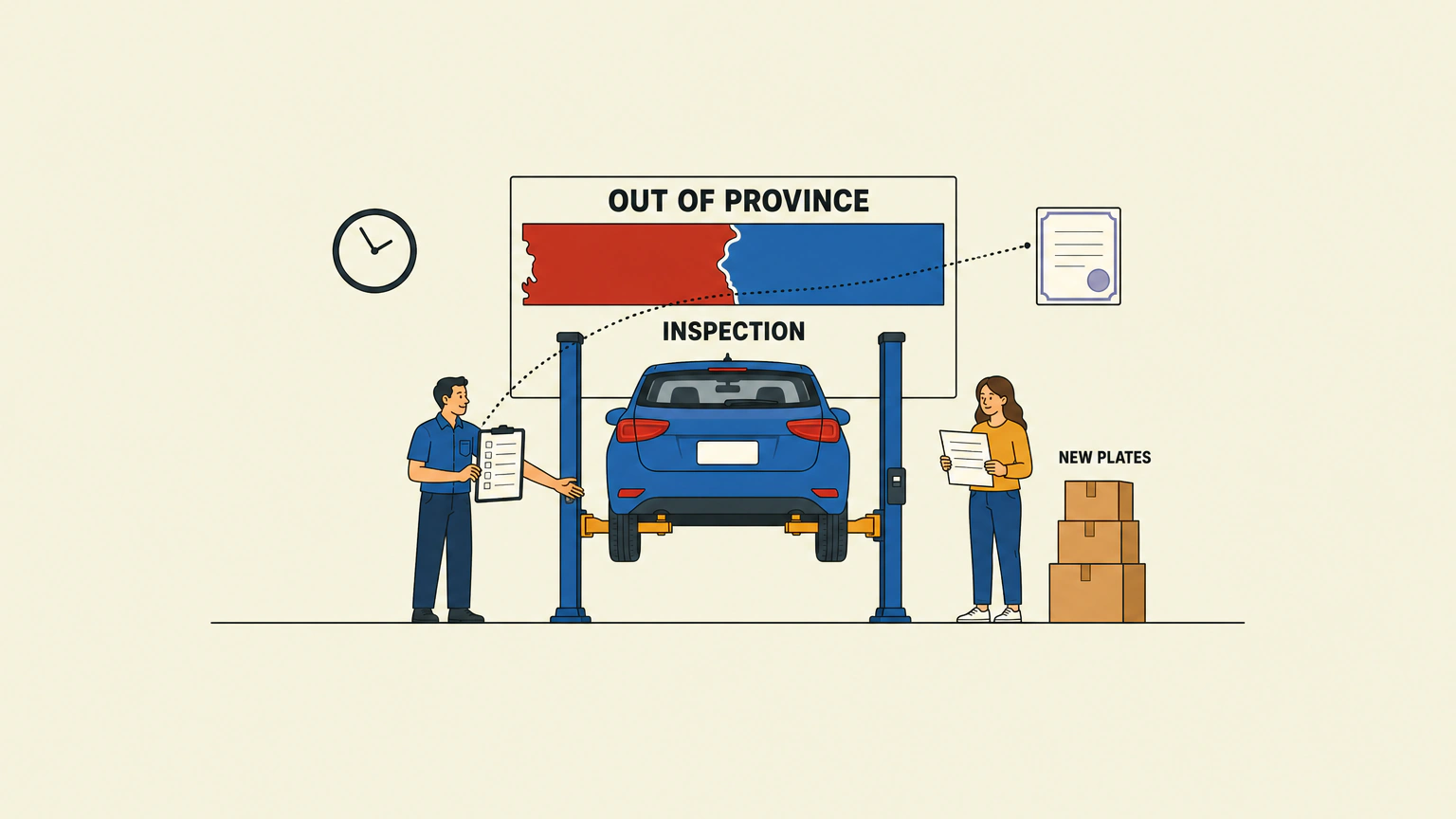
Plan on an inspection. Exceptions vary by destination province and include some recently dealer-purchased vehicles and qualifying New West Partnership moves. The comparison below covers seven provinces. New Brunswick and Prince Edward Island are not included, so confirm their current requirements directly before booking.
What the certificate is called where you're going
The names differ from province to province, and that is most of why this is hard to look up. It is an out-of-province inspection in Alberta, a provincial safety inspection at a designated inspection facility in British Columbia, a mechanical safety inspection in Saskatchewan, a Certificate of Inspection (COI) in Manitoba, a safety standards certificate (SSC) in Ontario, a mechanical inspection certificate in Quebec, and a Motor Vehicle Inspection (MVI) in Nova Scotia. Use the local term when you phone a station.
What this inspection is not
It is not a pre-purchase inspection, not a warranty and not an emissions test. Ontario's page says the certificate "confirms that your vehicle met the minimum safety standards on the date the certificate was issued. It is not a warranty or guarantee of the vehicle's condition." Manitoba Public Insurance says a COI "doesn't include a detailed inspection of the engine or transmission." Ontario's DriveON program runs emissions tests only for heavy-duty diesel commercial vehicles, so a passenger car gets a safety inspection and nothing else. And one shop can list three inspections at three prices, and only one of them will register your car.
Out-of-province inspection rules, province by province
The comparison covers seven provinces; each row identifies the regulator or public insurer and the date used.
| Province | What the certificate is called | Required when a vehicle arrives from another province? | Main exemptions | Who sets the price | Source and date read |
|---|---|---|---|---|---|
| Alberta | Out-of-Province Vehicle Inspection | Yes, before licence plates are issued | Dealer-new within 90 days; qualifying New West Partnership vehicles from B.C., Saskatchewan or Manitoba (conditions below) | The facility, which must post its prices in plain sight | alberta.ca, plus the ministry sheet dated 27 May 2026; read 17 Aug 2026 |
| British Columbia | Provincial safety inspection at a designated inspection facility | Yes, for private vehicles under 3,500 kg net weight registering from another jurisdiction | New vehicles; qualifying New West Partnership vehicles from Alberta, Saskatchewan or Manitoba; 3,501 kg net weight or more; low-speed electric vehicles; non-commercial trailers; motorcycles | The facility; ICBC says to ask for a quote | gov.bc.ca CVSE, updated 9 Dec 2025, and icbc.com; read 17 Aug 2026 |
| Saskatchewan | Mechanical safety inspection | Yes, for a vehicle recently registered in another jurisdiction | New West Partnership vehicles from B.C. or Alberta (conditions below) | Regulated as time, not price: shop rate times 1.5 hours for small vehicles, times 2 hours for large ones, GST only | sgi.sk.ca, importing and exporting vehicles, and vehicle inspection programs; read 17 Aug 2026 |
| Manitoba | Certificate of Inspection (COI) | Yes, for any vehicle brought into Manitoba, including the vehicles of people moving there | New vehicles; a returning Manitoba resident bringing back a vehicle previously registered to them there | "There is no set cost for a COI. The cost is determined by the inspection station." | Manitoba Public Insurance; archived capture, 15 May 2024 (see the note below) |
| Ontario | Safety standards certificate (SSC) | Yes, when registering a vehicle bought in or brought from another province, territory or country | Used motorized snow vehicles, off-road vehicles, motor-assisted bicycles such as mopeds, and trailers; transfers to a spouse | Each inspection centre; the cost "isn't regulated by the government" | ontario.ca, updated 1 Apr 2025 and 21 Aug 2025; read 17 Aug 2026 |
| Quebec | Mechanical inspection certificate from a mechanical inspection centre | Yes, for a used vehicle from outside Québec | Snowmobiles, snowblowers, ATVs, tool vehicles, and trailers of 900 kg or less | The inspection centre | SAAQ, page updated 16 July 2025; archived capture, 19 July 2026 (see the note below) |
| Nova Scotia | Motor Vehicle Inspection (MVI) | Yes, normally no later than 30 days after the vehicle enters the province and before registration; if it was not inspected first, RMV may issue a letter allowing 10 additional days after registration | A valid New Brunswick or Prince Edward Island inspection in the registrant's name; antique vehicles; and, over 4,500 kg registered gross weight, a valid inspection from another Canadian jurisdiction in the registrant's name | The inspection station | novascotia.ca, Registry of Motor Vehicles; read 17 Aug 2026 |
Three provinces get misread. Quebec's exemption list is short, so almost any used vehicle from outside the province needs the certificate. Nova Scotia starts its clock at the vehicle's entry rather than at registration, so the 30 days can run out while you are still unpacking. Manitoba's page gives its Certificate of Inspection one year of validity for transferring ownership.
Provinces not included in the comparison
New Brunswick and Prince Edward Island are not included in the table, so confirm their current requirements with Service New Brunswick or Access PEI before you book. Newfoundland and Labrador publishes a 90-day registration deadline and lists a copy of the inspection among the documents for a used-vehicle purchase, but says nothing about a vehicle you already owned. Confirm that with Motor Registration.
The two clocks that decide whether you pay one inspection fee or two
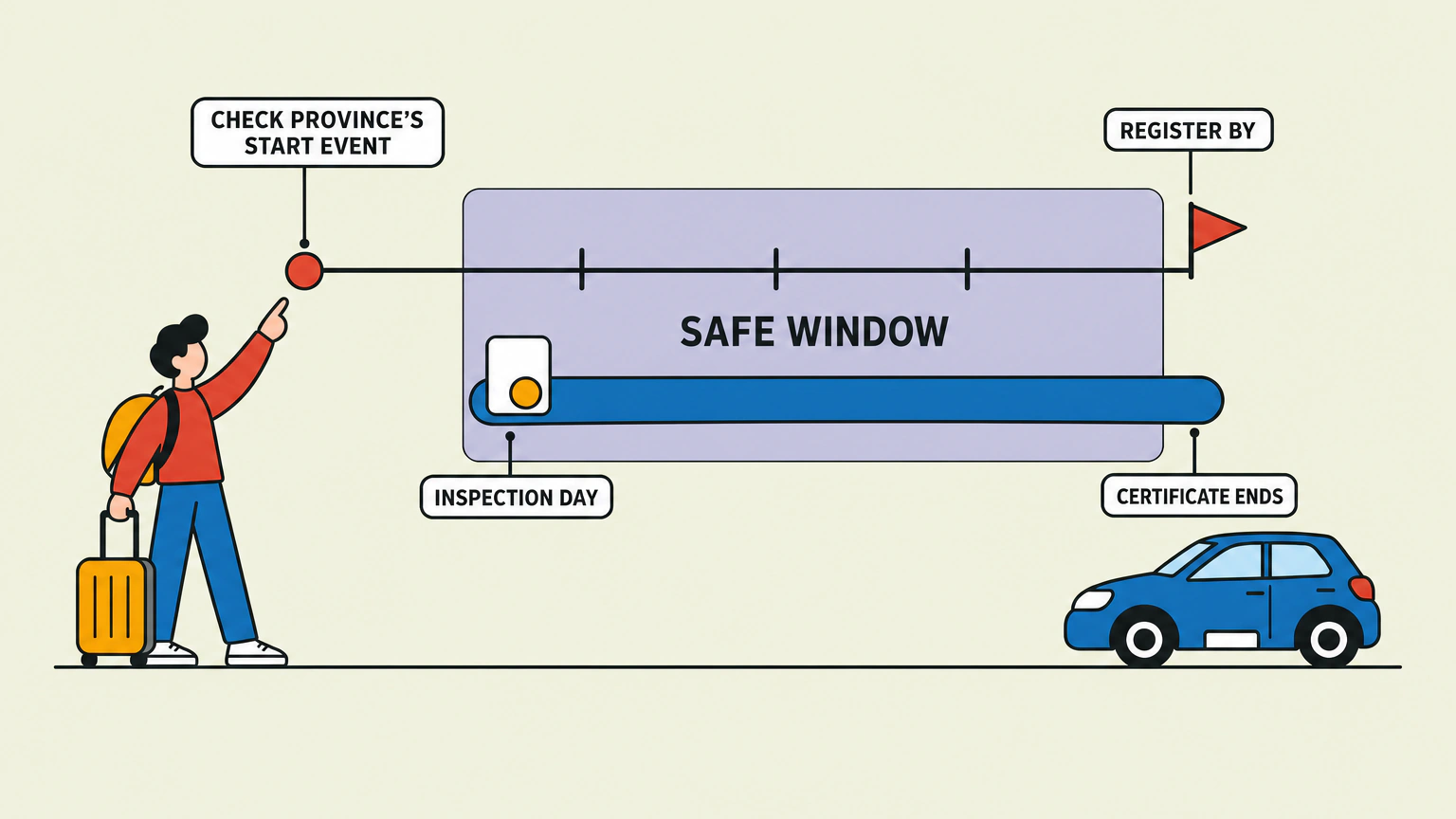
Your registration deadline and your certificate's expiry come from different rules, and they do not line up. The trigger varies by province: registration deadlines are tied to arrival, moving or residency, while Nova Scotia starts its inspection deadline at the vehicle's entry; certificate validity is generally measured from the inspection. Start the inspection late enough that the certificate is still alive on registration day, and early enough to leave room for a fail and a repair.
Clock one: how long you have to register after you move
British Columbia gives you 30 days to register, license and insure, and 90 days to switch your driver's licence; commercial vehicles must be done immediately. Alberta gives new residents 90 days, and requires no Alberta registration if you are staying temporarily for under 183 days and the vehicle remains registered in another jurisdiction. Saskatchewan lets you keep using your previous jurisdiction's registration and insurance for up to 90 days. Newfoundland and Labrador allows 90 days from arrival. Nova Scotia measures from the vehicle's entry.
Clock two: how long the inspection result stays usable
Alberta is the tight one: get the certificate to a registry agent within 14 days of the completed inspection, or the inspection is done again. Ontario's certificate is valid 36 calendar days, and an annual or semi-annual DriveON inspection can serve as one for the same 36 days. Manitoba Public Insurance describes a COI as good for a year. Saskatchewan publishes a 30-day re-inspection window; Nova Scotia issues a sticker with a two-year expiry for a used type 1 vehicle; the current B.C. and SAAQ pages cited here state no certificate-validity period.
Pro tip: Book the registry appointment first and work backwards, because some certificates expire before registration. In Alberta, read the posted price board at two or three facilities before you commit, since the province makes them post prices in plain sight and does not set them.
The order to do it in
Paperwork first, then the inspection, then the registry, with the registry appointment already booked.
- Confirm which certificate your destination province issues, and check the exemption list before you pay for anything.
- Run a cross-Canada VIN search before you move, because a salvage, rebuilt, non-repairable or flood status can make the vehicle unregisterable, and you want to know that before it is 2,000 km from home.
- Ask the destination registry what you must buy before the inspection. Alberta sells a Request for Vehicle Inspection Form at any registry agent, and the station cannot inspect without it.
- Book the registry appointment first, then book the inspection to land inside the certificate's window.
- Phone three licensed stations for a price, and ask each what a re-inspection costs.
- Confirm the station is licensed for the exact inspection you need, not a general safety check.
- Deal with the cheap, obvious fails yourself first: tires, wiper blades, burnt-out bulbs, a loose exhaust hanger, seat belts that do not retract.
- Keep the failed Record of Inspection. It lists every defect, and it is the document you use to get comparable repair quotes.
Who is exempt, and the New West Partnership rule people get wrong
An exemption saves you the fee and the wait. It is also where the provinces differ most.
The four-year rule and the ninety-day rule
Alberta's exemption sheet, dated 27 May 2026, covers two situations. A vehicle bought or leased within the last 90 days from a factory-authorized dealer, with the bill of sale or lease in your name, is exempt. So is a private passenger vehicle arriving from British Columbia, Saskatchewan or Manitoba that is newer than four years, meaning the current model year plus the previous three, or older than that but inspected under a B.C., Saskatchewan or Manitoba government mechanical inspection within the past 90 days. Saskatchewan adds the conditions Alberta's summary leaves out: a gross vehicle weight rating at or under 4,536 kg, and a normal status in the Inter-Provincial Records Exchange. British Columbia's list is broader, adding new vehicles, vehicles of 3,501 kg net weight or more, low-speed electric vehicles, non-commercial trailers and motorcycles.
Where the three provinces' own pages disagree
Alberta's page and ICBC's page both name British Columbia, Saskatchewan and Manitoba as the partner jurisdictions. SGI's page says the New West Partnership was launched in 2010 by Alberta, British Columbia and Saskatchewan, and names only B.C. and Alberta as origin provinces for its own exemption. Confirm with the registry in the province you are moving to, because that is the province whose rule governs.
Vehicles that can never be exempt
Alberta's list is blunt: salvage, non-repairable, unsafe, rebuilt, right-hand drive, custom or homebuilt, kit cars, and lifted or lowered vehicles. Quebec's bar is absolute, and the SAAQ states that a vehicle declared unrebuildable, for instance after a flood, can never be put back on the road. Saskatchewan matches it: any mention of flood damage in a vehicle's history means it cannot be registered in Canada, even if it was repaired and registered somewhere since.
What it costs, and why nobody can quote you a national price
There is no national price, because most provinces that publish a policy decline to set one.
How Saskatchewan regulates the charge
Saskatchewan regulates the time instead of the fee. A station may charge its shop rate multiplied by 1.5 hours for a small vehicle, up to and including a half-ton truck, or by 2 hours for a large vehicle, and only GST applies. Ask the station its posted hourly rate, multiply, and you have the number before you book.
What stations actually charge
Alberta requires facilities to set their own price and "post those costs in plain sight." Ontario says the cost "isn't regulated by the government." Manitoba Public Insurance says "there is no set cost for a COI." ICBC says cost varies and to ask for a quote. Two published prices: BCAA lists its Out of Province Vehicle Inspection at $155 plus tax, decal included, and a Calgary specialist lists one at $189 before GST. Prices move quickly, so use both as a starting point when you phone Alberta shops or B.C. facilities.
Budget for the repairs, not the inspection
The fee is the small number. PreferredMechanic.ca's own aggregate of quote profiles for auto repair shops puts a typical job at $383 to $671 across 730 cost profiles. And a pass tells you nothing about the expensive parts: SGI states that a mechanical safety inspection does not check the engine, transmission, air conditioning or other non-safety components.
What actually fails an out-of-province inspection
The published component lists are broadly consistent. Manitoba Public Insurance names brakes, suspension, tires, lights, exhaust, seat belts and steering. Saskatchewan folds a four-wheel alignment check into the inspection time, with alignment work charged separately and allowed at another shop. British Columbia's inspection also covers body integrity, heater controls and the engine compartment.
What a road-salt province does to your result
Corrosion is the quiet failure. Saskatchewan inspects certain structural parts to make sure corrosion or damage is repaired to original manufacturer specifications, while explicitly ignoring surface rust that does not jeopardize structural integrity. If the car has wintered in the salt belt, look at brake lines, fuel lines and rocker panels before you book. Those three can add substantial repair costs.
If you fail: your repair-and-retry window
| Province | How long you have to repair and return | What it costs to come back |
|---|---|---|
| Alberta | 10 days from the date on the record of inspection | A return inside 10 days is a verification of the repaired items only; after 10 days, a new full inspection |
| Saskatchewan | 30 days | No charge for the first re-inspection if no major parts must be removed and no alignment check is needed; after 30 days, a full inspection at your cost |
| Nova Scotia | 10 days from rejection | The original station may not charge an additional inspection fee to re-inspect the rejected items |
| Ontario | 10 days; return to the same DriveON Vehicle Inspection Centre | No charge unless wheel removal is needed; new failed or repaired items make it a full inspection |
| Manitoba | No published window | A re-inspection is required before a COI is issued |
| British Columbia | Not stated on the current public pages cited here | Ask the designated inspection facility |
| Quebec | 48 hours for a minor defect when the vehicle remains authorized for road use; a major defect prohibits road use immediately | Return to an inspection agent after repairs |
Alberta and Saskatchewan allow repairs at another repair facility, and Manitoba says you may do them yourself. If the bill becomes the argument, read what a shop can and cannot do if you dispute the bill.
Salvage, rebuilt and written-off vehicles: a second inspection entirely
A salvage or rebuilt brand makes the safety inspection half the job. Ontario requires both a Structural Inspection Certificate and a safety standards certificate from a centre licensed for the deeper structural inspection, and re-brands the vehicle from salvage to rebuilt only once you submit that Structural Inspection Certificate at a ServiceOntario location. Manitoba requires a Body Integrity Inspection Certificate before a salvageable vehicle can become rebuilt. Saskatchewan requires a body integrity inspection completed within 120 days of the initial inspection, by the station that started it, then a separate mechanical safety inspection. Run the cross-Canada VIN search before the move, because a status problem found after a two-province drive is not recoverable. The structural work belongs with auto body repair shops, not a general mechanic.
How to choose an inspection station in your new province
"Licensed" means something different in each province: a designated inspection facility in British Columbia, a DriveON Vehicle Inspection Centre in Ontario, an SGI-certified station in Saskatchewan, an Alberta facility licensed by the Vehicle Inspection Program with a journeyperson technician, and in Manitoba a station displaying the Vehicle Inspection Safety Station sign. Ask which one you are booking, by name.
Red flag: five things that should make you phone another station.
- A station that hints it can "get it through". The certificate is a government document and the technician signs it.
- A repair quote given verbally, with no written record of inspection listing the failed items.
- Being sold a pre-purchase or general safety inspection when you asked for the provincial one. One B.C. auto-club page lists inspections at $249.95, $179.95 and $155, and only the $155 one registers your car.
- A station that will not hand over the failed Record of Inspection, or that says repairs must be done in-house.
- Anyone who says the inspection covers the engine and transmission. Manitoba's page says a COI does not, and Saskatchewan's says its inspection skips the engine, transmission and air conditioning.
Start with inspection and emissions testing stations near you, then line up a repair shop for whatever fails. If the move is taking you somewhere colder, the next question is usually whether you need a block heater where you are moving.
Frequently asked questions
What does an out-of-province inspection cost?
There is no national price. Alberta, Ontario, Manitoba and ICBC all say the same thing differently: the station sets the fee. Saskatchewan is the exception among those four, capping the billable time instead. Two prices published on providers' own pages: $155 plus tax in British Columbia and $189 before GST in Calgary.
How long does an out-of-province inspection take?
Alberta says the inspection can take up to about two hours on average, depending on the vehicle. Saskatchewan's regulated billing basis says the same: 1.5 hours for a small vehicle up to and including a half-ton truck, 2 hours for a large one. Book a half-day and leave the car.
How long is an out-of-province inspection good for?
It depends on the province, and the range is wide. Alberta gives you 14 days to present the certificate to a registry agent. Ontario's safety standards certificate is valid 36 calendar days. Manitoba Public Insurance's page describes a Certificate of Inspection as good for a year. Some provincial pages publish a re-inspection window without stating a certificate-validity period.
Do I need an out-of-province inspection in Ontario?
Yes, in the form of a safety standards certificate. Ontario requires one when you register a vehicle bought in or brought from another province, territory or country. You can buy and register the vehicle without the certificate, but you cannot put plates on it, so nothing actually moves until the inspection passes.
Do motorcycles and trailers need one?
It depends on the province. British Columbia exempts motorcycles and trailers other than commercial ones. In Ontario the exempt list is trailers, mopeds, off-road vehicles and motorized snow vehicles. Quebec exempts trailers of 900 kg or less, ATVs, snowmobiles, snowblowers and tool vehicles, and Alberta exempts off-highway vehicles such as ATVs and snowmobiles, along with trailers.
What will fail an out-of-province inspection?
The published lists cover brakes, steering, suspension, tires, lights, exhaust and seat belts, and British Columbia's inspection adds body integrity, heater controls and the engine compartment. Corrosion is the one that surprises people leaving the salt belt: Saskatchewan measures structural corrosion against manufacturer specifications while ignoring surface rust that does no structural harm.
Can I drive the car while I wait to register it?
Depending on the province and the vehicle's status, you may need a permit. Ontario issues a 10-day temporary licence plate sticker so you can drive to a garage for the certificate. British Columbia uses an in-transit permit plus an interim insurance binder. Alberta and Saskatchewan let you keep using your previous jurisdiction's registration during their 90-day windows.
Manitoba Public Insurance and the SAAQ refuse requests from outside Canada, so those two rows come from archived captures rather than a live page, and they are the ones to re-check yourself. Rules change, so confirm with the registry in the province you are moving to before you book. None of this is legal advice, and your destination registry has the final say.