

On this page
- The short answer starts with your owner's manual
- Does your car already have one?
- How cold does it have to get before it matters?
- How long should you plug in? Canada's own agencies disagree
- What it costs to run
- What it costs to install, and what it costs when it fails
- Block heater versus the alternatives
- Plugging in safely
- Special cases
- So, do you need one?
- Frequently asked questions
- Where this comes from
The short answer starts with your owner's manual
Why that temperature? Because -20 °C is where Natural Resources Canada attached its old fuel-economy figure, and it is a line Environment and Climate Change Canada already counts at every station in the country. Two datasets, one number. Winnipeg averages 52 nights a year below it, Regina 45, Edmonton 38. Vancouver averages none.
That leaves two questions. Does the car already have a heater, and what does running one cost? Neither answer outranks the book in your glovebox, which was written for your engine rather than your postal code.
Does your car already have one?
Before you price anything, find out whether you already own one. Checking is free, and it is the step people skip.
Where to look
Take a flashlight to the grille and under the front bumper. You are looking for a short cord end, usually capped in plastic, sometimes coiled near the battery. Then the owner's manual index, under "engine block heater". If that comes up empty, the window sticker or build sheet says what the car was ordered with.
Look, don't tug. A cracked cord end is a technician's job.
What to do if you can't find a cord
Nothing found doesn't mean nothing fitted. The cord may be hidden, damaged, or removed by a previous owner. A dealer parts desk can often confirm the equipment from your VIN, which is one phone call. Or let someone with a hoist look: Mechanic shops in your city can check during a seasonal service.
How cold does it have to get before it matters?
What Natural Resources Canada actually says
Natural Resources Canada says two useful things, from two different eras of the same department.
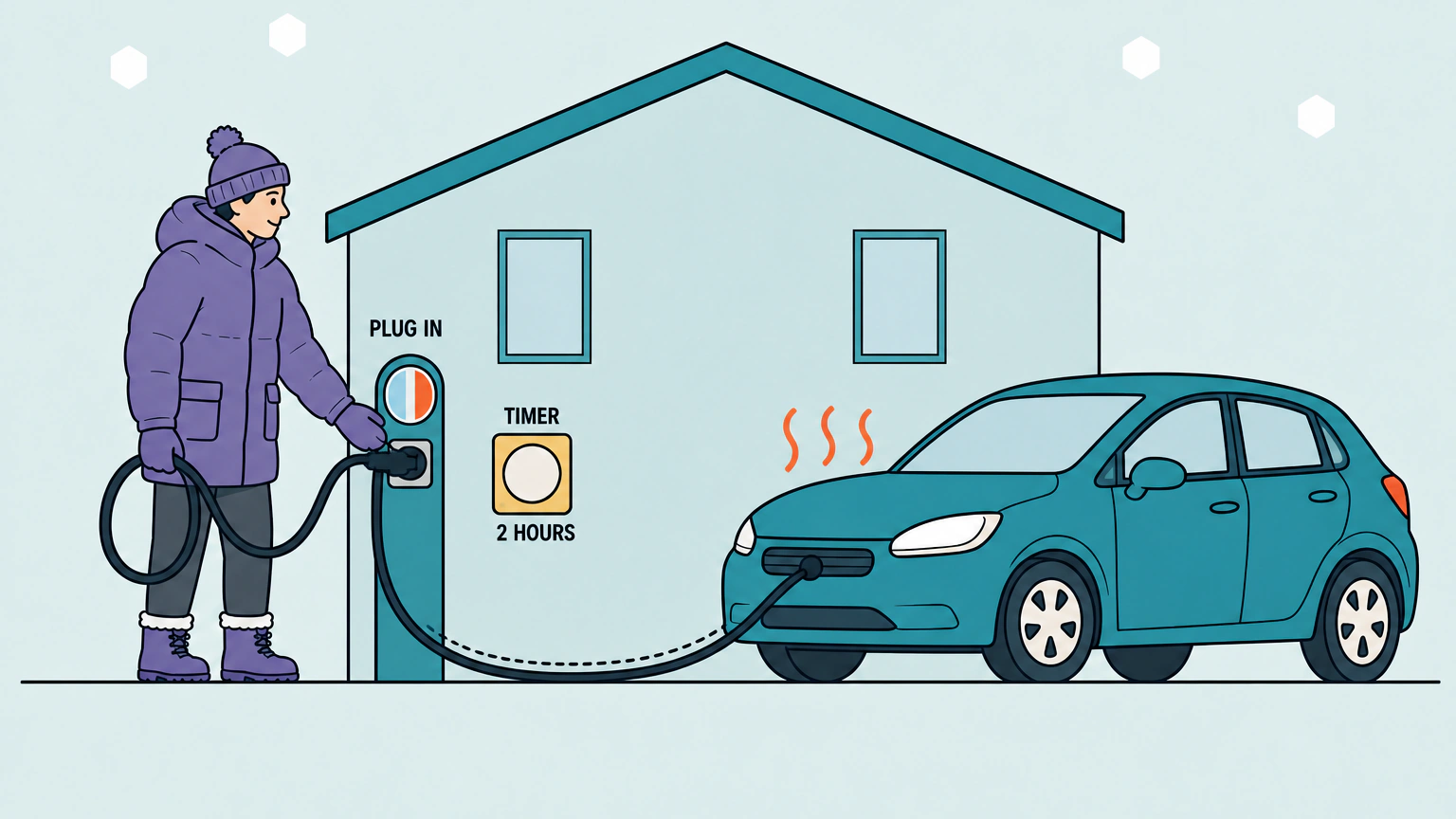
The current advice is about timing: put the heater on a timer set to switch on no more than two hours before you start the engine. A ceiling, not a target.
The percentages are older. An NRCan energy-efficiency article from 2008 put the gain at 10 percent better overall fuel economy at -20 °C, and in the order of 25 percent for a single short trip at -25 °C. The current page doesn't repeat them, so treat them as 2008 figures. That same article explains why cold costs you anything at all. Thick oil resists flowing. The mixture runs richer. And the catalytic converter does poor work until it warms.
Nights below -20 °C in your city
The count is of nights, not cold afternoons: days a year whose minimum falls below -20 °C, averaged over thirty years. Read it as a climate, not a forecast. A mild winter and a brutal one hide inside the same average.
| City | Prov. | Nights a year below -20 °C | Electricity, ¢/kWh | Climate context |
|---|---|---|---|---|
| Winnipeg | MB | 51.9 | 10.53 | Frequent |
| Regina | SK | 44.7 | 17.89 | Frequent |
| Edmonton | AB | 38.4 | 22.00 | Frequent |
| Calgary | AB | 21.6 | 22.90 | Regular |
| Ottawa | ON | 15.6 | 14.35 | Regular |
| Montréal | QC | 12.0 | 8.29 | Regular |
| Moncton | NB | 11.7 | 16.61 | Regular |
| Charlottetown | PE | 5.8 | 19.69 | Occasional |
| Toronto | ON | 2.7 | 15.57 | Rare |
| Halifax | NS | 2.6 | 20.48 | Rare |
| St. John's | NL | 0.4 | 15.59 | Very rare |
| Vancouver | BC | 0.0 | 12.60 | None in this normal |
Nights: Environment and Climate Change Canada, Canadian Climate Normals 1991-2020, element "Days with Minimum Temperature < -20 °C", annual value at each city's principal airport composite. Price: Hydro-Québec, Comparison of Electricity Prices in Major North American Cities, 2025 edition, residential average at 1,000 kWh a month, excluding taxes, rates in effect 1 April 2025. The climate-context column describes this benchmark, not vehicle guidance; follow your owner's manual.
The -15 °C rule of thumb, and why we use the colder number
You will hear -15 °C quoted more often than -20. It comes from SaskPower, which tells Saskatchewan drivers to plug in below that and run a timer for four hours. That is a utility talking to one province, not a specification for your engine.
We work from the colder number because that is where the federal fuel-economy figure was quoted, and because it is the line ECCC already counts. If your manual names a temperature, that is your number.
Either way the electricity is small money. Two hours of a 600 W heater draws 1.2 kWh, or roughly 10 to 28 cents a night across these cities.
What matters more than the number
Where the car sleeps moves the answer more than a degree or two does. An unheated garage takes the wind off it. A heated garage ends the conversation.
Then the battery. A tired battery and a cold morning are one problem from two directions, and the battery is the cheaper half to rule out: book a car battery service test before you spend anything on a heater. Two more things swing it. Whether the engine is a diesel, and how short your first trip is, because the fuel penalty lands in the first few minutes.
How long should you plug in? Canada's own agencies disagree
Two hours, three hours, or four
Three Canadian bodies, three answers, none of them wrong.
Natural Resources Canada wants a timer set to come on no more than two hours before you start the engine.
Efficiency Manitoba puts it this way: "Your block heater only needs to be plugged in for three hours for it to heat your engine."
SaskPower says four hours on a timer once the temperature drops below -15 °C.
That spread is the whole argument for reading your own manual: the agencies describe a typical engine and the manual describes yours. What all three agree on is the useful part. Once the engine is warm, more hours buy you nothing except electricity.
Why "all night" is the answer nobody defends
We went looking for a Canadian authority that endorses the overnight habit and came up empty. NRCan's older article tells readers to fit an automatic timer "instead of leaving it plugged in all night", and adds that two hours is usually all the time needed. Some owner's manuals go further and set a hard maximum to prevent damage. A maximum is not a suggestion.
Buy the timer.
What it costs to run
Almost nobody does the multiplication, which is why this is the most over-guessed number in winter car care. The city prices are published averages, so what comes out is an illustration, not a forecast of your bill.
The arithmetic, in full
The heater's rating in kilowatts, times the hours per night, times the nights you plug in, times your price per kWh. That is the whole calculation.
Winnipeg, worked through. A 600 W heater is 0.6 kW. Two hours a night across an average 51.9 nights below -20 °C comes to 62.3 kWh. At Winnipeg's published 10.53 ¢/kWh that is an illustrative $6.56 for the season. Run the same heater twelve hours a night and it is $39.35.
Six dollars. That number moves the real argument off the hydro bill and onto the engine. Two honest limits on it: those city prices are average bill prices rather than the marginal rate you would be charged for one extra kWh, and the wattage is the one input you have to go and fetch. Read the heater label or the cord tag.
What could this below--20 °C scenario cost?
Three details, and you have an illustrative number for the winter.
Enter the rating printed on the heater label or cord tag. The 600 W default is an example, not a claimed common rating.
Natural Resources Canada says no more than two hours; your owner's manual may set different temperature or maximum-time instructions. Follow the manual.
Your winter electricity cost
About $6.56 in this below--20 °C scenario
That is 62.3 kWh across an average 51.9 nights below -20 °C.
Vancouver's 1991-2020 normal records no nights below this benchmark. That does not decide whether your vehicle needs a heater; follow its owner's manual.
Nights below -20 C: Environment and Climate Change Canada, Canadian Climate Normals 1991-2020. Electricity price: Hydro-Quebec, Comparison of Electricity Prices in Major North American Cities, 2025 edition, rates in effect 1 April 2025, excluding taxes.
Illustrative only. Published prices are average total-bill prices at 1,000 kWh/month, exclude taxes, and are a snapshot of rates in effect on 1 April 2025; actual marginal rates and bill changes differ by tariff. Follow your owner's manual for operating temperature and maximum time.
What a timer saves you, by city
| City | Two hours a night (NRCan ceiling) | Twelve hours a night (hypothetical) | What the timer saves |
|---|---|---|---|
| Winnipeg | $6.56 | $39.35 | $32.79 |
| Regina | $9.60 | $57.58 | $47.98 |
| Edmonton | $10.14 | $60.83 | $50.69 |
| Calgary | $5.94 | $35.61 | $29.67 |
| Ottawa | $2.69 | $16.12 | $13.43 |
| Toronto | $0.50 | $3.03 | $2.53 |
Assumes a 600 W heater and use only on the average nights below -20 °C. Every figure is an illustrative multiplication of the hours, nights and published average price above; the Hydro-Québec figures are average bill prices, not marginal rates, so actual added cost can differ. Excludes taxes.

Edmonton is where a timer earns the most, and even there the prize is about $51 across a winter. Nobody is retiring on that. The twelve-hour column is hypothetical, not operating advice.
Where the real money is
The electricity was never the expensive part of this. Broader auto-electrical work runs into the low hundreds, and a tow on a January morning is its own separate bill. That is where the money in this decision actually sits.
What it costs to install, and what it costs when it fails
What the job actually involves
"Block heater work" is three jobs wearing one name, which is why quotes vary so much.
A cord replacement is the small one: the element is fine and the lead to the front of the car is not. An element replacement means going back in to the heater, and designs vary by vehicle, so coolant may be involved. A first-time fit adds parts and diagnosis.
The last two reach into electrical and cooling systems, so this is a technician's job. We can tell you what the decision should cost. Only your owner's manual knows what your engine wants.
What Canadian shops charge
| Category on PreferredMechanic.ca | National average | Typical range | Based on | What it covers here |
|---|---|---|---|---|
| Auto Electrical Specialists | $157 | $135 to $228 | 746 cost profiles | Heater fitting, element and cord work |
| Car Battery Service | $134 | $83 to $206 | 721 cost profiles | The weak battery behind many cold starts |
| Roadside Assistance | $108 | $87 to $118 | 585 cost profiles | The outcome you are avoiding |
These are PreferredMechanic.ca's own aggregates across every job in each category, not block heater quotes and not market statistics.
Treat the electrical line as a ballpark, then get the real number in writing before anyone opens the hood. That written quote is your whole defence if the invoice outruns the estimate at pickup: if it does, know what a shop can and can't do if you dispute the bill. To compare, start with auto electrical specialists near you.
When it's the cord, not the heater
Stop using the system the moment you see damage at the plug end or a brittle jacket, or if a GFCI trips when you plug in. Any one is enough.
Absence of warmth diagnoses nothing. Nothing noticeably warm after an hour doesn't identify the failed part. A shop can test the heater and the cord separately, which is the only way to know which one you are buying.
Block heater versus the alternatives
Four devices come up for cold mornings. They don't do the same job, and one doesn't do this job at all.
| Device | What it warms | Helps the cold start? | Rough running cost | What it doesn't do |
|---|---|---|---|---|
| Engine block heater | Engine components; design varies | Yes: up to 10 percent better overall economy at -20 °C in NRCan's 2008 figure | $6.56 illustrative estimate (Winnipeg, 600 W, timer) | Nothing for the cabin |
| Battery blanket or warmer | The battery only | Aimed at the part that turns the engine over; unquantified in our sources | Depends on its rating | Nothing for thick, cold oil |
| Oil-pan heater | The oil in the sump | Attacks the thick-oil problem from the oil side | Depends on its rating | Nothing for the coolant |
| Remote starter | The cabin, by idling | No: it idles a cold engine | Fuel, not electricity: ten minutes idling burns 0.25 to 0.50 L (NRCan) | Nothing for cold-start wear |
The remote starter deserves plain speech, because it is what people buy instead. NRCan says idling beyond 30 seconds does nothing for the vehicle, and that driving off warms an engine fastest. A remote starter buys you a warm cabin, which is a fair thing to want. Just don't buy one thinking it looks after the engine.
Plugging in safely
Red flag: four fires in one week. In the first week of January 2025 the Winnipeg Fire Paramedic Service responded to at least four fires related to block heaters and extension cords, according to Manitoba Hydro.
- "Never plug in your vehicle inside a garage," said Scott Wilkinson, Deputy Chief of Fire/Rescue Operations and Training, Winnipeg Fire Paramedic Service. "If a fire starts in your garage, it can spread quickly to your home or other nearby structures."
- Check the whole cord before the first cold night, not just the ends.
- One vehicle per cord, one cord per outlet, nothing daisy-chained.
The cord is the hazard, not the heater
The heater sits bolted into your engine. The cord does not. It lives outdoors, gets driven over, freezes, sits coiled or wet, then carries current for hours in the dark. That is Manitoba Hydro's warning in one sentence, and it is why the heater cord and the extension cord are the fire risk here.
The garage rule is the one people argue with. Attached or detached, the answer is no.
If a cold morning beats you anyway, roadside assistance is the fallback.
Your pre-winter cord check
- Inspect the cord's full length before the first cold night: cuts, flat spots, cracked insulation.
- If insulation is worn through and wires show, replace the cord. Do not tape it.
- Replace any cord you have driven over or dragged while plugged in, even if it looks fine.
- Use only outdoor-rated cords, and never exceed the cord's wattage rating.
- Never plug in a vehicle inside a garage, attached or detached, door open or shut.
- Fully extend the cord in use, because a coiled cord can overheat.
- Never run a cord under a mat or rug; keep all of it visible.
- One vehicle per cord and one cord per outlet, nothing daisy-chained.
Adapted from Manitoba Hydro and the Winnipeg Fire Paramedic Service, January 2025.
Special cases
Diesel light trucks
A diesel fires on the heat of compression instead of a spark, so a cold start asks more of it. That is why the question comes up hardest around diesel pickups.
We are not going to hand you a diesel temperature, because we could not verify one. Manufacturers set their own plug-in advice for diesels, and yours will be in the manual. If it gives a temperature, use that.
Electric and hybrid vehicles
If you drive a battery-electric car, this question belongs to somebody else. A block heater warms an internal combustion engine and you do not have one. What you have is preconditioning: warming the cabin and battery while the vehicle is still plugged in, so the range goes into driving.
Plug-in hybrids are the awkward middle. There is an engine in there, but block-heater fit and use are model-specific, so check the manual.
So, do you need one?
Four conditions, checked in order.
- Your owner's manual recommends block-heater use at the expected temperature.
- You park outside, or in an unheated garage.
- Your first trip of the day is short.
- Your battery condition has been checked.
If the first two hold and the car has a heater, use it as the manual directs and put it on a timer tonight. If it doesn't, book the battery test first, then ask a qualified technician whether fitting one makes sense. The city counts tell you what your winters do. Only the book in your glovebox tells you what your car needs.
Frequently asked questions
Can you leave a block heater plugged in all night?
Don't assume you can. Natural Resources Canada's current guidance is a timer set for no more than two hours, and some owner's manuals prohibit longer operation outright to prevent vehicle damage. Your manual settles it. The twelve-hour figures used for comparison show waste, not a habit anyone recommends.
How much does a block heater cost to run?
Less than most people fear. Multiply the rating in kilowatts by the hours per night, the nights you plug in, and the applicable energy rate. Against Winnipeg's published city average, a 600 W heater run two hours across 51.9 nights below -20 °C uses 62.3 kWh and estimates about $6.56 for the season. Your own bill moves by a slightly different amount.
How much does it cost to install a block heater?
Nobody can quote your vehicle sight unseen, and be wary of anyone who tries. As an anchor, PreferredMechanic.ca's own aggregate for auto electrical work is a $157 national average, typical range $135 to $228. Ask whether a cord replacement on its own would fix it, because that is the cheap version of this job.
How do I tell whether my car already has a block heater?
Look behind the front grille and under the bumper for a short capped cord end. Then check the owner's manual index under "engine block heater", then the window sticker or build sheet. If none of the three settles it, phone a dealer parts desk and read them your VIN.
At what temperature should you plug in?
There is no universal temperature, which is the honest answer nobody wants. We compare at -20 °C because that is where Natural Resources Canada quoted its older fuel-economy figure. SaskPower currently suggests below -15 °C for Saskatchewan drivers. Manufacturers give vehicle-specific guidance, and theirs is the one that applies to you.
Do new cars still come with block heaters?
Some do and some do not, and it varies by model, trim and where the vehicle was ordered. We went looking for a reliable figure on how common they are now and could not find one, so we are not going to guess. Check your own vehicle at the grille, the manual and the window sticker, or ask a dealer.
Do electric vehicles need a block heater?
No. A block heater warms an internal combustion engine, and a battery-electric vehicle does not have one. The equivalent is preconditioning: warming the cabin and battery while the vehicle is plugged in before you leave. Plug-in hybrids do have an engine, but whether a block heater applies is model-specific.
Where this comes from
Where all of this comes from:
- Natural Resources Canada, Factors that affect fuel efficiency, date modified 15 January 2025: the timer instruction and the idling figures.
- Natural Resources Canada, Office of Energy Efficiency, Block Heaters Save Fuel and Help the Environment, date modified 4 November 2008: the 10 and 25 percent figures.
- Environment and Climate Change Canada, Canadian Climate Normals 1991-2020, official Canada-wide data and station-inventory downloads: annual "Days with Minimum Temperature < -20 °C" at each city's principal airport composite.
- Hydro-Québec, Comparison of Electricity Prices in Major North American Cities, 2025 edition: residential average bill prices at 1,000 kWh a month, excluding taxes, rates in effect 1 April 2025.
- SaskPower, Simple Power Saving Tips for the Winter Season: the below--15 °C and four-hour timer guidance.
- Manitoba Hydro, Don't burn down your house by plugging your car in, 13 January 2025.
- Efficiency Manitoba, Save energy at home this winter, 10 January 2020.
- Ford owner manuals, current examples: vehicle-specific temperature guidance and three-hour damage-prevention maximum.
- PreferredMechanic.ca category pages, for the first-party cost aggregates.
Two things here will age. The electricity figures are a snapshot of rates in effect on 1 April 2025, and the climate normals cover 1991 to 2020.