

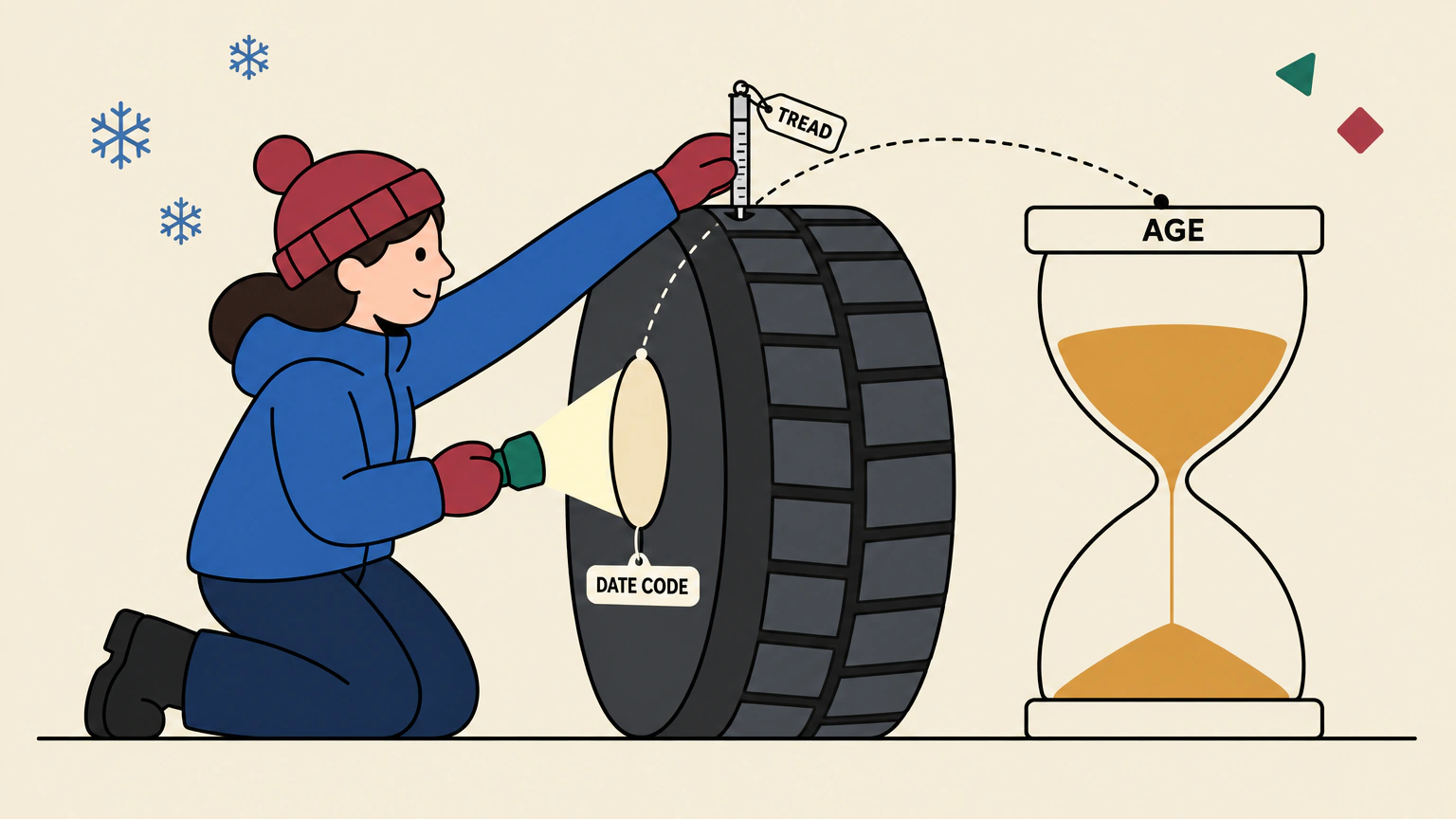
Winter tires last until the first of two clocks runs out. One is the tread: once it wears close to 4 mm, Transport Canada says it's too worn for snow. The other is age, which GM and Hyundai put at six years from the date code and Michelin at ten. On a set that only comes out for winter, the 4 mm line can arrive a couple of winters before the treadwear warranty's kilometres run out, because the warranty counts down to 1.6 mm.
On this page
Two clocks are running on every winter tire
The tread you can measure in millimetres. The age is moulded into the sidewall, and it keeps running while the tires sit in the garage all summer. Whichever clock runs out first ends the set.
It's tempting to squeeze out one more winter. In the Tire and Rubber Association of Canada's 2025 survey, 80% of drivers said they use winter tires, and 32% said cost made them less likely to buy a set that season. We'll start with age. It's the clock most people never read.
How old are your winter tires?
Every tire sold in Canada carries the date it was made. It's easy to miss, and how old is too old depends on who you ask: a carmaker, a tire maker or Transport Canada.
Reading the four digits on the sidewall
To read a tire date code, find the letters DOT on the sidewall. They start the tire identification number, and the date sits at the very end of it. Under the federal Motor Vehicle Tire Safety Regulations, those last four digits are the week and then the year the tire was made. Hyundai's owner's manual reads its example, 1526, as week 15 of 2026. Week 01 is the week that starts on the first Sunday of the year.
Only three digits at the end? Michelin's warranty manual dates that older format to tires made before August 2000, far past even Michelin's ten-year limit. Transport Canada's tire guide sums it up: "The four digit code identifies the date of fabrication."
Why the date might be on the other side
Blame the federal rules if you can't find it. They require the full code on one sidewall only, and Transport Canada's tire standard lets the other side carry a shorter version without the date. On tires made since September 1, 2009 with a marked outside face, the full code goes on that face. A tire with no marked outside face can carry the date on either side, so it may end up facing the car.
GM's manual says it plainly: "only one side may have the date of manufacture." Hyundai's says you may find it "on the inside of the wheel."
So check the other face while the tires are off the car, or ask the shop to read all four dates at the changeover.
Six years or ten: who says what
GM's manual recommends replacing tires, the spare included, after six years "regardless of tread wear." Hyundai Auto Canada's manual is firmer. Tires over six years old "must be replaced by new ones."
Michelin takes a different line. It says it's "impossible to predict when tires should be replaced based on their calendar age alone." Once a tire has been in use five years, Michelin wants a specialist to inspect it at least once a year, and it sets ten years from manufacture as the outer limit, spare included. For tires that came on a new car, Michelin says to follow the carmaker, "but not to exceed 10 years."
Transport Canada sets no age limit at all on its consumer tire pages. Yet Michelin's own winter-tire page credits a ten-year expiry to Transport Canada, and we didn't find that rule anywhere on Transport Canada's pages.
Your owner's manual comes first. If it says replace at six, we'd replace at six, however good the tread looks. Ten years is the hard stop for everyone.
Who puts an age limit on a tire
| Source | What it says about age | Where the clock starts |
|---|---|---|
| GM, 2025 Chevrolet Equinox owner's manual (U.S. and Canada edition) | Replace tires, the spare included, after six years, whatever the tread looks like. | The date code on the sidewall |
| Hyundai Auto Canada, 2026 owner's manual | Tires over six years old, the spare included, "must be replaced by new ones." | The date code on the sidewall |
| Michelin, replacement tire owner's manual | Once a tire has been in use five years, have a specialist inspect it at least once a year. | The day it went into service |
| Michelin, same manual | Replace any tire 10 years after it was made, even if it looks fine. For tires that came on a new car, follow the carmaker, up to 10 years. | The date code on the sidewall |
| Transport Canada, consumer tire pages | No age limit. Replace tires at the wear bars, or if they're cut, cracked or bulging. | No age rule |
Your own owner's manual sets the rule for your car. Look in its tire section for the word replace or the word inspect.
A brand new tire can already be a few years old
A tire sold as new isn't always new rubber. Quattro Tires, a Quebec online seller, says in its FAQ that it's "committed to provide you with tires that are more recent than 5 years," and that it can't give you the DOT code before the tires ship. Against a six-year rule counted from the date code, a tire that old on arrival has about a year left. Michelin's warranty clock, by contrast, starts at the date on your sales invoice.
Check the date before the tires go on. One Canadian online seller promises tires made within the past five years. A six-year rule counted from the date code could leave a tire like that about a year. Read the four digits when the tires arrive. That seller will help with a tire over six years old only if it hasn't been installed.
What old rubber looks like
On a car that doesn't go far, age can end a set before the tread does. Transport Canada says tires with "deep cuts, slits, cracks, blisters or bulges are potentially dangerous and should be replaced." Michelin's winter page adds that a winter tire over six years old may have hardened enough to lose its grip below 7 °C, even with tread left. So a deep reading on an old tire isn't a pass. If you're not sure, have a tire service shop look at the set before it goes on.
How much winter tread is left?
Depth is the clock you can check yourself. The catch is that five different lines get quoted for a worn winter tire, and they come from different people.
The depth that counts as worn for winter
Transport Canada's line is the one we'd use. "As a tire wears, it loses traction," its winter tire page says. "Don't use tires that are worn close to 4 mm (5/32) tread depth on snow covered roads."
Quebec's page says grooves "should not be less than 1.6 mm deep," and it recommends at least 4.8 mm in winter. British Columbia requires at least 3.5 mm for a winter tire on its signed routes. Kal Tire tells customers to replace winter tires once they're half worn. Some tires draw the line for you: Nokian's snowflake wear mark "remains visible until the groove depth is four millimetres."
The tread depths people quote for a worn winter tire
| Tread left | Who says so | What it means for your set |
|---|---|---|
| Half worn, which is 7/32 in. (about 5.6 mm) on a tire that starts at 12/32 in. | Kal Tire | A retailer's cautious line for braking on snow and ice. |
| 4.8 mm (about 6/32 in.) | Government of Quebec, recommended for winter | The margin to keep if you drive deep snow. |
| 4 mm (5/32 in.) | Transport Canada, and the point where Nokian's snowflake wear mark disappears | Don't use the tire on snow-covered roads below this. |
| 3.5 mm | British Columbia, the legal minimum for a winter tire on its signed routes | Below this, it doesn't count as a winter tire on those routes. |
| 1.6 mm (2/32 in.) | The built-in wear bars, Quebec's stated minimum and the end of Michelin's treadwear warranty | Bald for any season. Replace now. |
Inch figures are rounded conversions. Measure the shallowest groove, not the deepest.
That's our answer to when to replace winter tires: at 4 mm, or at 4.8 mm if you drive deep, unplowed snow. Quebec's quarter test makes the same point. If you can see the caribou's snout with the coin in a groove, the tire "will not grip well in deep snow." Thinking of one set for the whole year? Here's why a tire worn all year reaches these lines sooner.
Measuring it in five minutes
A tread depth gauge is the right tool. Push it into the shallowest groove and read it at three spots around each tire. Quebec's advice: "Check several grooves in different locations for tire wear." Include the inside edge, which can wear out of sight when the alignment is off.
The toonie and quarter checks are rough screens, good for deciding whether to measure but not for a call at 4.5 mm. Some winter tires print depth numbers in the tread, and Nokian's show the groove depth in millimetres. If readings differ a lot between tires, or across one tire, ask a shop to check the alignment and pressures.
Why warranty kilometres overstate your winters
Michelin's own page on how long winter tires last uses a 70,000 km warranty and 10,000 km a winter. It says six years, though those numbers divide to seven.
The bigger problem is where the warranty stops counting. Michelin's warranty manual counts tread down "to the level of the treadwear indicators, which is 2/32nds of an inch (1.6 mm)." That's well past the 4 mm winter line. Take Michelin's X-Ice Snow, which carries a 60,000 km warranty on an average 10/32 in. of new tread.
How far a winter tire's warranty kilometres really get you
| Stop at | Tread above that line | Share of the warranted tread | Kilometres to the line, if wear is even | Winters at 10,000 km a winter |
|---|---|---|---|---|
| 1.6 mm, where the warranty ends | 6.34 mm | 100% | 60,000 | 6.0 |
| 3.5 mm, BC's legal minimum | 4.44 mm | 70% | about 42,000 | 4.2 |
| 4 mm, Transport Canada's winter line | 3.94 mm | 62% | about 37,000 | 3.7 |
| 4.8 mm, Quebec's recommendation | 3.14 mm | 50% | about 30,000 | 3.0 |
Example tire: Michelin's X-Ice Snow, listed at an average 10/32 in. (about 7.94 mm) of new tread with a 60,000 km treadwear warranty that counts wear down to 1.6 mm. The kilometres assume the tread wears at an even rate. The 10,000 km a winter is Michelin's own example figure, so put in your own.
Only about 62% of that warranted tread sits above 4 mm. At 10,000 km a winter, that's about 37,000 km, or roughly 3.7 winters, to Transport Canada's line. By the warranty, it's 6. Quebec's 4.8 mm comes at about three. Your own odometer is the better guide, so note the reading at each changeover.
Two conditions decide whether the warranty helps at all. Michelin's winter tires must be used only between September 1 and April 30, with the install and removal dates documented each winter. They must be rotated every 10,000 to 12,000 km, or sooner if the carmaker says so. Michelin's replacement-tire warranty also ends six years after purchase or at the wear bars, whichever comes first.
What wears a winter set out early
Three habits take winters off a set, and all three are cheap to fix.
Leaving them on through the summer
Winter rubber is built to stay soft in the cold. Transport Canada puts the turning point at 7 °C, below which all-season tires lose elasticity and winter tires keep theirs. In summer heat, that soft tread wears fast. Continental says running winter tires in warm weather "can reduce their lifespan by up to 60% due to faster tread wear," and that's a ceiling, not a typical loss. Summer driving can also cost you Michelin's winter treadwear cover, which requires winter-only use. Our changeover guide covers when to swap back in spring.
Storing them where the rubber ages
Transport Canada's storage advice is specific. Tires "should be stored upright in a clean indoor location, free from exposure to sunlight or strong artificial light, heat, ozone (electrical motors) and hydrocarbons," which means fuel, oil and solvents. If they're on rims, let them down to about 103 kPa (15 psi) "to avoid possible cracking and deformation," then pump them back up to the door-label pressure before the first drive.
Michelin's winter page differs on one point: mounted tires can be stacked or hung, it says, and only loose tires should stand upright. Either way, storage doesn't stop the age clock. Our tire service page gives a budget estimate of CA$80 to $200 for four tires stored at a shop for one season.
Skipping rotations
Front and rear tires usually wear differently. Transport Canada says a set lasts longer if you rotate it on the carmaker's schedule, with about every 10,000 km as common practice. The deepest tread goes on the rear. Our tire service page gives a budget estimate of CA$30 to $50 for a rotation, and it's easy to ask for one at the changeover.
Keep, inspect or replace: the check before they go back on
Run through this list with the set on the garage floor, before anyone bolts it on.
Before the set goes back on the car
- Find the four-digit date code on each tire. If the side facing you has none, check the other sidewall.
- Work out each tire's age. The first two digits are the week, and the last two are the year.
- Read the tire section of your owner's manual. Note whether its age rule says replace or inspect.
- Measure the tread with a gauge in the shallowest groove, at three spots around each tire, inside edge included.
- Compare your lowest reading with 4 mm. Use 4.8 mm if you want Quebec's margin for deep snow.
- Look into the grooves and along both sidewalls for cracks, cuts and bulges. Any of these means a tire shop looks before you drive.
- If the tires have been in use five years or more, have a tire shop inspect them this season and every year after.
- Bring stored tires back up to the pressure on the driver's door label before the first drive.
If the set fails, our tire stores page gives a budget estimate of CA$500 to $950 for four fitted 205/55R16 winter tires, wheels and sensors extra. Start with tire stores near you, and see what a new winter set costs by size.
Questions drivers ask about winter tire life
Do winter tires expire?
There's no printed expiry date, but there is a birth date. The last four digits of the code on the sidewall are the week and year the tire was made, and the age rules count from there. GM's and Hyundai Auto Canada's manuals say six years, and Michelin sets ten as its outer limit. Transport Canada's consumer tire pages set none.
Are 10-year-old winter tires safe if the tread looks good?
No, by every rule we found. Michelin says tires 10 years or more past their manufacture date should be replaced "even if such tires appear serviceable," spare included. The six-year line in GM's and Hyundai's manuals passed four years earlier. Rubber hardens with age, so deep tread on an old tire grips less than it looks.
How long do winter tires last in storage?
Storage slows the damage, but it doesn't stop the clock, because age counts from the date code, not the kilometres. Transport Canada says to store tires upright indoors, away from sunlight, heat, electric motors and fuel or solvents, at about 103 kPa if they're on rims. Once they've been in use five years, Michelin wants them inspected every year.
How many kilometres do winter tires last in Canada?
It depends on the tire and on which line you stop at. Michelin's X-Ice Snow carries a 60,000 km treadwear warranty counted down to 1.6 mm. If the tread wears evenly, that works out to about 37,000 km to Transport Canada's 4 mm winter line. Note your odometer at each changeover and you'll know your own number.
Can I leave winter tires on all year to use them up?
You can, but you'll use them up faster than you think. Continental says warm-weather driving can cut a winter tire's life by up to 60%. Michelin's winter treadwear warranty covers only use between September 1 and April 30, with the dates documented. If one set all year is the goal, that's what all-weather tires are for.
Do I have to replace all four winter tires at once?
Replacing all four is best. Transport Canada says to install winter tires in sets of four, with the same type, size, speed rating and load index on all four, and the deepest tread on the rear. If one tire on a nearly new set is damaged, ask the shop whether a matching tire is still available. Our guide to matching the load and speed rating on a replacement set explains the codes.
Before the changeover, read the four digits and measure the shallowest groove on each tire. Take both numbers with you, and anything a tire service shop tells you about the set becomes something you can check.