
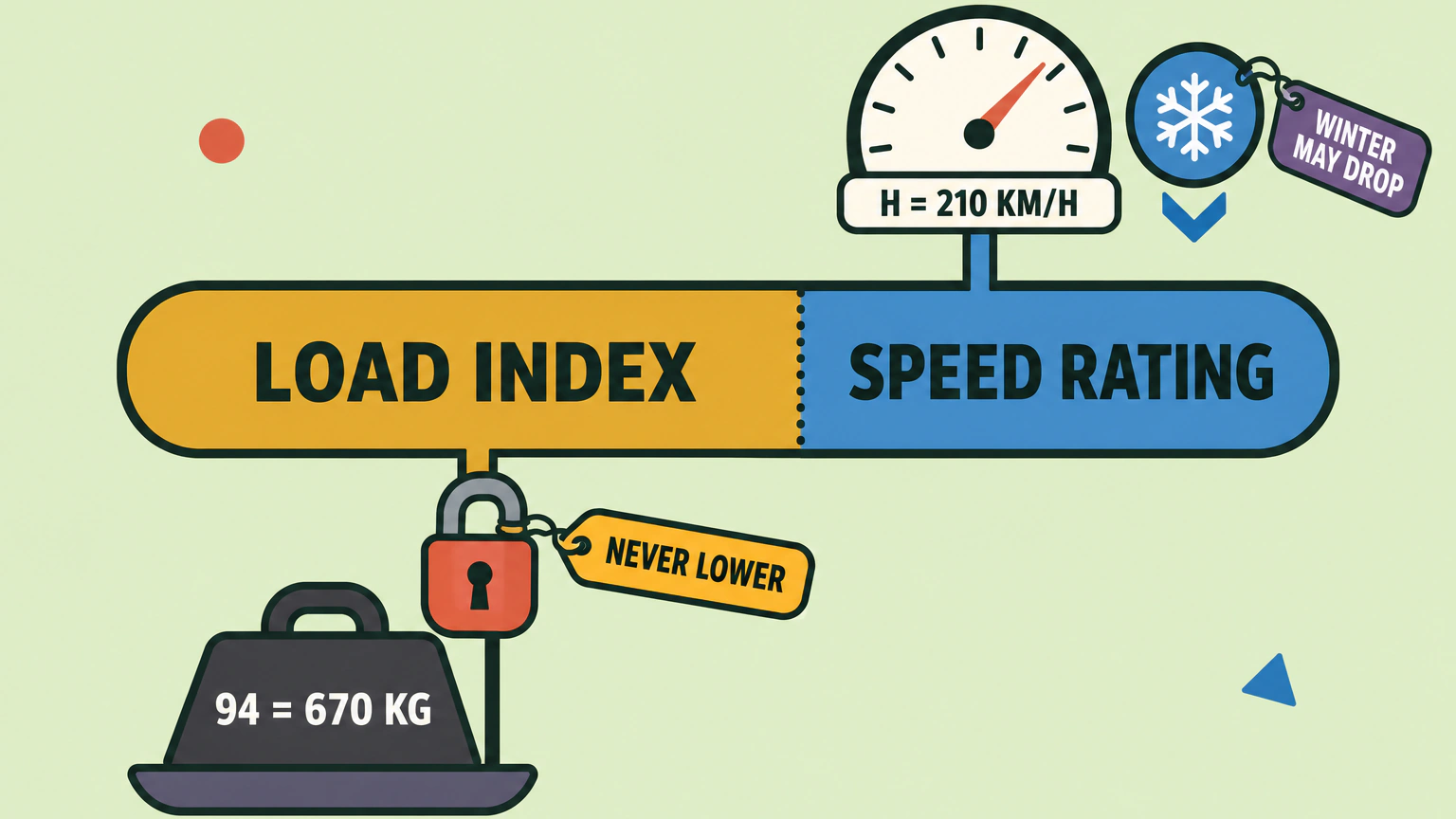
A tire's speed rating is the last letter in the code on its sidewall, and it's the fastest that tire is built to run: T is 190 km/h, H is 210, V is 240. Winter tires can carry a lower letter than the tires your car came with, as long as you stay under it. But the number in front of the letter, the load index, should never drop.
On this page
What the letter on your tire means in km/h
Take a code like 215/60R16 95H. The 215/60R16 is the size. The 95 is the load index, which means each tire can carry up to 690 kg. The H is the speed rating.
UN Regulation No. 30, the international tire regulation these letters come from, defines the speed category as the maximum speed the tire can sustain. Its scale runs from L at 120 km/h to Y at 300 km/h.
That's a laboratory limit, not an invitation. The Automobile Protection Association says the letter holds "assuming that it is in good condition and inflated to the pressure recommended by the manufacturer of the car it is installed on." The APA adds that in North America you're unlikely to ever reach it, and that the letter is also a rough guide to how the tire handles.
Tire speed ratings in km/h
| Speed rating | Top speed |
|---|---|
| L | 120 km/h |
| M | 130 km/h |
| N | 140 km/h |
| P | 150 km/h |
| Q | 160 km/h |
| R | 170 km/h |
| S | 180 km/h |
| T | 190 km/h |
| U | 200 km/h |
| H | 210 km/h |
| V | 240 km/h |
| W | 270 km/h |
| Y | 300 km/h |
Why H comes after U, and what ZR means
The scale isn't alphabetical. H is 210 km/h and sits between U at 200 and V at 240, a holdover BFGoodrich traces to the "common perception that H stood for 'high performance'" at one time. So compare letters by their km/h, never by the alphabet. H beats T. V beats H.
The fastest tires carry extra marks. On a tire rated above 240 km/h, meaning W or Y, the R in the size may read ZR. A code in brackets, such as (95Y), means the tire is rated above 300 km/h.
At the slow end sits the compact spare. Kal Tire notes that a temporary spare is rated M or N, 130 or 140 km/h, and its advice is blunt: "you have to drive for the donut, not the other three."
Where to find the rating your car came with
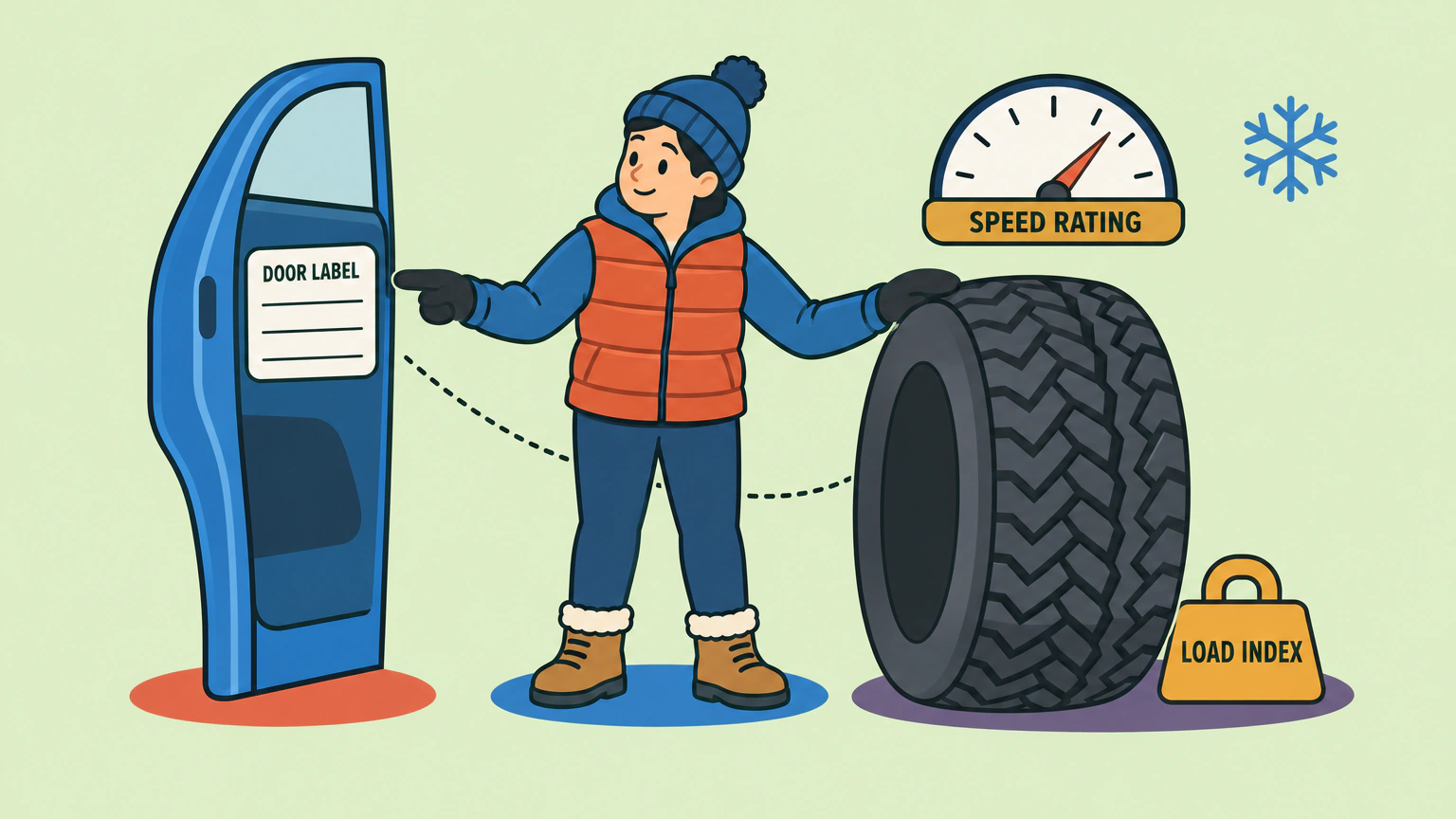
Look in three places: the sidewall of the tires the car was delivered on, the owner's manual, and sometimes the tire label on the driver's door edge or door post.
"Sometimes" is the point. Transport Canada's standard for that label, Technical Standards Document 110, makes the tire size and the recommended cold tire pressure mandatory. It lets the carmaker add the load index and speed rating "at the manufacturer's option." Michelin Canada's guide lists the door placard as one place to find the speed rating, and on your car it may not be there. If the label shows only a size, the owner's manual or the original tires have the rest.
Pro tip: The kilograms are printed on the tire. You don't need a chart to check how much a tire carries. Canadian rules make every passenger tire show its maximum load in kilograms on the sidewall, in small print between the widest part of the tire and the rim. Find that line on your old tire and on the new one, and compare the two numbers directly.
What Canada's tire rules test, and what they leave out
Every new tire sold in Canada has to meet the Motor Vehicle Tire Safety Regulations. Transport Canada says the maple leaf symbol on the sidewall "means the manufacturer certifies that the tire meets Transport Canada requirements."
The standard behind that mark for radial tires on cars, SUVs and light trucks is TSD 139. It runs a tire on a test drum for ninety minutes at 85 per cent of its maximum load, in three half-hour stages at 140, 150 and 160 km/h.
Then the standard lists what must be moulded on the sidewall. The size is on that list, along with the maximum pressure and the maximum load. The speed rating isn't, and the standard never mentions it at all. The letter is the tire maker's own rating under the international scheme, UN Regulation No. 30.
Q, the lowest letter the Automobile Protection Association and Kal Tire name for winter tires, is 160 km/h. That's the top speed of the federal test, and every tire under that standard faces it, whatever letter is moulded on the side.
The number in front of the letter matters more
The load index is how much weight one tire may carry. A 91 carries up to 615 kg and a 94 carries up to 670 kg, so three steps down the scale is 55 kg less on every corner.
Load index: what each tire carries
| Load index | Each tire carries up to |
|---|---|
| 88 | 560 kg |
| 91 | 615 kg |
| 94 | 670 kg |
| 95 | 690 kg |
| 96 | 710 kg |
| 97 | 730 kg |
| 98 | 750 kg |
| 99 | 775 kg |
| 100 | 800 kg |
| 103 | 875 kg |
| 105 | 925 kg |
| 110 | 1,060 kg |
That number isn't negotiable, because the car was certified around it. Under TSD 110, the carmaker has to fit tires whose marked load ratings cover the weight each tire carries, axle by axle on SUVs and trucks. That's a duty on the carmaker, not a rule you'd be ticketed under. It's still why the original number is a floor.
The manuals agree. We read six, and four ask for the same load as the original tires. None says a lower one is acceptable. The Automobile Protection Association puts it in one line: "Never install tires that have a lower index than that noted in the owner's manual."
Heavier vehicles often come on extra-load tires, marked XL, which Michelin Canada says are reinforced to carry more weight at higher pressures. Electric cars make the point sharply. A heavy EV can need more load capacity than a gas car of the same size, so a winter tire with the right size and the right letter can still be the wrong tire.
Ontario's safety inspection standard, the one behind a safety standards certificate, rejects a tire rated to carry less than the carmaker specified. It has no line about speed rating at all. So when a used car goes through an inspection station in Ontario, the number gets checked and the letter doesn't. If you're bringing a car in from another province, here's what a provincial inspection looks at.
Red flag: A lower number in front of the letter. If the tire on your quote has a lower load index than the tire your car came with, that's the line to stop at. A cheaper tire in the same size sometimes carries less. Ontario's safety inspection rejects a tire with "a lower load rating / capacity than specified by the vehicle manufacturer". Ask for the same size at your original number or higher.
A higher load index is fine, and it buys you nothing
Going up is allowed. Michelin Canada says a tire with a higher load rating is permitted, and that it "does not increase the vehicle's allowable load." Your limit stays where the door label puts it, in the line that begins "The combined weight of occupants and cargo should never exceed."
So a 98 where the car came with a 94 is acceptable. It just isn't an upgrade worth paying extra for on its own.
To check your own two codes, put the original and the quoted tire side by side and let the comparison do the subtraction.
Can winter tires have a lower speed rating?
Yes, and the people who sell tires don't agree on how far. Kal Tire says the only time a downgrade is OK is on winter tires, "where a 'Q' rating is acceptable." Yokohama Canada "recommends using winter tires with the same or higher speed rating." CAA-Quebec allows a lower one and says to "stick as close as possible to the original rating."
Most of those voices sell tires. Going up a letter is always allowed, and it's rarely needed. BFGoodrich itself says a higher rating typically trades tread life for grip.
The documents that bind you are the owner's manuals.
What six owner's manuals say about winter tires
| Manual | On size and load | On speed with winter tires |
|---|---|---|
| Chevrolet Equinox, 2025 (GM, U.S. and Canada edition) | "Use only radial ply tires of the same size, load range, and speed rating as the original equipment tires." | "If winter tires with a lower speed rating are chosen, never exceed the tire's maximum speed capability." |
| Nissan Rogue, 2025 | "select tires equivalent in size and load rating to the original equipment tires" | "Generally, snow tires will have lower speed ratings than factory equipped tires and may not match the potential maximum vehicle speed. Never exceed the maximum speed rating of the tire." |
| Toyota RAV4 (U.S. and Canada edition) | "Use tires of the specified size." | "Do not drive in excess of 75 mph (120 km/h), regardless of the type of snow tires being used." |
| Mazda CX-50, 2025 (mazda.ca) | "use tires of the specified size" | "Do not go faster than 120 km/h (75 mph) while driving with snow tires." |
| Hyundai, 2026 online manual (Canadian edition) | "they should be the same size and have the same load capacity as the original tires" | "Do not drive faster than 120 km/h (75 mph) when your vehicle is equipped with snow tires." |
| Honda CR-V, 2025 (American Honda online edition) | "Select the size and load ranges that are the same as the original tires." | Nothing about a speed rating or a speed limit |
Side by side, the six manuals sort neatly. Three of them cap snow tires at 120 km/h, whatever letter they carry. Two expect a lower letter and tell you never to exceed it. One sets no speed rule for winter tires at all. Even Q is 160 km/h, 40 km/h above that cap.
Transport Canada's own winter tire advice adds one more rule: install them "in sets of 4," with "the same type, size, speed rating and load index" on all four wheels. Once the code on your quote checks out, you can work out what a set of four winter tires costs.
Why a lower letter can be the better snow tire
The Automobile Protection Association, which publishes winter tire recommendations for Canadian drivers, says the "best snow tires for really bad weather are Q, R, S, or sometimes T-rated." A winter tire rated H or higher, it says, "is likely more responsive when road conditions are good, but has a tread design that will not bite as well in deep snow." And winter tires for touring cars and SUVs "are seldom rated higher than a T."
GM's manual makes the same point from the other side. Winter tires in the original rating "may not be available for H, V, W, Y, and ZR speed rated tires."
A sidewall that flexes a little is part of how a winter tire finds grip in snow. So for most cars, a T-rated winter tire is the normal product, not a compromise.
What you give up when you drop a letter
Handling on a dry road, mostly. Kal Tire's own braking test is the one hard number in this argument. From 100 km/h, an S-rated tire took 39 metres to stop and a V-rated tire took 35. When the V-rated tire stopped, the S-rated one "was still going almost 25 km/hr." That 4-metre gap spans several letters on one retailer's test, with no published method, so read it as the shape of the trade rather than a law of nature.
CAA-Quebec explains why: the sidewalls of an S-rated tire "are not as stiff as those of an H- or a V-rated tire." For a powerful rear-drive or all-wheel-drive car, the APA's advice is to step down from V or W summer tires to an H-rated winter tire, which it calls "a good compromise."
The shop owes you one sentence, too. Michelin Canada says "The customer must be informed of the new speed restriction." Ask a tire shop that mounts and balances to write the new top speed in km/h on your invoice.
When a lower speed rating is a bad idea
On any tire that isn't winter-capable. Transport Canada's general tire-care guide says new tires "should be the same size, and have the same load capacity and speed rating as the original tires." That page makes no exception for winter tires. Michelin Canada says a lower rating "is not advised unless they are winter-capable," meaning winter or all-season tires with the mountain and snowflake emblem. Before you lean on that emblem, read what the mountain and snowflake symbol proves. Kal Tire's reason is heat: lower-rated tires "flex and squirm under pressure, causing heat-build up."
Mixing is the second bad idea. With two ratings on the car, your top speed is the lower one, and Michelin Canada says the lower-rated pair goes on the front axle.
Then there's the legal picture. We read the federal tire standards, Ontario's safety inspection standard and Quebec's winter tire requirement. None of them sets a minimum speed rating. Quebec's rule turns on the winter pictogram or studs, not the letter. That's what those three rule sets say, not a promise about every rule in Canada.
Insurance is the open question. Michelin Canada's own pages disagree with each other about lower letters, but one of them warns that tires rated below spec "may affect your insurance coverage in the event of an accident." Take that as a reason to ask your insurer before you run a lower letter year-round.
We're not your carmaker, and your owner's manual outranks any chart, ours included. If it sets a rule for winter tires, follow it.
What to check on the quote before you pay
A good quote prints the full code for every tire, not just the size. You now know which half of that code is fixed and which half can move.
Six things to check on a tire quote
- The quote prints the whole code for each tire: the size, then the load index, then the speed letter.
- The load index matches the tire your car came with, or it's higher. The door label, the owner's manual or the old tire will tell you the original.
- If the speed letter is lower than the original, the tires are winter or all-season tires with the mountain and snowflake symbol, and you know the new top speed in km/h.
- All four tires carry the same load index and the same speed letter.
- You've read the winter tire page of your owner's manual. If it sets a speed limit for snow tires, that limit is yours.
- If you plan to run a lower letter all year, you've asked your insurer first and kept the answer in writing.
Next, take a photo of your door label and of the code on an old tire. Bring both, with the quote, to one of the tire stores near you, and ask for the full code on the invoice. Once the codes match, the last number to check is what the changeover itself costs.
Questions drivers ask about speed ratings
The short versions, for when you're at the counter with a quote in one hand and your phone in the other.
What does 92H mean on a tire?
It's the tire's service description. The 92 is the load index, which means each tire can carry up to 630 kg. The H is the speed rating, which means the tire is built for speeds up to 210 km/h. You'll find the pair right after the size, as in 205/65R15 92H.
What does speed rating H mean?
H means the tire is rated for 210 km/h. It sits out of alphabetical order, between U at 200 km/h and V at 240 km/h. So H is higher than T, which is 190 km/h, and lower than V. Compare letters by their speed, never by their place in the alphabet.
Is a higher speed rating better?
Not automatically. BFGoodrich says a higher rating usually brings better grip and stopping power and a shorter tread life. For deep snow, the Automobile Protection Association prefers lower-rated winter tires, Q to T. Match what your car came with, and don't pay for letters above it unless you want sharper handling.
Can you mix tire speed ratings?
You shouldn't. Transport Canada says to fit tires of the same type, size, speed rating and load index on all four wheels. If you end up with a mixed set, your top speed is the lowest-rated tire's, and Michelin says the lower-rated pair belongs on the front axle.
Do winter tires have a lower speed rating?
Usually, yes. The Automobile Protection Association says winter tires for touring cars and SUVs are seldom rated higher than T, which is 190 km/h. GM and Nissan say as much in their manuals and tell owners to stay under the winter tire's rated speed. Toyota, Mazda and Hyundai set a flat 120 km/h limit on snow tires.
Does a tire's speed rating affect insurance?
We couldn't find a Canadian insurer or regulator that sets a speed rating rule. Michelin Canada warns that tires rated below your car's specification "may affect your insurance coverage in the event of an accident". If you plan to run a lower letter on tires without the mountain and snowflake symbol, ask your insurer first and keep the reply.
What happens if you exceed a tire's speed rating?
The tire runs hotter than it was built for. Michelin Canada says exceeding a tire's load or speed limits "can generate excessive heat, which may affect durability and increase the risk of tire damage". A soft or overloaded tire gets there sooner, so the letter only holds for a sound tire at the right pressure.