

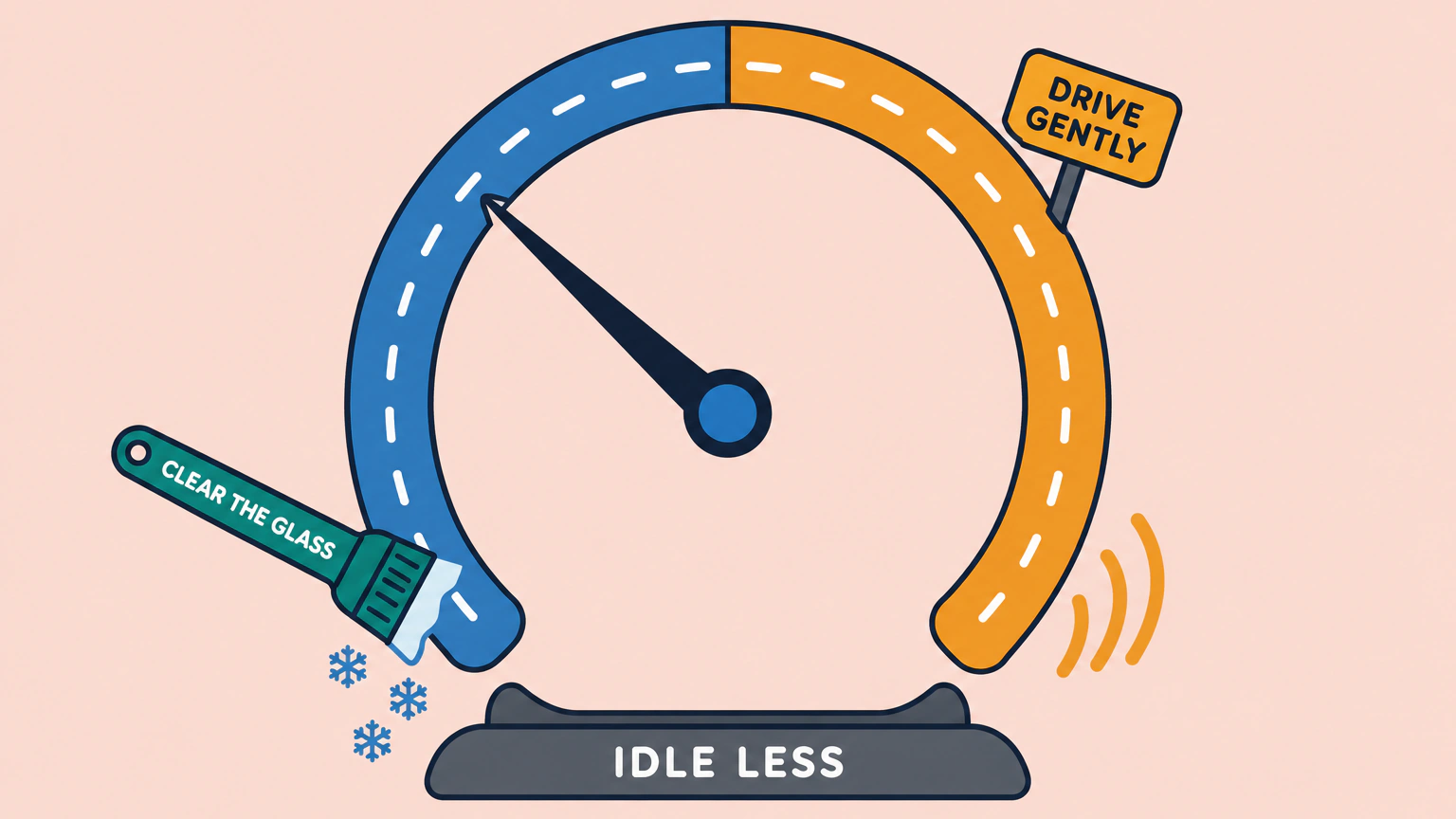
Thirty seconds is enough for most modern cars. Natural Resources Canada says idling any longer does nothing for the vehicle, and that a few minutes of driving is the most efficient way to warm the engine. Driving also warms the transmission, wheel bearings and tires. The part that can take longer is clearing your windows. How long your city lets you idle while you do it runs from one minute in any hour in Toronto to no limit at all for cars in Calgary. We read the rules in nine Canadian cities, and the gaps between them are bigger than you'd guess.
On this page
- What your engine actually needs on a cold morning
- The windows are the warm-up the law cares about
- How long your city lets you idle
- Leaving the car running while you're inside
- Electric cars and hybrids warm up differently
- Common questions about warming up a car in winter
- Before you head out tomorrow morning
What your engine actually needs on a cold morning
Three different things get called "warming up." There's the engine. There's everything the engine drives, from the transmission to the tires. And there's the glass you have to see through. Each one needs something different. Clearing the glass can take longer than the engine needs.
Thirty seconds, then drive off gently
Natural Resources Canada (NRCan) is blunt about it. Idling for more than 30 seconds "has no benefit for the vehicle," and "Driving for a few minutes is the most efficient way to warm the engine, drivetrain and the cabin." NRCan's guidance for municipalities goes a step further. After about 30 seconds from a cold start, it says, idling to warm up the engine pollutes more than simply driving away.
The City of Edmonton is a little looser. It suggests cutting warm-up idling to 60 seconds, as long as your windows are clear before you leave. The two agree on the point that matters. A minute, not ten.
The habit isn't free, either. NRCan puts ten minutes of idling at 0.25 to 0.50 litres of fuel. GM's 2025 Equinox manual, the edition GM publishes for both the U.S. and Canada, says it plainly: "Avoid idling the engine for long periods of time." In very low temperatures, its Cold Weather Mode can change engine speed, shift patterns and fan speed "to enable the vehicle to warm up quicker." We'd give it 30 seconds, buckle up and go.
Driving warms more than the engine
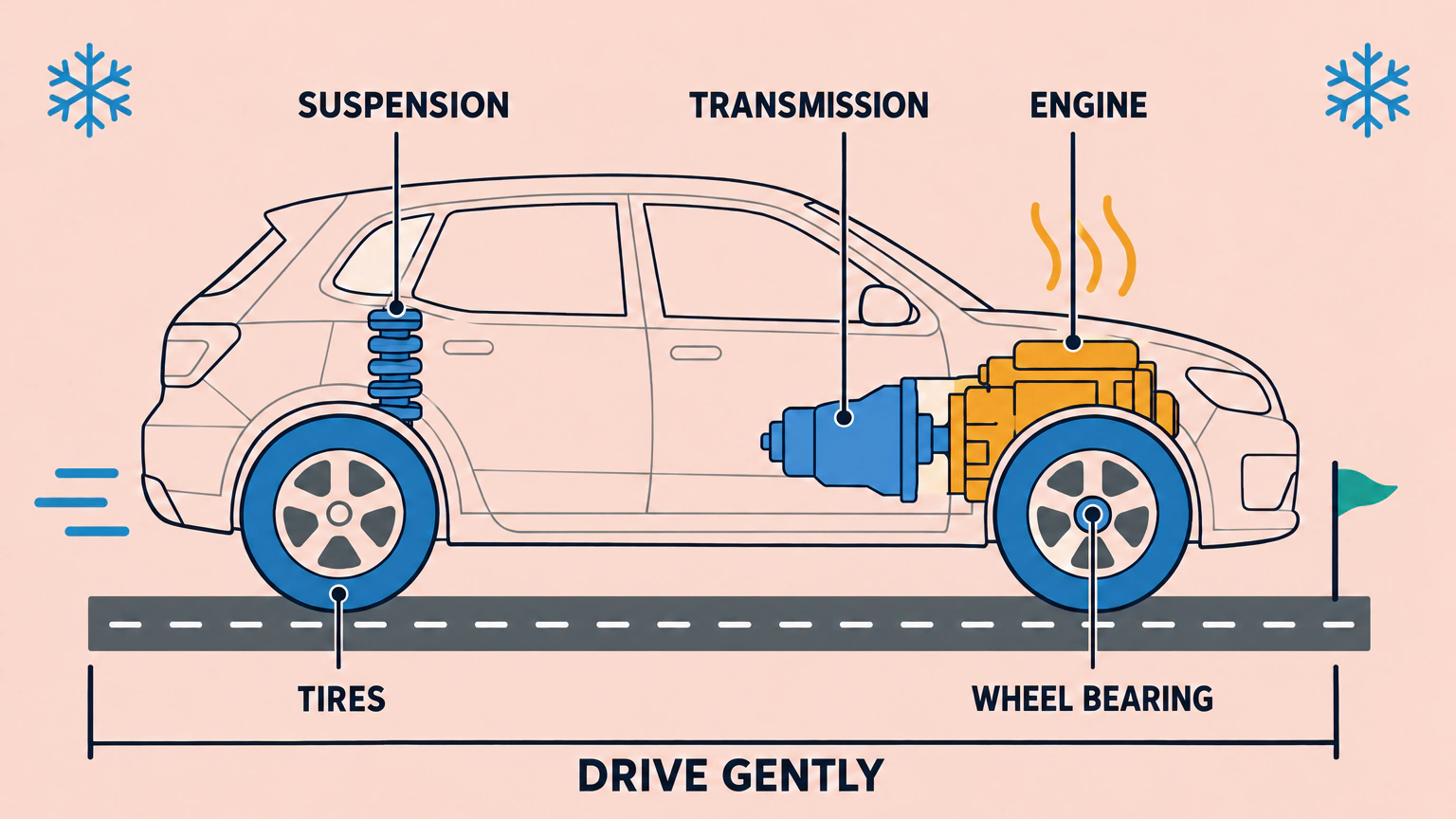
Gentle driving warms the engine and drivetrain together. Wheel bearings and tires also warm as the car rolls.
GM's Cold Weather Mode can change the transmission's shift patterns while the car warms up. The first few kilometres are the real warm-up. Keep the throttle gentle, skip the hard launches, and if you can, give the car a few minutes on side streets before you merge onto the highway.
When a couple of minutes makes sense
There are real exceptions, and "it's cold out" isn't one of them.
In deep cold, a block heater warms the engine before you start it. NRCan says to put it on a timer that comes on no more than two hours before you start the engine. We've looked at whether you need a block heater, and what it costs to run on its own page.
Diesels are different. NRCan's municipal guidance says most diesel vehicles "need a few minutes to warm up the engine" at the start of a shift. Quebec City gives heavy diesels more idling time than cars. Montreal's diesel limits vary by borough. If your owner's manual gives a specific cold-start instruction, it beats any general advice, ours included. Go by the one for your car. And if the engine runs rough until it's warm, that's a fault for a mechanic, not a warm-up question.
One habit to drop: starting a cold engine just to move the car a few metres. Shutting it off before it warms can flood the engine.
The windows are the warm-up the law cares about
Almost everyone does this. You start the car, go back inside for another coffee, and come out to clear glass. The engine didn't need that. The windshield might have.
Ontario's Highway Traffic Act says you can't drive unless the windshield and front side windows give you "a clear view to the front and side," and the rear window a clear view behind (unless your mirrors do that job). Quebec's Highway Safety Code says the windows "must be free of any material that might reduce visibility for the driver." It also lets a police officer order you to clear them. A peephole scraped in the frost won't pass either test.
That's the one honest reason to idle, and bylaws say so in writing. Mississauga's and Brampton's both allow "reasonable Idling" to get the clear view the Highway Traffic Act asks for. Montreal allows idling for frost and glazed frost "for the time it takes to make the vehicle safe to drive." Toronto has no specific window-clearing exception. It does exempt vehicles forced to stay still by weather conditions beyond the driver's control.
So brush and scrape while it runs, and turn on the defroster. NRCan notes that on newer vehicles, the defrost setting automatically uses the air conditioning to keep the windows from fogging. CAA adds that clearing snow and ice off the car is the law in some provinces.
Before you pull out on a cold morning
- Brush the snow off the whole car and scrape every window, not just a hole in the windshield.
- Check that snow isn't packed around the tailpipe before you start the engine.
- Start it and give it about 30 seconds while you buckle up.
- Run the defroster, which on newer cars uses the air conditioning to dry the inside of the glass.
- Drive gently for the first few kilometres, because that's when the rest of the car warms up.
- If you use a remote starter, set the shortest run time it allows and keep the doors locked.
How long your city lets you idle
Idling limits in Canada are city bylaws, so the answer changes when you cross a city line. Toronto and Mississauga share a border and differ by two minutes. We took each city's limit for an ordinary parked car from its own bylaw or bylaw page. Bylaws change, and each city words its exceptions its own way, so read your own city's rule before you count on one.
Idling limits in nine Canadian cities
| City | How long a parked car may idle | Cold-weather allowance | The rule |
|---|---|---|---|
| Toronto | 1 minute in any 60-minute period | No general temperature allowance. Weather-forced stops beyond the driver's control and certified medical needs are exempt | Municipal Code Chapter 517 |
| Ottawa | 3 minutes per hour with someone inside, 1 minute per hour if the car is empty | Up to 10 minutes per hour for an occupied car below 0°C or above 27°C, humidex included | Idling Control By-law, in force since January 1, 2025 |
| Mississauga | 3 minutes in a row | None for cars. Public transit vehicles have one | Idling Control By-law 0194-2009 |
| Brampton | 3 minutes in a row, on roads and on private property | None for cars. Public transit vehicles have one | Idling Control By-law 133-2011 |
| Montreal | 3 minutes per 60-minute period for a gasoline engine | Below -10°C with someone aboard and the heat on, and while frost or glazed frost is cleared | City rules for all 19 boroughs |
| Quebec City | 3 minutes per 60-minute period | None for cars. Taxis with someone aboard, November to March | Regulation R.A.V.Q. 337 |
| Vancouver | 3 minutes in a row in any 60-minute period, and never while unattended and unlocked | None | By-law No. 9344, section 2.7 |
| Edmonton | 5 minutes in any 30, only in posted no-idling zones at participating schools and hospitals | Below 0°C, only for safe operation and clear windows. Minimum window-defogging time is also exempt | Community Standards Bylaw 14600 |
| Calgary | No car limit. Trucks with registered maximum weights over 5,450 kg have a 20-minute limit in or within 150 m of residential developments. Concrete mixers and garbage trucks are excluded | No car limit to relax | Community Standards Bylaw |
Limits shown are for an ordinary parked car. All eight rules that limit cars also exempt emergency vehicles.
Edmonton and Calgary look easygoing for a reason. Edmonton's five-minute limit only covers posted no-idling zones at participating schools and hospitals. Below 0°C, an exception allows idling for safe operation and clear windows. Calgary's truck limit starts above a registered maximum weight of 5,450 kg. If you live somewhere else, search your city's name plus "idling bylaw."
Toronto has the strictest rule we found
Toronto's Municipal Code Chapter 517 says no one may let a vehicle idle "for more than one minute in a sixty-minute period." There's no temperature exception for an ordinary car. The medical exemption covers a person aboard whose doctor certifies in writing that they need a set temperature or humidity. (Mississauga, Brampton and Ottawa have a version of that one too.)
How the rule gets enforced is the honest part. A February 2025 staff report to council says the bylaw applies on public and private property. Enforcement runs on complaints to 311, and the first step is a warning letter mailed to the address linked to the vehicle. In 2023 the city logged 737 complaints, sent 716 warnings and issued no tickets at all.
The ceiling is high, though. Since September 2026 the chapter allows a fine of up to $100,000 on conviction. Toronto's February 2025 report put its biggest fine at $2,500, back in 2002.
Ottawa makes a useful contrast. Its bylaw, in force since January 1, 2025, allows three minutes an hour with someone in the car. That stretches to ten minutes an hour below 0°C or above 27°C, humidex included. An empty car gets one minute an hour at any temperature. Council passed the new rules 15 to 8 after keeping the three-minute limit instead of tightening it to one.
Does a remote start count as idling?
Yes, under every definition we read. Toronto defines idling as running the engine while the vehicle is "not in motion." Mississauga and Brampton say "not moving forward or in reverse," and Montreal limits how long a vehicle can stop "with the engine running." It makes no difference if you're in the driver's seat or the kitchen.
Your driveway counts too, in the three cities that spell out private property: Toronto (in its council report), Brampton and Quebec City. Brampton's 311 page says flatly that "idling to warm up a vehicle in the winter" isn't an exception. In Ottawa, an empty car warming up on a remote start gets the one-minute limit, not the ten-minute cold allowance.
GM's manual warns that local laws may restrict remote starters, and that "some laws require a person using remote start to have the vehicle in view." Edmonton's advice is to skip the remote starter altogether when it's warmer than -10°C. If you want a shorter run time, or a starter that won't let anyone drive off without the key, talk to a shop that installs and programs remote starters.
Pro tip: Check how long your remote start runs. GM's manual for the 2025 Chevrolet Equinox says a remote start shuts the engine off after 15 minutes, and one extension takes it to 30. Toronto, Brampton and Quebec City apply their limits on private property, so a full cycle in your driveway is several times what they allow. If your system lets you shorten the run, set it to the minimum.
Leaving the car running while you're inside
Even where no bylaw reaches your driveway, two things can go wrong while the car warms up without you. Someone drives off in it, or its exhaust ends up in your house.
A running car is an easy car to steal
Calgary police say running-car thefts climb when the weather turns cold. "It only takes seconds," Sgt. Nick Wilsher said when Operation Cold Start launched in January 2024. The police advice is simple: stay with the car or use a remote starter, never leave a key or a spare inside, and keep it locked.
Two provinces put part of that into law. Quebec's Highway Safety Code says no one may leave a vehicle unattended "without previously removing the ignition key and locking the doors." That applies on public roads, shopping-centre lots and other land open to public traffic. Your own driveway isn't on the list. B.C.'s Motor Vehicle Act says a driver can't leave a vehicle standing unattended on a road unless it's locked or secured so nobody else can use it. Vancouver's bylaw separately bans idling "while unattended and unlocked."
Red flag: The warm-up theft. Calgary police counted 114 vehicles stolen while they were left running in ten weeks of the 2023 to 2024 winter. A car that's running with the key or fob inside can be gone in seconds. Stay with it while it warms up, or use a remote starter that won't let anyone drive away without the key.
Never in the garage, even with the door open
GM's manual leaves no room here: "Never park the vehicle with the engine running in an enclosed area such as a garage or a building that has no fresh air ventilation." Quebec's health ministry goes further. Its carbon monoxide leaflet says never to leave a gas-powered vehicle running "in the garage or temporary shelter even if the door to the garage or shelter is open." Then it adds: "Even running it intermittently can pose a health risk." That temporary shelter is the fabric car shelter so many Quebec homes put up for the winter.
Snow is the other trap. GM warns that exhaust can get into the car when it idles in deep snow that blocks the tailpipe. Both GM and the ministry say to clear the snow away first. Health Canada's attached-garage study explains why the house is at risk too: garage pollutants "can enter homes through doors or cracks in the wall." In Ontario, the Fire Code requires a working carbon monoxide alarm in every home with an attached garage.
Electric cars and hybrids warm up differently
An electric car has no engine to warm, so the question shifts from idling to range. CAA's advice is to warm the cabin while the car is still plugged in. Many EVs let you schedule that preconditioning for your departure time, which CAA says gets you the most range and comfort. Montreal's rule exempts electric and hybrid vehicles from its idling limit outright. If the cold has you worried about range and battery health, we've looked at what winter does to an EV battery.
Common questions about warming up a car in winter
Quick answers for the first cold snap of the season.
Is it bad not to warm up your car in winter?
Not if you drive off gently. Natural Resources Canada says idling for more than 30 seconds has no benefit for the vehicle, and that a few minutes of driving is the most efficient way to warm the engine, drivetrain and cabin. Take the first few kilometres easy while the drivetrain and tires warm up.
How long should you warm up your car when it's minus 30?
Long enough to clear every window, and no longer. A block heater warms the engine before you start it. Natural Resources Canada recommends putting it on a timer that comes on no more than two hours before you leave. Diesels can need a few minutes, so follow your owner's manual if it says more.
Does idling warm up the transmission?
Driving warms it more efficiently. Natural Resources Canada recommends a few minutes of driving to warm the engine, drivetrain and cabin. Some automatic transmissions can warm while stationary, so follow your owner's manual if it gives a cold-start instruction.
Is it illegal to idle your car in Ontario?
It can be, depending on where you live, because idling limits are city bylaws. Toronto allows one minute in any hour. Mississauga and Brampton allow three minutes in a row, and both let you idle as long as you reasonably need to clear your windows. Ottawa allows three minutes an hour with someone inside, up to ten minutes an hour when it's below 0°C, and one minute if the car is empty.
How long does a remote start run before it shuts off?
Often longer than your city allows. GM's 2025 Chevrolet Equinox manual says a remote start shuts the engine off after 15 minutes, and one extension takes it to 30. That first 15 minutes is five times Mississauga's three-minute limit. If your system lets you shorten the run time, set it to the minimum.
Can I warm up my car in the garage with the door open?
No. Quebec's health ministry says never to leave a gas-powered vehicle running in a garage or temporary shelter, even with the door open. GM's manual warns against running the engine in any enclosed space without fresh air. Start it and drive straight out. If the car's parked outside, clear any snow away from the tailpipe before you start it.
How much gas does warming up a car use?
Natural Resources Canada puts ten minutes of idling at 0.25 to 0.50 litres of fuel, depending on the vehicle and conditions. Do that on each of a month's 20 workdays and you've burned 5 to 10 litres without moving. A gentle drive warms the engine more efficiently than idling.
Before you head out tomorrow morning
Dig out the tailpipe, start the car, and clear every window while it runs. Then drive gently for the first few kilometres. If it cranks slowly on the first real cold morning, get the battery tested before the deep cold arrives. If it won't start at all, read up on jump-starting it safely. And if the heater still blows cold after a proper drive, that's a fault, not a warm-up problem.