

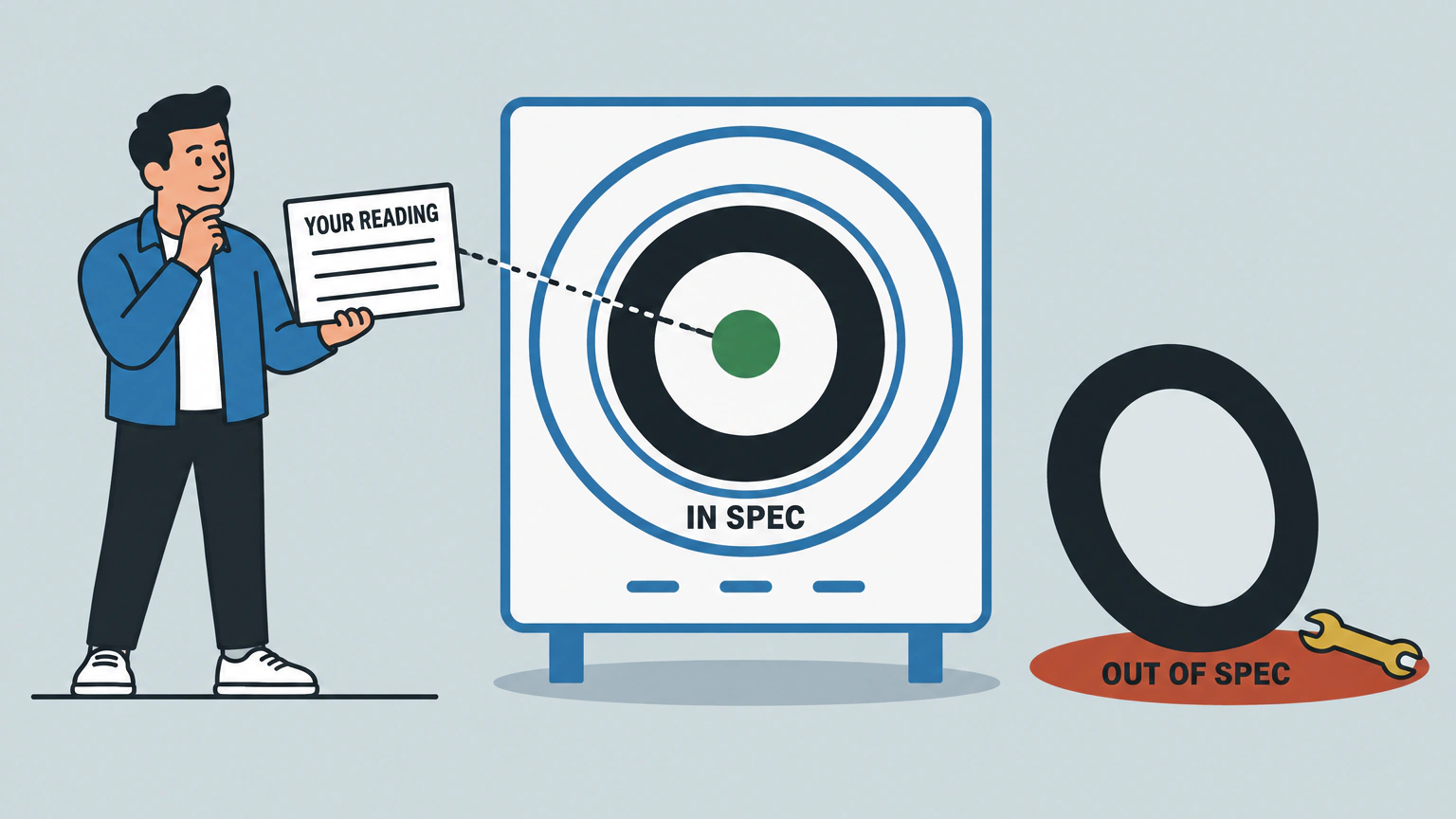
Across Canada a four wheel alignment generally runs about $100 to $200, and our own alignment listings cluster lower, at $66 to $97 for a typical visit. The harder question is whether you need one at all. An alignment is a measurement against your car's factory specification, so ask the shop to show you the reading before you agree to anything. Ask too whether your car needs a steering angle sensor reset afterward, because on close to half the vehicles on North American roads that reset is now part of the job.
On this page
What a four wheel alignment costs in Canada
One widely cited Canadian guide gives two numbers: $50 to $100 for two wheels and $100 to $200 for four. That's Canada Drives, and it prints them with no source. So we looked up the prices Canadian shops actually publish, and they spread wider than that band on both sides. Our own listings sit under it. A Land Rover dealer sits above it. Fountain Tire carries a flat labour line for the job in its own product data. None of that makes the $100 to $200 band wrong. It shows why you need to know where a quote comes from and what it covers.
The two jobs shops quote, and why the four wheel number is the one to ask for
Two different jobs hide behind the one word. A front-end or two-wheel alignment adjusts one axle and leaves the other where it sits. A four wheel alignment measures all four corners and squares the rear axle to the front, so the car tracks straight down the lane instead of crabbing very slightly sideways in it. That squaring is the part a two-wheel job can't do. When one quote comes in noticeably cheaper than the others, ask which job you're being sold. Kal Tire's published description of its own service is a good checklist of what you're buying: a full inspection of steering, suspension and tire condition, computerized measurement of every alignment angle, then adjustment back to factory specifications.
| Where the figure comes from | What it covers | Price (CAD) | Basis |
|---|---|---|---|
| Our own alignment listings | Typical quote range | $66 to $97 | 719 cost profiles |
| Fountain Tire | Alignment, technician labour | $190 | Fountain Tire's own product data |
| Level Auto, Toronto | Four wheels, 3D imaging aligner | From $100 | The shop's published price |
| Toronto garages generally | Four wheels, standard car | $90 to $130 | Level Auto's read of its market |
| Coventry North Land Rover | Basic four wheel, Land Rover | $150 to $250 | The dealer's published range |
| Canada Drives' four-wheel band | Four wheels, no source given | $100 to $200 | Canada Drives |
What our own alignment listings show
Across 719 cost profiles on our own alignment listings, a typical visit lands at $66 to $97. That's under the band in circulation, and it's worth being precise about what the figure is. It's our own aggregate of quote data for this category, priced to a location instead of one fixed line across the country. Use it as a floor check, not as a market statistic. If a shop quotes you $95 for four wheels, our data says that's an ordinary price and not a bargain hiding a catch. If a shop quotes $300 for a standard car with nothing unusual underneath it, that number has earned a question. You can see the alignment shops near you on the same listings.
Required or suggested: the question that comes before the price
An alignment can end with every angle inside specification and nothing adjusted. The measurement was still work, and whether you pay the same as you would for a full adjustment should be clear in the estimate you accepted. That's why the question of whether you need the job matters more than its price. The trade has a written way of answering it.
What should trigger a check or an adjustment
AMRA's current Motorist Assurance Program says a repair is required when a part no longer does its job, misses a design specification or is missing. A service is suggested when it answers a customer request, follows the maker's maintenance schedule or rests on the technician's informed experience. Suggested services are optional. For an alignment, a symptom can justify a check, but an adjustment follows only when the readings or the vehicle maker's procedure call for it. Brakes sort the same way, so the question works just as well on what a fair brake job costs.
| What the shop found | What to do next | What that means for you |
|---|---|---|
| Pull, drift or wander | Check the alignment | The symptom alone does not prove which angle is wrong |
| One-sided or rapid tire wear | Check alignment and tire condition | Wear can have more than one cause |
| An angle measured outside the maker's spec | Adjust if the vehicle allows it | Ask to see the reading |
| A part was replaced that can affect alignment | Check the alignment | Follow the vehicle maker's procedure |
| Steering wheel sits off centre | Check the alignment | Ask whether the readings explain it |
| Past the maker's suggested interval | Check, do not assume | An interval does not prove adjustment is needed |
| New tires and even wear on the old set | Check if the shop or tire maker recommends it | Authorize adjustment only if the reading calls for it |
Read your old tires before you say yes
The cheapest test in this whole business costs nothing and happens before the car goes up. Look at the tires you're about to retire. Even wear across the tread is reassuring, but it doesn't prove every current angle is in specification. A strip of wear along one shoulder is a reason to check the alignment. Michelin notes that worn suspension parts, hard cornering and tire rotation can produce the same pattern. Skip the folk test. Don't take your hands off the wheel to see whether the car pulls. It's dangerous, and most of what it measures is the crown of the road, which is built to shed water toward the shoulder. Ease off the pressure with your hands still on the wheel, briefly, and watch what the car does.
Red flag: A free alignment check and a paid alignment are two different transactions, and some Canadian tire and repair shops do the check for nothing. If every angle is inside the maker's specification, there's nothing to adjust. So before the car goes up, ask what the measurement costs if the reading comes back in spec.
The three angles, and what the printout has to show you
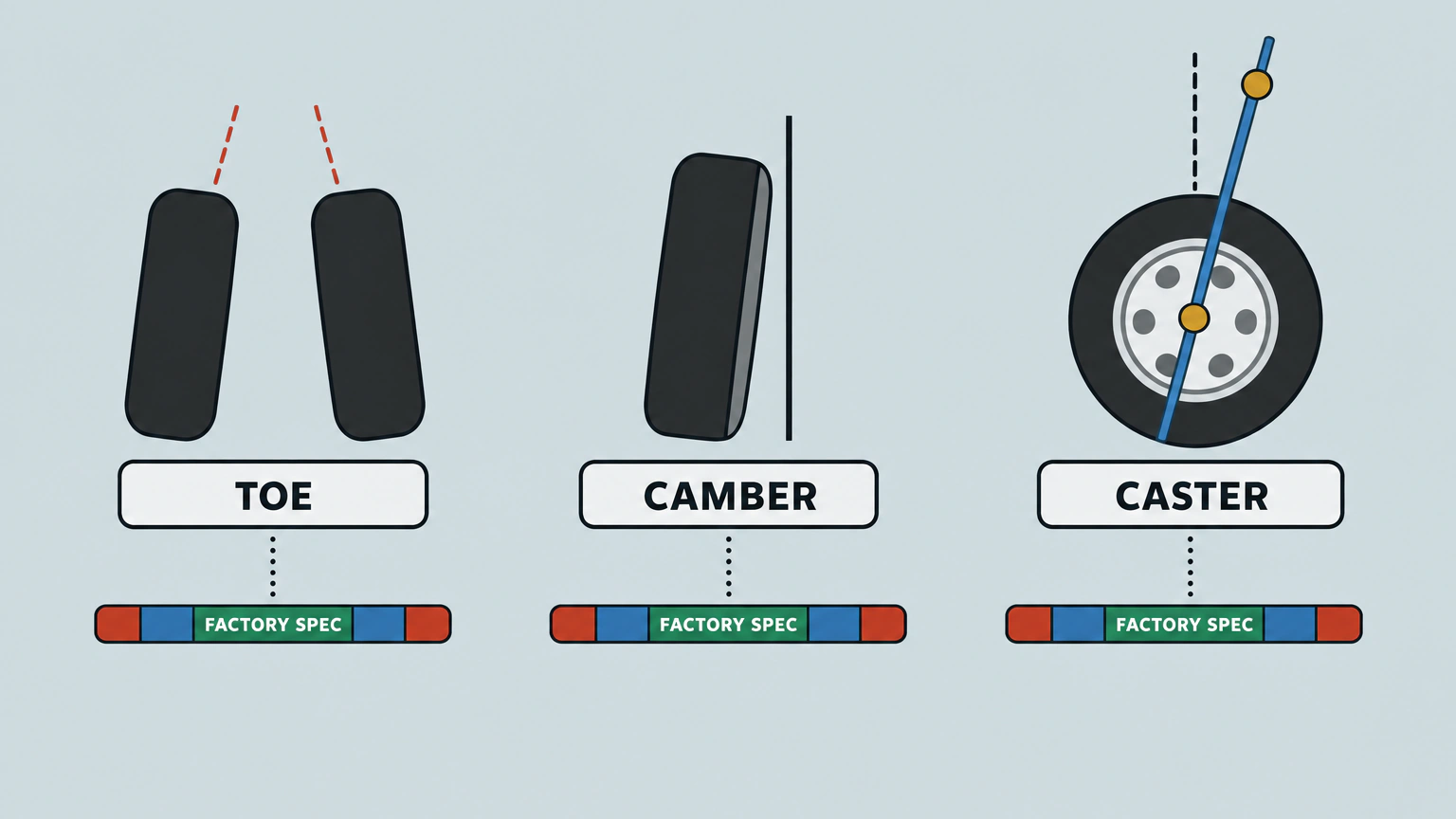
A proper alignment should end with a printout. It shows the angles measured at each axle, the maker's target range beside each one, and where your car sat before and after any adjustment. A grid of decimals and coloured bars can look opaque. Knowing the three basic angles turns that sheet into something you can check yourself.
Toe, camber and caster in plain words
Toe is whether the wheels point straight ahead, slightly toward each other, or slightly apart, seen from above. Kal Tire calls it the angle most likely to drift out, and a wrong toe setting can scrub the tread. Camber is the lean of the wheel seen from in front, with the top tilted in toward the car or out away from it. Too much either way and one shoulder carries the load the whole tire should be sharing. Caster is the tilt of the steering axis seen from the side. You feel caster rather than see it, in how the car holds a line and how the wheel returns to centre after a turn. Which angles can be adjusted depends on the vehicle. A printout can show an angle out of range even when the maker provides no direct adjustment for it.
Why a shop may tell you it cannot align your car
Angles only stay where a technician sets them if the parts holding them are tight. So before the machine goes on, the shop checks the basics: tire pressures and matching sizes, how the car is loaded, ride height, and every steering and suspension joint. A worn tie rod end or a loose ball joint means the wheel can still move after the adjustment, and the numbers walk straight back out. A shop that refuses the job in that state is doing you a favour, and it may quote the repair instead. This is where the real money shows up. Across 602 cost profiles, our own steering and suspension quote data runs $690 to $978, compared with $66 to $97 for an alignment. A worn steering or suspension part is a safety matter as well as a bill, so it's worth a second opinion rather than a delay, and our steering and suspension shops listings are where to get one.
Whatever the job turns out to be, a finished alignment should leave you holding five things:
- A printout with before and after measurements for the angles the rack checked at each axle
- The maker's specification range printed beside each of those numbers
- A line saying whether a steering angle sensor reset was done
- A written estimate you agreed to, and in Ontario a final bill within 10% of it
- The steering wheel sitting straight when the car tracks straight
Ask if the quote includes a steering angle sensor reset
Here's a line worth checking on the quote. Hunter Engineering says roughly 45% of vehicles on North American roads need the steering angle sensor reset or recalibrated after a wheel alignment because the maker instructs it. That sensor reports where the driver has pointed the wheels. Move the mechanical angles underneath it and its idea of straight is now wrong, which is why Hunter says that after an alignment the sensor's position is unknown. What the sensor feeds isn't a comfort feature. Stability control uses it, along with lane keep assist and blind spot monitoring on equipped cars. Skip the reset on a vehicle that needs it and those systems are working from a wrong idea of centre.
What to ask before you hand over the keys
Ask three questions, in this order. Is this a two wheel or a four wheel alignment? Does my vehicle need a steering system reset afterward? And is that reset inside the price you just quoted me?
In Ontario, asking first is more than good practice. Under the Consumer Protection Act, 2002, a repair shop has to give you a written estimate before it can charge you, and the final cost can't come in more than 10% above that estimate. New or reconditioned parts and the labour to install them generally carry a minimum warranty of 90 days or 5,000 km, whichever comes first. The estimate protects the price. The warranty applies to the covered repair itself.
Alignment and the winter changeover
This is where many Canadian drivers meet the question. The tires are off, the car is on the hoist, and an alignment is the natural thing to offer. It's also the moment you're least equipped to judge it, because you're already holding one quote and a second number has just landed on top of it. Quebec's winter tire deadline falls on December 1, and British Columbia's rules for designated highways start on October 1, so the bays are full and everyone is moving fast. If you want to know whether the first half of that bill is fair, here's what a winter tire changeover should cost.
What actually knocks a Canadian car out of alignment
Not time, and not kilometres on their own. Water works into a crack in the pavement, freezes, expands, thaws and does it again, and by March the crack is a pothole with a hard vertical edge. Hit the far edge hard and the impact can knock the alignment out or damage a suspension part. Curbs can do the same thing. The damage may not announce itself as a pull. Some alignment problems aren't immediately noticeable.
Fall or spring, and the honest answer
Fall is when many drivers are offered the alignment. Spring is when freeze-thaw damage is easiest to spot. So here's what we'd do. In the fall, have the alignment checked after a symptom, a recent impact, relevant steering or suspension work, or when new tires go on. Buy the adjustment when the readings or the vehicle maker's procedure call for it. Otherwise take the free check, keep the printout, and book the alignment for spring once the roads have finished working on your car. Our tire service shops listings will show what's near you, and the question to open with is whether the check is free.
Frequently asked questions
How much should a four wheel alignment cost in Canada?
Budget roughly $100 to $200 for four wheels, but published prices vary. Our own listings put a typical visit at $66 to $97 across 719 cost profiles, Fountain Tire publishes $190 for alignment technician labour, a Toronto specialist starts at $100, and a Land Rover dealer quotes $150 to $250 on its own marque. A quote near $300 for an ordinary car has earned a question.
Do I need an alignment every year?
Not automatically. Use the vehicle maker's schedule, symptoms and the latest measurements to decide. Kal Tire recommends a check if you drive year-round on 3-season or all-weather tires and it's been one to two years. That's a measurement, not an adjustment. Book a check too when you have a symptom, an impact, new tires or fresh suspension parts. Authorize an adjustment when the reading calls for one.
Do I need an alignment when I buy new tires?
Only if something says you do. Look at the tires coming off first. Even wear is reassuring, while one-sided shoulder wear is a reason to check the alignment and suspension. Read the treadwear warranty that comes with the new set and ask the shop what it requires of you, since some warranties set conditions you have to meet.
Is an alignment the same thing as balancing?
No, they're different jobs. Balancing, done on a separate machine, corrects the weight distribution of one wheel and tire assembly so it spins without vibrating. Alignment sets the angles of the suspension holding all four wheels. Michelin lists vibration as a balancing warning sign and uneven wear as an alignment warning sign, but either symptom can have other causes.
Why did the shop charge me for an alignment it could not finish?
The shop may charge for rack time and readings even when a worn tie rod end or ball joint stops the adjustment. Check the estimate you authorized to see what the price covers. Get the printout anyway, and ask what the alignment will cost once the part is replaced.
Does my car need a steering angle sensor reset after an alignment?
Quite possibly. Hunter Engineering puts it at roughly 45% of vehicles on North American roads, including vehicles with stability control and driver-assist systems. The maker decides that, not the shop. Ask before the work starts whether the reset is required for your car and whether it sits inside the quoted price, then check the invoice says it was done.