
On this page
- What a brake job costs in Canada right now
- Why the shop down the road quoted you two hundred dollars less
- The quote is not the bill, and here is what sits between them
- The salt bill, or what a Canadian winter adds to a brake job
- Do you need new rotors, or just pads?
- How Ontario, Alberta and Quebec limit the final bill
- The repair warranty you already have
- How to check a brake quote in five minutes
- Common questions about brake costs in Canada
What a brake job costs in Canada right now
Two things first. The named shops quote pad and rotor work per axle, not per wheel. Their figures cover parts and labour, but none of those pages says whether tax is included.
Pads only, one axle
A pad-only job is what it sounds like. Worn friction comes off, new pads go on, the rotors stay. Expect $150 to $340 for one axle. Urban Lube publishes that full band; My Calgary Mechanic and Cars With Fares publish narrower ranges inside it. It covers both wheels on that axle, because pads are replaced in pairs. New friction on one side and worn on the other makes a car pull.
Pads and rotors, one axle
This is the common job, and what most quotes describe. An economy car runs about $350 to $600 per axle. An SUV sits closer to $450 to $750, a truck around $600 to $900, and a European or luxury car can reach $600 to $1,200 or more. Rotors come along with pads more often than owners expect, and that isn't automatically an upsell. A rotor at or below the manufacturer's minimum thickness has to be replaced even if the pads wore out first.
All four corners, and whether you actually need that
Published whole-car bands for economy cars and SUVs run from $700 to $1,400. Front and rear brakes often wear at different rates, so if one axle is due while the other still measures well, doing all four is a scheduling choice, not a mechanical necessity. A brake fluid flush is a separate line at $80 to $150.
What each brake job costs in Canada, and where the number comes from. All amounts CAD and include parts and labour. The named pages do not say whether tax is included.
| The job | What Canadian shops publish | Priced per | Where that range comes from |
|---|---|---|---|
| Pads only | $150 to $340 | Axle | Urban Lube (Calgary), My Calgary Mechanic, Cars With Fares (Ontario) |
| Pads and rotors, economy car | $350 to $600 | Axle | Urban Lube, My Calgary Mechanic, Cars With Fares |
| Pads and rotors, SUV | $450 to $750 | Axle | Cars With Fares, Urban Lube |
| Pads and rotors, luxury or European | $600 to $1,200 | Axle | Cars With Fares |
| All four corners, pads and rotors | $700 to $1,400 | Whole car | Cars With Fares |
| Machining rotors instead of replacing | $25 to $80 | Rotor | Tower Service Station ($25 to $50), Urban Lube ($30 to $80) |
| Brake fluid flush | $80 to $150 | Whole car | RIDEZ, Tower Service Station and Urban Lube publish the same band |
| Caliper replacement | $150 to $500 | Caliper | Tower Service Station ($150 to $400), Urban Lube ($300 to $500), Cars With Fares ($350 to $450) |
| Brake line repair | $150 to $500 and up | Varies with damage | Tower Service Station |
| Our own listings, all brake work | $138 to $317 typical, $43 minimum, $579 maximum | Mixed | Our brake category, 834 cost profiles |
The first nine rows combine advertised figures from the named pages; they are not market rates from a representative survey. Calipers show why that matters: three sources give three different bands, so we give you the spread instead of picking a favourite. The last row is ours, from 834 brake cost profiles on our own listings. How we build our numbers is public. The next move is a shortlist of brake shops in your city.
Why the shop down the road quoted you two hundred dollars less
Two honest shops can quote two hundred dollars apart on the same car. Nobody is lying. Three common reasons are below.
Labour is billed by the book, not by the clock
Some shops bill brake work at flat rate, also called book time. An industry labour guide publishes a time for that job on your vehicle, the shop multiplies it by an hourly rate, and that's your labour charge. The stopwatch never comes out. A technician who finishes in fifty minutes still bills the book time.
So two quotes diverge because one shop books more hours than the other and their rates differ on top. Ontario doesn't leave you guessing which basis you're on. The written estimate must state the "total cost for the labour and how it will be calculated (e.g., an hourly rate or a flat rate, or some combination)". Ask for both numbers, the hours and the rate.
The parts grade nobody explains at the counter
Pads and rotors come in tiers, and the counter rarely says which tier you were quoted. Parts prices vary by brand and grade. Original-equipment parts usually cost more. Ontario makes the shop tell you whether parts are new, used or reconditioned and whether they came from the original manufacturer, and Alberta requires the same in writing.
Where you are, and what you drive
Labour rates change with the city and the shop type. RIDEZ publishes independent-shop rates of roughly $100 to $180 an hour, with dealership rates above that. Vehicle class moves the parts side: bigger rotors, bigger calipers, more metal. Some newer vehicles use an electronic parking brake that needs a model-specific maintenance mode for rear brake service, sometimes through a scan tool. That can add book time. When two quotes from independent mechanic shops disagree, the labour line is usually where.
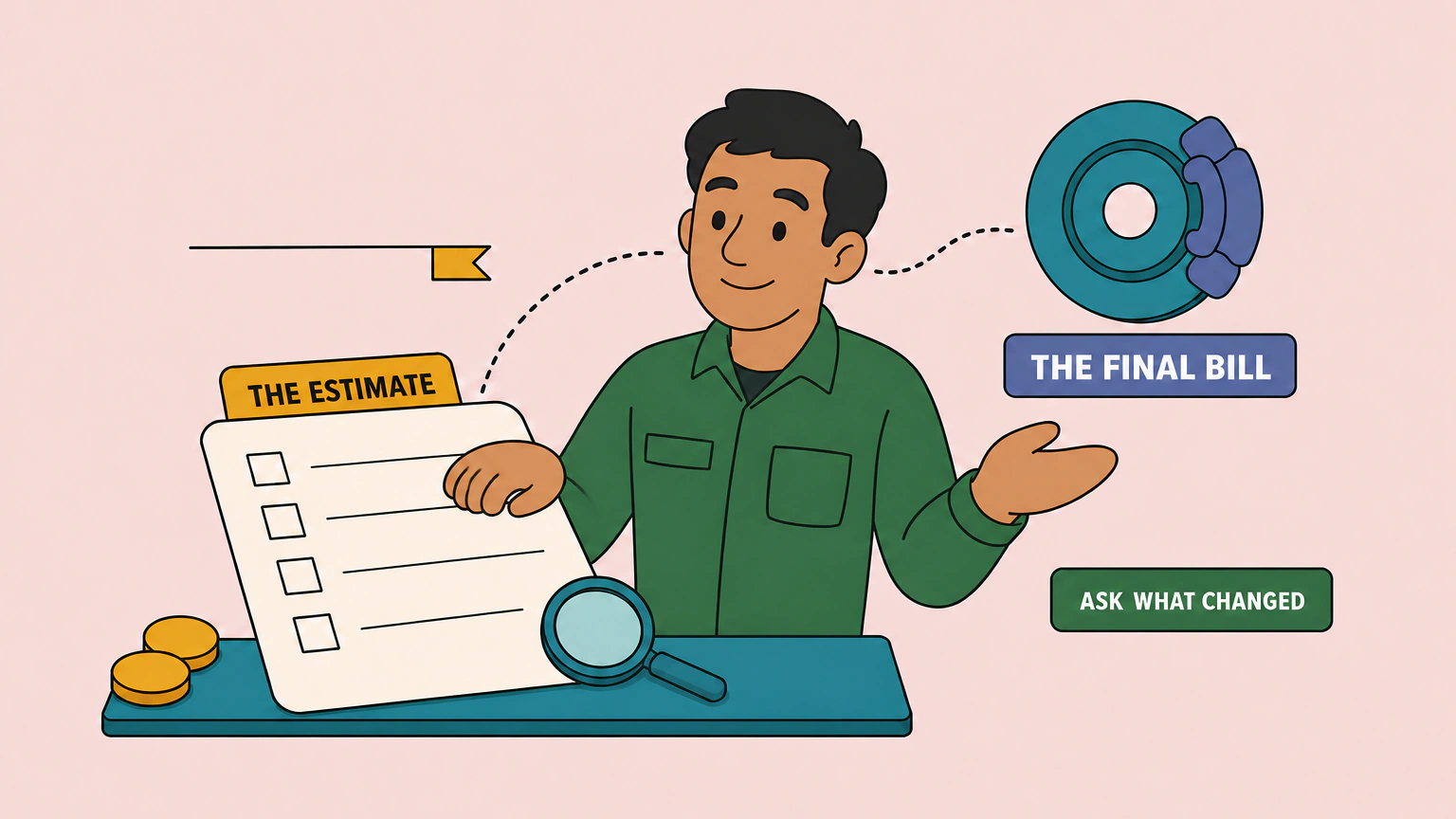
The quote is not the bill, and here is what sits between them
Four things move the number between the estimate and the invoice you sign. Three are perfectly legitimate. One is where you want a rule on your side.
The shop supply line, and the tax that is not in the quote
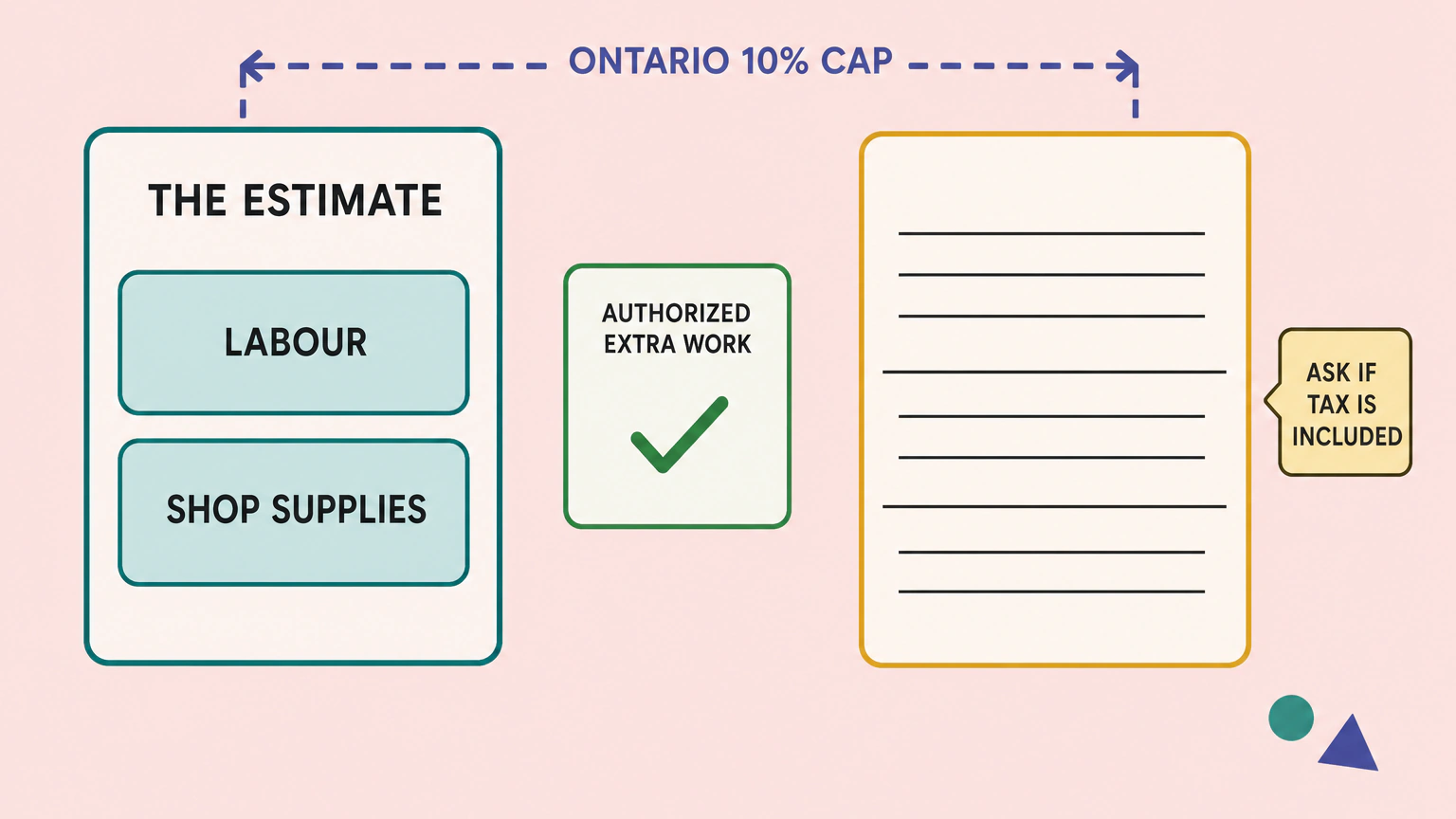
Shop supplies, sometimes billed as an environmental charge, cover what a brake job consumes that nobody itemizes: cleaner, anti-seize, caliper lubricant, gloves, rags, disposal of old fluid and metal. You should be able to see it, and Ontario requires the invoice to list "shop supplies charged to a customer (and not included in normal operating costs)" as its own item.
Then the omission almost every Canadian brake price guide makes. Some prices leave tax out. At 13 per cent HST, a $500 before-tax quote in Ontario becomes a $565 bill. Ask which one you were given.
Work found once the wheel is off
You can't see some of this from the service counter. A caliper seized on its slide pins, a brake line rusted thin above the fuel tank, a rotor welded to the hub by three winters of salt. Discovery is real, and not automatically a scam.
What separates an honest discovery from a bad one is authorization. In Ontario, verbal permission for extra work has to be written down by the shop. Alberta wants it in writing, or a written record of who gave it, when and how. So the question isn't whether they found something. It's whether they phoned you first. A written second opinion from one of the auto repair shops near you can cost less than the work in dispute.
The salt bill, or what a Canadian winter adds to a brake job
Road salt is one reason Canadian brake jobs carry extra corrosion costs. Through the winter, salty water reaches the parts that have to slide and flex.
The seized caliper
Many sliding calipers move on greased guide pins so they can centre over the rotor. Salt water finds the boots, the grease turns to paste, and the pins seize. Now the caliper can't release. One pad grinds itself away while its partner barely wears, that wheel runs hot, and the car tugs to one side when you brake. Replacement runs $150 to $500 per caliper. Sometimes the fix is only pins, boots and lubricant, so ask which you're being quoted. If the pull comes without the heat and the uneven wear, steering and suspension specialists are the honest second stop.
The corroded brake line
Brake lines are steel tubes running the length of the underbody, and on salted roads they rot from the outside in. A badly corroded line can fail suddenly, so it is not a repair to defer. A line that lets go can dump pressure from one hydraulic circuit. The pedal may drop much farther, and stopping distance can increase sharply even if the other circuit still works. Tower Service Station puts repairs at $150 to $500 and up. Ask them to show you the section on the hoist. Corroded lines can also make a car fail an out of province inspection.
Rotors rusted to the hub
A light film of orange after a wet night often clears in the first few stops. A rotor bonded to the wheel hub can add labour, and that time lands on your invoice. Rust can also finish a rotor that still measures above its minimum thickness, because the pitted surface stops new pads from sitting flat. If you keep cars on salted roads, rust proofing in Canada is worth understanding first.
Do you need new rotors, or just pads?
Two things decide it, and a shop can show you both.
The first is thickness. Every rotor has a manufacturer-set minimum, or discard, thickness, and the technician measures against that figure with a micrometer. At or below it, the rotor goes. The second is surface condition: deep scoring, heat cracking, corrosion pitting or thickness variation that causes a pulse through the pedal can all end a rotor's life while it still measures above the minimum.
Machining, also called turning or resurfacing, sits in the middle. A lathe cuts a fresh flat face for $25 to $80 per rotor. It's only an option when the finished rotor will still sit above the manufacturer's minimum thickness.
Ask for the measured thickness, written on the invoice.
How Ontario, Alberta and Quebec limit the final bill
Almost every Canadian page that mentions a 10 per cent rule treats it as a national fact. It isn't. Three provinces run three structurally different regimes, and on a job where the number moves once a wheel comes off, that is money.
| Province | Must the shop give a written estimate? | How far above the estimate it may bill | Warranty the law puts on the repair | Where a complaint goes |
|---|---|---|---|---|
| Ontario | Yes, before it can charge you, unless you declined one and agreed a maximum you would pay | Not more than 10% above the estimate, with no dollar ceiling | Minimum 90 days or 5,000 km, whichever comes first, on parts and labour | Ministry of Public and Business Service Delivery and Procurement, through Consumer Protection Ontario |
| Alberta | On request, and it must be in writing, with a description of the work and the estimated total including labour and parts | Not more than 10% above, to a maximum of $100, unless you expressly consented first or agreed to amend the estimate for extra work | No minimum repair-warranty period is set in the Automotive Business Regulation; ask the shop to put its warranty in writing | AMVIC, the Alberta Motor Vehicle Industry Council |
| Quebec | Yes, for repairs over $100, free of charge unless the exact fee was stated first | Nothing above the written evaluation. Only additional repairs you authorized may be added | 3 months or 5,000 km, whichever comes first, on repair work over $50, covering parts, labour and reasonable towing | Office de la protection du consommateur |
Of the three provinces we could verify, Quebec is the only one that allows no extra charge for repairs in the accepted evaluation. Authorized additional repairs may be added.
Ontario, ten per cent and no dollar ceiling
Ontario's rule is the one people half-remember, and the half they remember is right. The province is blunt: "Before a repair shop can charge you, they must have given you a written estimate, unless you declined it and instead agreed on a maximum amount you are willing to pay for the repair. The final cost charged cannot be more than 10% above the estimate."
No dollar cap sits on that 10 per cent, so a $1,200 brake job has a $1,320 ceiling. The estimate has to carry real content too: the vehicle, an exact description of the repairs, the price of each part, the labour total and how it's calculated, and the date it expires.
A shop may charge for the estimate, but only if it tells you the fee first, and you can't be charged it if you authorize the repair before reassembly. Never sign a blank work order.
Alberta, ten per cent or one hundred dollars, whichever is smaller
Alberta's Automotive Business Regulation says a business must not "charge a price for goods or services that is more than 10%, to a maximum of $100, higher than the estimate given". Two exceptions: you expressly consented to the higher price before the work was done, or you needed extra work and both sides agreed to amend the estimate.
That $100 ceiling is what makes Alberta bite differently. On a $700 estimate the two provinces behave identically, because 10 per cent is $70 and the cap never engages. On a $2,000 estimate Ontario's ceiling is $2,200 and Alberta's is $2,100, and the gap widens as the job grows. Alberta also wants the diagnostic charge stated up front when a job has to be diagnosed before it can be quoted.
Quebec, the evaluation is the price
Quebec runs the strictest of the three, and it starts low. Garages must give you a written evaluation before repairs costing more than $100, free of charge unless they told you the exact fee beforehand. From there the Office de la protection du consommateur is unambiguous: "The garage cannot charge you more than the total price stated in the evaluation. Only fees for additional repairs authorized by you can be added."
The OPC names a trap too. A garage's own printed form declining the evaluation, signed by you, "has no legal value". And if the bill arrives higher anyway, pay under protest. Write those words on the cheque or the invoice, then send a formal notice and go to small claims.
Everywhere else in Canada, get the estimate in writing anyway. It's evidence whether or not a statute compels one. Check your provincial consumer affairs office for what applies where you live, and know the limit on any dispute: the shop can hold your car until the bill is paid. Rules change, and your province may not work the way these three do. If a bill and a shop are already in dispute, your provincial consumer office costs nothing and it is the right first call.
The repair warranty you already have
In Ontario the work comes with a legal minimum warranty, and most people paying the bill have no idea. Parts and labour carry at least 90 days or 5,000 km, whichever comes first. If the car breaks down or becomes unsafe in that window because the repair was faulty, the shop has to refund what you paid and cover reasonable towing. The invoice must state the warranty terms for each part fitted and the labour to fit it.
Quebec's version is broader and quieter. Any repair over $50 carries three months or 5,000 km on parts, labour and reasonable towing. The clock starts the day you collect the car, and it pauses for however long the car is back in for the same fault.
Alberta's Automotive Business Regulation sets no minimum repair-warranty period. Ask the shop to put its warranty in writing. A cheap quote with nothing behind it isn't the same product as one with 90 days on it.
How to check a brake quote in five minutes
None of this needs a mechanic's knowledge, only eight questions asked before you say yes.
- Ask for the estimate in writing, by email or text, before the car goes on the hoist.
- Ask whether the labour is billed at an hourly rate or at a flat rate, and how many hours the job is booked at.
- Ask whether the price you were given includes tax, or sits before it.
- Ask what the shop supply or environmental charge is, and how much it comes to.
- Ask whether the quote is for pads only or pads and rotors, and for which axle.
- Ask them to phone you before doing anything that was not on the estimate, and say you want that noted on the work order.
- Ask for the measured rotor thickness to be written on the invoice if rotors are being replaced.
- Ask to see the old parts, and say so when you authorize the work rather than afterwards.
Common questions about brake costs in Canada
Do I need new rotors, or just pads?
It comes down to two things the shop can show you. A rotor has a manufacturer-set minimum thickness, and once it measures at or below that it has to be replaced. If it measures fine but is deeply scored, heat cracked or rust pitted, it goes anyway. Ask for the measured thickness on your invoice.
Do I have to do all four wheels at once?
No. Front and rear brakes often wear at different rates, so one axle can be due while the other still has plenty left. Doing all four in one visit saves you a second appointment later, which makes it a scheduling decision rather than a mechanical one. Ask what the rear pads measure first.
Why did the final bill come in higher than the quote?
Usually one of four things. The labour was booked at flat rate hours you never saw, a shop supply line got added, the quote came before tax, or something seized came off with the wheel. Ontario caps the final bill at 10 per cent above a written estimate. Alberta allows 10 per cent or $100, whichever is less. Quebec allows only additional repairs you authorized.
How much should pads alone cost in Canada?
Roughly $150 to $340 per axle at an independent shop. Urban Lube publishes that full band, while My Calgary Mechanic and Cars With Fares publish narrower ranges inside it. That's parts and labour; ask whether tax is included. Some vehicles with an electronic parking brake cost more at the rear because the system needs a model-specific maintenance mode.
Is a dealership brake job worth the extra money?
Sometimes. Dealers charge a higher labour rate and fit the manufacturer's own parts. That's worth paying for on a vehicle still under warranty, or one whose brakes tie into driver assistance. On an eight-year-old commuter, a good independent doing the same job with quality parts is the better buy. Compare the labour line on both quotes.
How often do brake pads actually need replacing?
There is no single replacement interval that fits every vehicle and driving pattern. Canadian Super Shop puts typical pad life at 40,000 to 100,000 km, and where you land depends on city stops, hills, towing and how hard you brake. Measured pad thickness is the real answer. A seasonal tire changeover is a practical time to ask for a pad-thickness check.