

On this page
- The short answer on cost, warranty and timing
- Published rust-proofing prices in Canada
- The four things sold as "rust proofing" — and what each one actually does
- What factory corrosion warranties actually cover
- When to book it
- Should you buy it? An eight-step decision
- What body repair and refinishing can cost
- Choosing a shop, and what a quote must tell you before you agree
- Frequently asked questions
- The bottom line
The short answer on cost, warranty and timing
Rust proofing in Canada costs roughly $130 to $190 a year for an annual oil spray, or $600 to $1,000 once for a tar-based or dealer undercoating package. Before you book either one, look up the date your vehicle was first put into service. Toyota, Honda, Mazda and Subaru publish anti-perforation terms of five to seven years with no kilometre limit, but other Canadian warranties fall outside that range. Toyota Canada states in writing that additional rust inhibiting products are not required to maintain its Corrosion Perforation Warranty. That warranty covers defined perforation due to defects in material or workmanship. Warranty expiry alone doesn't decide when preventive treatment is worthwhile.
This is a decision about product, condition, coverage and how long you plan to keep the vehicle, not only about timing. Three prices recur in the published examples: about $150 for a yearly oil spray, $600 to $1,000 for a one-time coating or a dealer package, and another $500 to $1,000 for an electronic module. Which one is right for you turns on the product's scope, the state of the vehicle, what your manufacturer tells you to do, and how many winters you still expect to drive it. Remaining warranty is only one of those factors.
Published rust-proofing prices in Canada
These prices are in Canadian dollars, as each publisher printed them, and none of those pages says whether tax is included. Rust Check International puts "PRICES MAY VARY ACCORDING TO LOCATION" directly above its own list. Treat the figures as published comparisons, not as a quote.
| Method | Published price (CAD) | How often | What it is best at |
|---|---|---|---|
| Annual oil spray, drip type | $130 to $190 | Every 12 months | Creeping into seams and enclosed cavities |
| Annual oil spray, dripless type | $130 to $170 | Every 12 to 18 months | Full body and underbody coverage with no dripping |
| One-time tar or rubberized undercoating | $600 to $900 | Sold as a one-time job | A hard barrier over exposed underbody metal |
| Dealer protection package | $600 to $1,000 | Sold as one-time protection; warranty terms vary | Convenience at delivery, with a written warranty |
| Electronic module | $500 to $1,000 | One-time installation | Not established by any source cited here |
The drip and dripless bands come from Cansumer's Canadian cost guide, which lists Rust Check at $130 for a car and $160 for an SUV or truck, Krown at $140 and $150 to $160, and Corrosion Free's Complete Package at $180 and $170. Rust Check's own current price list runs $149.95 for a small car, $159.95 for a medium or full-sized car, $169.95 for a minivan, small SUV or pick-up, and $189.95 for a full-sized truck or SUV. The tar and dealer-package figures are Cansumer's as well.
Annual oil spray is the repeat-treatment option
An oil spray is a light corrosion-inhibiting oil applied under pressure to the underbody, seams and the inside of enclosed panels. It's sold annually because it's designed to creep along seams and re-cover small breaks rather than to seal the metal in a shell. That's a genuine engineering choice, not a subscription trick: a coating that seals is only as good as its worst crack, and a fluid that migrates keeps finding the gap. It also means the value is in the repeat, so a single spray you never renew buys you roughly one winter.
One-time coatings and dealer packages
The $600 to $1,000 tier is a thicker tar-based or rubberized product sprayed onto the underside, which hardens into a shell. Cansumer records Ziebart's tar-based undercoating at $600 to $900 and dealership vulcanized or rubber undercoating at $600 to $1,000, some of it sold with a ten-year warranty. Read any long-term warranty carefully, and ask for its inspection and maintenance conditions in writing before you pay.
What changes your quote
Vehicle size and treatment scope move the published number, and existing rust may require assessment or preparation before application. Ask whether the price includes injecting the inside of rockers, doors and frame rails or only spraying what is visible from underneath. Local quotes can differ from the published figures.
What the electronic module is, and why it is not a substitute
An electronic module passes a weak current through the vehicle's metal on the theory that it slows corrosion. Cansumer's guide states that products using this technology "have repeatedly been shown to be ineffective when used on vehicles", and lists these modules at $500 to $1,000. No manufacturer warranty document we opened endorses one, though silence in a warranty booklet is not the same as opposition.
The four things sold as "rust proofing" — and what each one actually does
The practical distinction is between the outside and the inside. An underbody spray protects what you can see from below. A cavity treatment targets the inside of the rockers, doors and frame rails; Honda defines covered perforation as corrosion working "from the inner surface through to the outer surface of the body". A quote that treats only the underbody is not a cheaper version of the same job. It's a different job.
That's also the honest answer to the drilled-holes worry. Cansumer says drip oil applications commonly use small drilled access holes in doors and rocker panels, while some other products use factory openings. The question to ask is not whether the shop drills, but where it drills, whether every hole is plugged when the job is done, and whether that's written on the estimate.
| What it is | Where it goes | Reaches enclosed cavities? | Trade-off |
|---|---|---|---|
| Drip oil spray | Underbody, seams and inside closed panels | Yes, usually through drilled access holes | Drips for a few days; needs access holes |
| Dripless oil spray | Whole body including the underbody, as a thicker gel | Yes, in the full-vehicle package only | Cheaper underbody-only packages skip the cavities |
| Tar or rubberized undercoating | Exposed underbody surfaces | No | A cracked or badly prepped shell can hold moisture against metal |
| Cavity wax or oil injection | Inside rockers, doors and frame rails | Yes, that is its whole purpose | You cannot see the result, so documentation matters |
What factory corrosion warranties actually cover
Factory corrosion coverage varies by make, model year and covered component. Here's what four manufacturers publish in their own Canadian documents.
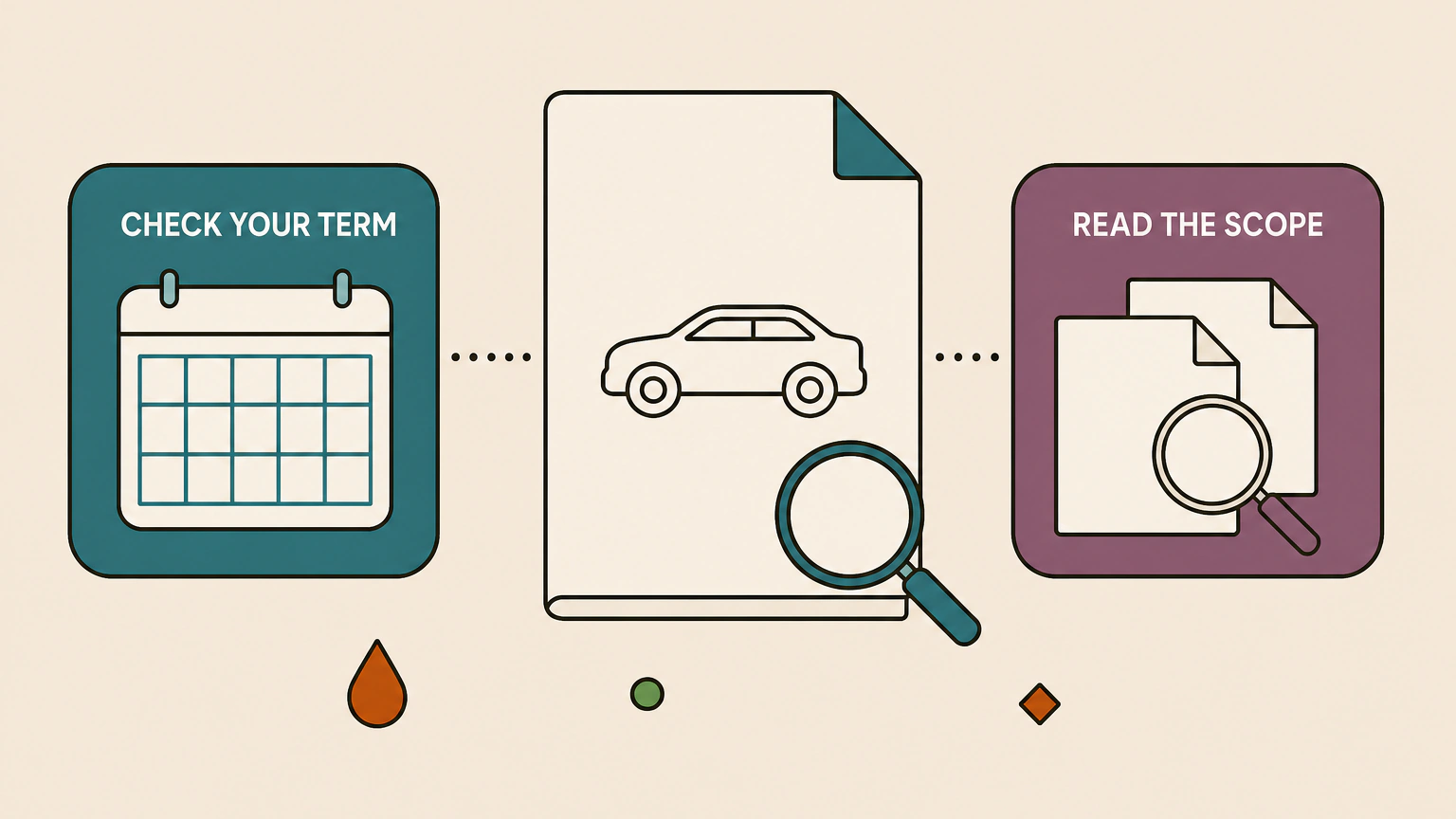
The four makes in this table publish five-to-seven-year terms
The table is intentionally limited to four makes and does not establish a Canada-wide minimum or maximum.
| Make | Anti-perforation (rust-through) | Surface corrosion | Source and currency |
|---|---|---|---|
| Toyota | 60 months, unlimited km | Corrosion other than perforation is not warranted; paint defects 36 months or 60,000 km | Toyota Canada, Owner's Manual Supplement, 2026 Models, pp. 6 and 8 |
| Honda | Five years, no distance limit | Three years, no distance limit, and it excludes the vehicle underbody | honda.ca Standard Warranty page |
| Mazda | Seven years, unlimited mileage under Mazda Unlimited, 2015 and later models; 84 months or 160,000 km on the earlier schedule | Not stated separately on this page | mazda.ca warranty coverage overview |
| Subaru | 60 months from the date of initial registration, no kilometre limit | External, readily visible body panels: 36 months or 60,000 km | subaru.ca current Subaru Warranty page |
"Perforation" means a hole right through, from the inside out
This is the definition that makes the coverage narrower than the headline sounds. Toyota warrants "any original body sheet metal found, under normal use, to have developed a perforation (hole through the body panel) from corrosion", and adds plainly that "corrosion other than perforation is not warranted". Honda's wording is the same idea from the other side: perforation "from the inner surface through to the outer surface of the body". Bubbling paint, stone-chip rust and surface corrosion do not meet these manufacturers' perforation definitions and may be excluded or subject to separate terms.
Honda excludes the underbody from surface-corrosion coverage
Honda's surface-corrosion warranty runs three years with no distance limit and states that it "does not include the vehicle underbody". Subaru's current page limits surface coverage to external, readily visible body panels for 36 months or 60,000 km. Neither of those is a substitute for preventive maintenance. The anti-perforation warranty covers only qualifying rust-through, under its own defect and exclusion terms.
Can rust proofing affect a warranty claim?
Toyota says: "The application of additional rust inhibiting products is not required in order to maintain the Corrosion Perforation Warranty." It excludes corrosion caused by non-Toyota rust-inhibiting material that retains moisture or contamination against body sheet metal. Subaru's current page separately limits coverage to qualifying perforation, while its 2018 booklet ties that coverage to maintenance duties. Those are two different tests, so any warranty effect depends on what caused the damage and what your own terms say. Honda's 2022 Canadian guide goes further and says additional corrosion-inhibiting materials are unnecessary and not recommended.
If your make is not in the table
Find your own booklet, or the manufacturer's Canadian owners' site, and search for "perforation" or "anti-perforation". Then find the start event: Toyota uses the warranty-registration date, its original in-service date, which "may be earlier than the date of sale"; Honda uses first registration; and Subaru uses first registration or, when applicable, demonstrator service. Don't assume the retail purchase date controls.
When to book it
Timing advice differs by vendor and by product, so follow the preparation instructions for the product you choose and ask the shop when it can actually fit you in.
Vendors disagree on the best season
Rust Check recommends fall before winter, while Krown calls spring one of the best times and says its protection works in every season. There's no single Canada-wide window that suits every product. Ask whoever you book with about surface preparation and how far ahead they need you.
Is it too late to do it in winter?
Not necessarily. Rust Check says winter treatment can still help. What it takes to prepare the vehicle depends on the product and the provider, so ask what cleaning or drying is required and whether that changes the quote.
Annual, or every two years?
For a drip oil spray, annual is the product's own design, and Cansumer records a 12-month interval for Rust Check and Krown and 12 to 18 months for Corrosion Free's dripless product. Anything longer, and any inspection requirement, comes down to the specific product and its written warranty. Read both before you buy.
Should you buy it? An eight-step decision
Four things really decide it: how old the vehicle is against your make's anti-perforation term, how it's driven and stored, how long you intend to keep it, and whether rust has already started. Work through them in order.
- Look up the date your vehicle was first put into service, not only the date you bought it. Find it in the warranty registration or ask the manufacturer or dealer; it may precede your purchase.
- Check whether your make's anti-perforation term has expired and what it covers. Five years is the shortest of those four terms and seven the longest; that is not a Canada-wide range.
- Count your winters honestly. A vehicle parked outside on salted roads all season is a different case from one that's garaged and driven twice a week.
- Decide how many more years you actually intend to keep it, because the value of protection changes if you plan to sell the vehicle soon.
- Get on your knees with a flashlight and look at the rocker panels, the wheel arches and the seam behind each rear wheel. Five minutes on a dry day tells you more than any quote.
- If there is already bubbling paint or flaking, have it assessed before you price protection. Whether a product suits the vehicle at all, and what preparation it needs first, depends on the rust and on the product.
- Ask any shop you call whether the quote includes cavity injection or underbody spray only. If the answer is vague, that's your answer.
- Ask whether the warranty requires an annual re-inspection, what it costs, and exactly what happens if you miss one.
Leased vehicles and vehicles you plan to sell in under three years
On a lease, or on a vehicle you expect to sell soon, weigh the price of the product against your lease terms, how long you'll actually have the car, what condition it's in and what the manufacturer tells you to do. And don't count the factory warranty as maintenance: it applies only to defined rust-through under its terms. It's the same seasonal spend-or-skip question as whether you need a block heater.
Start with the maintenance your manufacturer calls for
Subaru's 2018-model-year warranty booklet tells owners who drive on salted or dust-controlled roads, or near the ocean, to flush the undercarriage at least monthly with fresh water, and to keep the door and rocker-panel drain holes clear. On PreferredMechanic.ca, car wash services average $17 to $28 across 616 cost profiles, though nothing on that page says an underbody flush is included. Ask what the wash actually covers, and follow the current booklet for your vehicle.
What body repair and refinishing can cost
The ranges below are broad PreferredMechanic.ca cost profiles, not rust-specific repair quotes. Read them as an order of magnitude, not a quote for your vehicle.
| What you are paying for | Range on PreferredMechanic.ca | Sample size |
|---|---|---|
| Auto body repair | Typical price range $230 to $522; maximum recorded $4,996 | 771 cost profiles |
| Automotive painting and refinishing | Typical price range $1,226 to $1,838; minimum $1,022, maximum $4,592 | 607 cost profiles |
| Car wash services (underbody flush not established) | Average price range $17 to $28; minimum $12, maximum $38 | 616 cost profiles |
A decade of yearly oil sprays at roughly $150 lands near $1,500, which sits inside PreferredMechanic.ca's published $1,226 to $1,838 typical range for automotive painting and refinishing. That is a scale comparison, not a rust-repair estimate; the panels do not establish rust-specific costs, structural-repair outcomes or out-of-province inspection results.
Choosing a shop, and what a quote must tell you before you agree
Rust proofing is sold by dedicated franchises, dealers, general repair shops and auto detailing shops. What you want from any of them is the same thing in writing: the treatment scope, the preparation included, and the warranty terms. A shop that will tell you what it treats and what it does not is the one to book.
Red flags: a quote that will not say in writing whether enclosed cavities are treated or only the underbody is sprayed. Long-term warranty conditions not disclosed before payment. A package sold on the claim that it is required to keep Toyota's factory warranty, when Toyota's document says otherwise. No plan for assessing existing scale or flaking. And, for Ontario vehicle work covered by Part VI, no estimate or authorized maximum: the Consumer Protection Act, 2002 generally requires an estimate before charging (s. 56(1)); if the consumer declines an estimate, the exception requires an authorized maximum and a charge within it (s. 56(2)). Where an estimate is given, the final bill is capped at 10 per cent above it (s. 58(2)). The Consumer Protection Act, 2002 remains in force; the Consumer Protection Act, 2023 is not yet in force. Other provinces set their own rules.
Pro tip: photograph the underbody before and after the application, and file the invoice with your service records. Those records can document the vehicle's condition and what was applied if a warranty question comes up later.
Frequently asked questions
How much does rust proofing cost in Canada?
Published annual oil-spray figures run from about $130 to $190 by vehicle and provider, and Cansumer lists tar, rubberized and dealer packages from $600 to $1,000. Rust Check's current posted prices run from $149.95 for a small car to $189.95 for a full-sized truck or SUV, with a note that prices vary by location. Ask whether the quote covers cavities or only the underbody.
Does rust proofing void your new-vehicle warranty?
Not automatically, but the exact cause and warranty terms matter. Toyota says additional rust-inhibiting products are not required to maintain its Corrosion Perforation Warranty, while excluding corrosion caused by a non-Toyota material that retains moisture or contamination against the sheet metal. Check your own booklet before authorizing a treatment.
Is rust proofing necessary on a new car in Canada?
A warranty term alone doesn't answer that question. Anti-perforation coverage applies only to defined rust-through under each manufacturer's defect and exclusion terms, and that isn't preventive maintenance. Start with your current warranty booklet and its maintenance instructions, then weigh the product's scope, where you drive, the condition of the vehicle and how long you'll keep it.
What is the best time of year to rust proof a car in Canada?
Timing depends on the product. Rust Check recommends fall, before winter. Krown calls spring one of the best times and says there is no bad time to start. Follow the preparation instructions for the product you choose, and ask the provider how far ahead it books.
Do you have to rust proof every year?
Follow the interval for the product you bought. Cansumer records 12 months for Rust Check and Krown and up to 18 months for Corrosion Free's dripless product. Anything longer, and any re-inspection condition, depends on the written product warranty.
Is it too late to rust proof a car that already has rust?
That depends on the condition and the product. Cansumer warns that tar-based undercoating will not help areas already affected by rust or damage, and that it can trap moisture if the coating cracks. Get active scale, flaking or perforation assessed before you choose between repair, preparation and treatment.
What is the difference between undercoating and rust proofing?
Undercoating is one type of rust proofing, not a synonym for it. It coats exposed surfaces under the vehicle with a tar or rubberized layer. Cavity treatments instead target internal areas such as rockers, doors and frame rails; Honda defines covered perforation as corrosion passing from the inner surface through to the outer surface.
Does rust proofing improve resale value?
Possibly, but the only number we found comes from a seller. Rust Check's blog claims rust-free vehicles sell for "sometimes $2,000 to $4,000 more" than rusted ones, and that is the vendor's own estimate rather than a measurement. We went looking for an independent figure on the resale premium and couldn't find one.
The bottom line
Anti-perforation coverage is a narrow defect warranty, not factory rust prevention. Don't let its expiry date alone decide whether you buy treatment. Read what your current booklet actually covers, which causes it excludes and what maintenance it asks of you, then weigh that against the vehicle's condition, its exposure, how long you plan to keep it and the treatment's written scope.
Start with two things: your in-service date and your current warranty booklet. Between them you'll know whether coverage is still running and what it reaches. Then ask a provider for a written treatment scope and its preparation requirements before you agree to anything.