

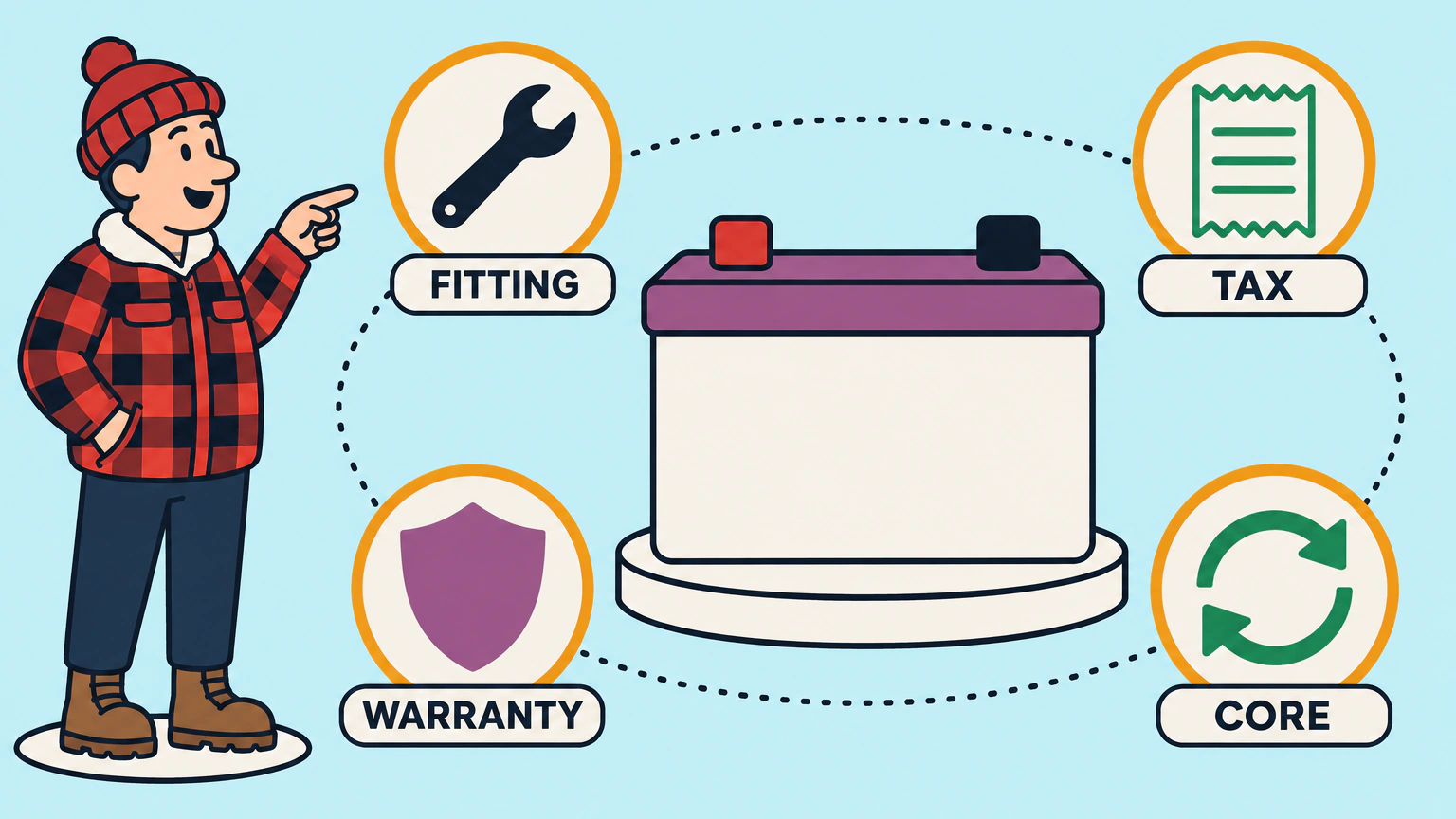
Plan on CA$150 to CA$450 for a standard battery fitted in Canada, and CA$260 to CA$650 for an AGM battery, the type many stop-start cars need. Then ask what the counter adds: sales tax of 5% to 15% depending on your province, and a core charge if you keep your old battery.
On this page
What a car battery costs installed in Canada
Those ranges are our own budget estimates, from our Car Battery Service pages. They price the job, battery and fitting together, because that's what you pay for.
What a fitted battery costs
| Job | Budget estimate | What it covers |
|---|---|---|
| Standard flooded battery, fitted | CA$150 to CA$450 per battery | A suitable 12-volt battery and routine fitting. Ask about testing and recycling. |
| AGM battery, fitted | CA$260 to CA$650 per battery | A suitable 12-volt AGM battery and fitting. Confirm any registration or coding. |
| EFB battery, or a battery that's hard to reach | Get an itemized quote | Give the battery type, group size, access and any registration the car needs. |
From our Car Battery Service pages. These are ordinary 12-volt starting batteries, not hybrid or EV drive batteries. Remote call-outs, unusual access and programming can cost extra.
A standard flooded battery is the conventional lead-acid kind. An EFB battery, or any battery that's hard to get at, gets an itemized quote instead of a range, because the job varies too much to price blind.
We see three things move the car battery cost inside those rows: the battery's technology and size, then access, terminal repairs and registration, then the mobile visit, recycling or the core return, and the warranty terms. Take them in that order. To see how local quotes compare, look up battery shops near you.
The battery your car needs sets most of the price
The car decides the type and size, not you. Matching it is the biggest decision in your car battery price. It's also where a cheaper battery that doesn't suit the car ends up costing more.
Flooded, EFB or AGM
The standard flooded battery is the cheaper of the two we price. AGM, short for absorbent glass mat, costs CA$110 more at the bottom of our estimates and CA$200 more at the top. EFB stands for enhanced flooded battery.
Stop-start cars, the ones that shut the engine off at a red light, are built around an AGM or EFB battery. Hyundai's owner's manual for a stop-start model leaves no room for argument: "Use only a genuine HYUNDAI AGM battery for replacement. If not, the ISG system may not operate properly." ISG is its idle stop and go system. Our own advice on the downgrade is just as plain: "Don't swap the AGM battery in a stop-start car for a plain flooded one, because it won't survive the charging cycles."
The tempting mistake is a money one. Someone fits a flooded battery where an AGM belongs, and the car keeps running the new one down. Before you compare prices, check the label on the old battery or the owner's manual.
The cold rating to match
Cold cranking amps, or CCA, is the number that matters in a Canadian winter. Yuasa, the battery maker, defines it as the current a battery delivers at -17.8°C (0°F) for 30 seconds while holding at least 7.2 volts. It's printed on the label. Yuasa also warns against confusing it with CA, cranking amps, which "is measured at higher temperatures and can be misleading in cold weather". So a big CA figure on a cheap battery proves nothing about January. Ads love showing a battery cranking in a block of ice, but ice melts at 0°C. On the Prairies, your question is whether it starts at -25°C or -30°C.
Our rule: meet or beat the maker's CCA figure, and keep the size, terminal layout and hold-down the same. As our battery pages put it, "A cheap battery that quits in February isn't cheap." In the deep-cold parts of the country, a block heater takes some of that load off the battery, because a warm engine cranks faster.
Registration and awkward access
We send two kinds of job to an itemized quote: EFB batteries, and batteries that are hard to reach. A battery under a seat, in the trunk or behind a panel takes longer to change than one under the hood. One mounted inside the car is often AGM, because that type barely gives off gas.
On many stop-start cars and other newer models, the new battery has to be registered, or coded, to the car's computer so the charging system knows what it's feeding. Skip it and the car can keep the new battery at a low charge, or let it go flat. It's a scan-tool job that any good independent shop with the tool can do. The dealer isn't the only option.
So ask the question our estimates are built around. Does the total include fitting, testing, registration and the mobile visit?
What gets added at the counter
A quote can leave two lines out. CAA South Central Ontario's battery page says it outright: "Prices quoted do not include taxes." We'd give you the same warning. Ask whether taxes are included, and confirm the complete total, taxes and mandatory fees. The two lines that land on top of the car battery price are sales tax and the core charge.
Sales tax, province by province
Tax lands on a battery job everywhere in Canada. The Canada Revenue Agency's GST/HST rate table runs from 5% GST in Alberta to 15% HST in New Brunswick, Newfoundland and Labrador and Prince Edward Island. Nova Scotia's HST has been 14% since April 1, 2025, so a page that still says 15% is out of date.
The tax reaches the fitting too. The CRA says GST/HST applies to most property and services. B.C. counts installing goods as a "related service" and charges 7% PST on it. Manitoba and Saskatchewan tax the whole repair bill, labour included. Revenu Québec lists "automobile repair services" among the supplies taxed at both the GST and the QST.
At 15% HST, a CA$650 AGM job comes to CA$747.50 at the till. Ask whether a quote is before or after tax, then set it beside another.
What a battery job comes to with tax
| Province | Tax on a battery job | A CA$150 to CA$450 flooded job becomes | A CA$260 to CA$650 AGM job becomes |
|---|---|---|---|
| Alberta | 5% GST | CA$157.50 to CA$472.50 | CA$273.00 to CA$682.50 |
| British Columbia | 5% GST plus 7% PST | CA$168.00 to CA$504.00 | CA$291.20 to CA$728.00 |
| Saskatchewan | 5% GST plus 6% PST | CA$166.50 to CA$499.50 | CA$288.60 to CA$721.50 |
| Manitoba | 5% GST plus 7% RST | CA$168.00 to CA$504.00 | CA$291.20 to CA$728.00 |
| Ontario | 13% HST | CA$169.50 to CA$508.50 | CA$293.80 to CA$734.50 |
| Quebec | 5% GST plus 9.975% QST | CA$172.46 to CA$517.39 | CA$298.94 to CA$747.34 |
| Nova Scotia | 14% HST | CA$171.00 to CA$513.00 | CA$296.40 to CA$741.00 |
| New Brunswick, Newfoundland and Labrador, Prince Edward Island | 15% HST | CA$172.50 to CA$517.50 | CA$299.00 to CA$747.50 |
Rates from the Canada Revenue Agency's table of GST/HST and provincial sales tax, applied to a quote given before tax. Yukon, the Northwest Territories and Nunavut charge 5% GST only.
The core charge, and how to keep it off your bill
The core charge is a deposit on your old battery, and it's the easiest line on the bill to make disappear.
In its Manitoba stewardship plan, the Canadian Battery Association says battery makers "levy retailers with a $20 core charge" when old batteries don't come back. The plan is just as clear about who ends up paying it: "Retailers will add the manufacturer's core charge to a sale if the customer does not give the old battery back to the retailer." The $20 roughly matches the value of the lead inside. CAA South Central Ontario charges an $18 recycling fee if you keep the old battery, and says the amount can change. What you shouldn't see is an eco-fee. The association's stewardship documents for Manitoba and B.C. both say consumers won't be charged one at the retail level.
Then the tax. The CRA's GST/HST info sheet on core charges treats the core as part of the price, so GST or HST applies to it. Trade the old battery in at the sale and the tax is worked out on the net amount. That way the core costs you nothing. Bring it back later and it's a separate sale, if the store agrees to buy it. You get "an amount" that "may be equal to the core charge or may be some other amount", and no GST or HST comes back with it. On a $20 core charge in Ontario, that's $2.60 of HST gone.
So bring the old battery with you, or let the shop take it out. One exception: a GST/HST-registered business buying for a work vehicle follows different rules, and its bookkeeper will want the receipt.
Make sure it's the battery before you buy one
A slow crank isn't proof of a bad battery. A weak battery, a poor cable connection and a failing starter or alternator can feel the same from the driver's seat. That's why our battery pages ask for "a battery and charging-system check so a connection or charging fault does not get mistaken for a bad battery." Good shops test before they sell.
A battery that keeps going flat has a reason: something drawing power after the car is off, a charging system that isn't keeping up, or trips too short to refill it. Winter makes that last one worse, with the heater, heated seats and rear defroster all pulling power. A shop finds a drain by measuring the current with everything shut off and pulling fuses until the draw drops. That hunt is paid by the hour. Our budget estimate for electrical diagnostic labour at an auto electrical shop is CA$100 to CA$200 per authorized hour. Agree a time limit and an approval point first.
If the battery light on your dash came on while you were driving, have the charging system checked before you buy anything. If the trouble is a car that sits for weeks, a plug-in maintainer may be the fix rather than a new battery.
The warranty is part of the price
Two batteries at the same price aren't the same buy if one replaces itself free for longer. Read the free-replacement period, not the headline years.
CAA South Central Ontario's premium batteries carry a 6-year total warranty. If one fails within the first three years, you get a free replacement. After that, a prorated guarantee covers a shrinking share of a new battery. So the number to compare is the three, not the six. Then ask the question from our own estimates: is warranty replacement labour covered?
Quebec drivers get one more layer, and it's a good one. The Office de la protection du consommateur says the law doesn't count "the sale and installation of a battery, if billed at the same time" as a repair. So Quebec's repair-shop rules don't govern the job, and the legal warranties on the battery itself do. The OPC's guide to legal warranties says they apply automatically and free of charge, and that goods must "have reasonable durability, based on the price paid, the terms of the contract and the conditions of use". The merchant can't make you deal with the manufacturer. Either one may choose to repair the battery, exchange it or refund you. A battery that dies young may still be the seller's problem.
Six questions to ask before you pay
Ask these in person or on the phone. They follow the bill line by line, from the battery itself to the warranty.
- Is this the same type my car came with: flooded, EFB or AGM?
- Does its cold cranking amps figure meet or beat the old battery's?
- Does the price include fitting, testing and any registration?
- Is that price before or after tax?
- Will you take my old battery, or is there a core charge?
- How many months of free replacement does the warranty give me?
Then compare a few battery shops near you, and ask each one the same six questions.
Frequently asked questions
Is there tax on a car battery?
Yes, everywhere in Canada, on the fitting as well as the battery. GST or HST applies across the country. British Columbia, Saskatchewan and Manitoba add their own provincial tax on the whole job, and Quebec adds QST. In Ontario that's 13% HST, so a CA$450 quote given before tax becomes CA$508.50 at the till. Ask whether a quote includes tax before you compare shops.
Do you get the core charge back on a battery?
Yes, when the old battery goes back. The cheapest way is to bring it with you, or let the shop take it out during the job, so the core charge never reaches your bill. Return it on a later trip and the store can buy it from you as a separate sale, for the core charge or some other amount. Under the Canada Revenue Agency's rules, the GST or HST you paid on the core stays paid.
Can I put a normal battery in a start-stop car?
Not if the car came with an AGM or EFB battery. Hyundai's manual tells owners to use only a genuine Hyundai AGM battery as a replacement, or the idle stop and go system may not operate properly. Our own advice is blunter: a plain flooded battery in place of the AGM in a stop-start car won't survive the charging cycles. Match the type that's in the car now.
Do you need to register a new car battery?
Often, if the car has stop-start. Our battery pages say those cars usually need the new battery registered to the car's computer. Ask whether registration or coding is in the price. Some makers build in a wait instead. Kia's and Hyundai's manuals say that after an AGM battery is replaced, the battery sensor needs about four hours with the car off, then a few engine starts, before idle stop and go works again.
How much does CAA charge for a battery replacement?
It depends on the car. CAA South Central Ontario quotes by vehicle, because its prices vary with engine size. The quote doesn't include tax. Members save $25 on a new CAA Premium Battery, and delivery and fitting are included. It stocks conventional lead-acid batteries for most vehicles, hybrids excluded. The service isn't offered everywhere, so call your own club first.
Is it cheaper to replace a car battery yourself?
Sometimes, on an older car with the battery under the hood. You save the fitting, and bringing the old battery to the counter keeps the core charge off the bill. On a car that needs its new battery registered, or hides it under a seat or in the trunk, the saving shrinks fast. Skip the registration and stop-start may not work properly. That part is worth paying a shop for.