

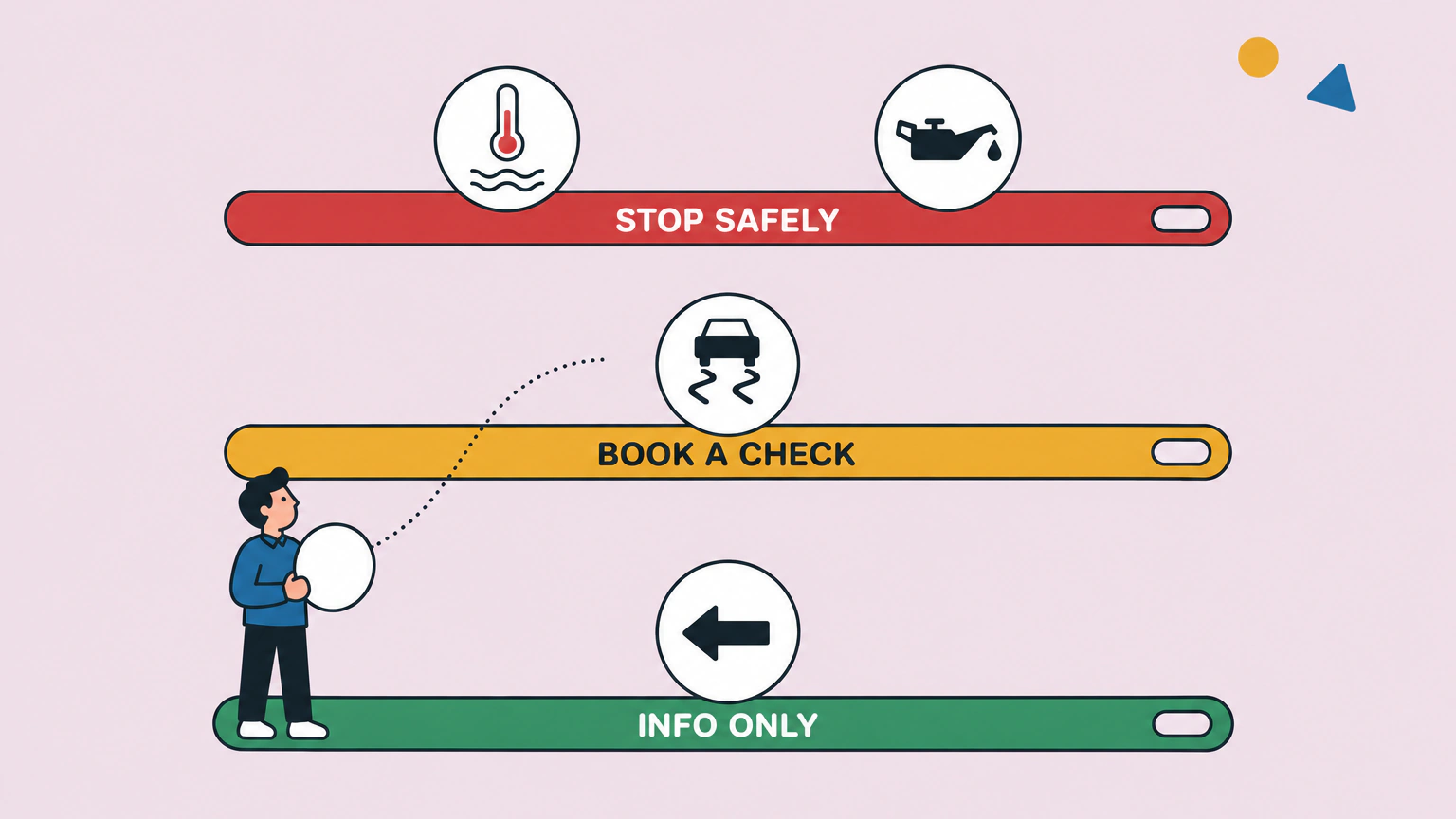
On a Canadian dash, colour helps identify the warning, but the symbol and message set the deadline. Red usually marks the warnings that demand the quickest response, while green or blue usually tells you a system is on. Yellow needs one more step: identify the symbol and read the message or manual. A tire-pressure warning needs attention now, while some faults let you drive carefully to a shop. The airbag light is allowed to be red or yellow. The oil pressure, coolant temperature, battery and fuel lights are prescribed with no colour at all. On those four, the red you're used to seeing is convention rather than law.
On this page
Start with the colour, then read the symbol
Symbols change from one carmaker to the next more than most drivers expect. Canada prescribes the identification and colour for many fitted tell-tales, so colour is a good first clue to which system is complaining. It doesn't replace the message beside the light or your owner's manual.
What red, yellow and green can tell you
A red warning usually calls for the quickest response, but the symbol still matters. Pull over only when you can do it safely. On a 100 km/h highway in November, signal, slow down and take the next exit or the first wide, flat shoulder clear of traffic. Then read the message or manual before deciding what comes next.
A yellow light can mark anything from a low tire that needs checking now to a system fault that needs a shop. Mazda tells drivers to slow down immediately for its tire-pressure warning. Its check engine light calls for lower speed and a dealer as soon as possible. The deadline comes from three things: the symbol, whether it's steady or flashing, and the car's message.
Green and blue are status. Canada's rules make the turn signal light green and the high beam light blue or blue-green. Nothing is wrong. Something is on.
The airbag light is the exception, and the regulation says so
Look at the airbag malfunction row of Canada's tell-tale table and the colour column reads "Red or yellow". The side airbag light gets the same choice. No other light in the table may be either one. So on the light where you'd most like colour to tell you how fast to move, it tells you nothing. That's the law working as written, not a carmaker being sloppy.
Treat it as book-it-now, whichever colour your car uses. Mazda's manual states the stakes plainly: "The system may not operate in an accident." It also counts a light that flashes, stays on, or never comes on when you switch on the ignition as a malfunction.
The symbols Canadian law puts in front of you
Canada doesn't leave dashboard identification to the carmakers. Canada Motor Vehicle Safety Standard 101, part of the federal Motor Vehicle Safety Regulations, sets identification and colour rules for listed controls, tell-tales and indicators when they are fitted. Its table describes each symbol and gives a colour where Canada prescribes one. The descriptions are written in words. The brake warning is "a circle containing an exclamation mark", drawn between parentheses. That's the red circle with an exclamation mark on your dashboard, so you can match the shape in front of you against the government's own description.
What the symbol looks like and what Canadian law says about it
| What the symbol looks like | Colour the regulation prescribes | What it means | What to do |
|---|---|---|---|
| A circle with an exclamation mark inside, between parentheses | Red or red-orange | Brake system malfunction. On many cars the same light also covers the parking brake and low fluid | Release the parking brake fully. If it stays on, park and have the brakes inspected before driving on |
| A circle with the letters ABS inside, between parentheses | Yellow | The anti-lock system has a fault. Normal braking still works, without the anti-lock help | Book a check as soon as possible. If the red brake light is on too, don't drive |
| A circle between dotted parentheses | Red or red-orange | The brake linings are worn to their limit | Check your owner's manual and book a brake inspection promptly |
| A circle between parentheses, its lower third filled with liquid | Red or red-orange | Brake fluid is low | Park and have the brakes inspected before driving on |
| A circle with the letter P inside, between parentheses | Red or red-orange | The parking brake is applied | Release it fully. If the light stays on, treat it as a brake fault |
| The back of a car above two thick squiggly lines, or the letters ESC | Yellow | Electronic stability control has a fault | Check the message or manual and book a check |
| The same car and squiggly lines with the word OFF beneath, or ESC OFF | Yellow | Stability control has been switched off | Switch it back on, unless you turned it off on purpose |
| A seated person wearing a seat belt, seen from the side, facing a circle | Red or yellow | Airbag malfunction. The airbag may not work in a crash | Book it now, whatever the colour |
| A seated person wearing a seat belt, seen from the front | Red | A seat belt is unfastened | Buckle up |
| An oil can seen from the side, with a drip from its spout | No colour prescribed | Engine oil pressure is low | Pull over and shut the engine off now |
| A thermometer standing on two wavy lines | No colour prescribed | The engine is running too hot | Pull over, shut the engine off and let it cool |
| A car battery with its positive and negative terminals | No colour prescribed | The charging system has stopped charging | Shed electrical load, get off the road and call |
Source: Motor Vehicle Safety Regulations, C.R.C., c. 1038, Schedule IV, s. 101 (CMVSS 101), table "Identification of Controls, Tell-tales and Indicators". The colours are the regulation's own, and the symbol descriptions follow its wording.
Five of those twelve lights are brake warnings, and they all end at the same counter: a brake specialist. The red circle carries more than one meaning by design. When a car uses one light for several brake conditions, the regulation says it has to be the brake malfunction symbol. So if it stays lit with the parking brake fully off, Mazda's manual says the fluid may be low or the system has a problem, and tells you to park somewhere safe. Once the car is on a hoist, here's what the brake work itself should cost.
The battery light needs a quick decision. It means the alternator or charging system has stopped doing its job, so you're running on whatever the battery has left. Mazda's manual says not to keep driving, because the engine could stop unexpectedly. Shed every load you can, get off the road, and have one of our battery and charging system shops test it.
Four lights the regulation never gives a colour
Oil pressure, engine coolant temperature, battery charging and fuel level each have a prescribed symbol. Their colour cell in the regulation's table is empty.
So carmakers choose. A 2021 Mazda CX-5 sold in Canada shows its battery, oil and coolant warnings in red and its low fuel warning in amber, and both choices are legal. Red on the first three is the maker's call, and it's the right one.
Don't let the missing rule soften them. Low oil pressure and a hot engine are the two lights Mazda's manual treats as shut-the-engine-off events, and a dead charging system can leave you stalled in traffic. Of the four, fuel is the only light that can honestly wait for the next gas station.
Your manual has to explain every required symbol, in English and French
Section 101 puts one more duty on the manufacturer, and this one is on your side: "The English and French versions of the owner's manual shall contain an explanation of every symbol, word, abbreviation or letter used to identify a control, tell-tale or indicator that is fitted in the vehicle and is required to be identified under this section."
That makes the book in your glovebox a primary source. Mind the last clause, though. The duty covers the symbols section 101 requires, not every icon a carmaker invents. Mazda's Canadian manual explains its own wrench and key symbols anyway, and both Mazda and Honda post their manuals online.
The tire pressure light is not like the others
Canada doesn't generally require passenger vehicles to have tire-pressure monitoring. A 2008 Canada Gazette amendment explained that Canada adopted TPMS symbols for vehicles equipped with the system without mandating the equipment. The United States requires TPMS on the light vehicles covered by FMVSS 138.
Transport Canada describes two kinds. One uses the ABS sensors to watch how fast each wheel turns, because an under-inflated tire spins slightly faster. The other puts a pressure sensor in each wheel and reads the pressure directly.
A flashing tire light points to a system fault
A steady tire-pressure light that came on without first flashing normally means a pressure warning. Under the American standard, it has to come on within 20 minutes after a tire reaches the applicable threshold. That threshold is 25 per cent below the pressure on your door label or a minimum in the standard, whichever pressure is higher. It may warn sooner. Transport Canada's advice is to measure your tires as soon as possible, because some systems only warn once a tire is well down.
A light that flashes for about a minute before staying on is reporting a system fault. FMVSS 138 permits that combined tell-tale pattern and specifies 60 to 90 seconds of flashing, repeated at each start while the fault remains. The standard also permits a separate malfunction tell-tale. Mazda's Canadian manual uses the combined pattern and warns that while it's showing, the system may not be able to tell you about low pressure.
Adding air won't repair a system malfunction. Replacement tires or wheels can keep a TPMS from working properly, and Transport Canada says changing or rotating tires without resetting some systems can trigger the warning. If it started after a seasonal swap, here's why the light can stay on after a changeover. Check your manual, then book a tire shop.
Why a cold snap can set it off
The light doesn't care how your tires looked in August. It measures against the pressure on the tire information label, which Transport Canada says usually sits on the edge of the driver's door or the door post. Cold does the rest. Transport Canada puts the loss at about 7 kPa, or 1 psi, for every 5 °C drop, and says tires also seep about 2 psi a month.
Why a cold morning can trip the light: A system built to FMVSS 138 must warn within 20 minutes after a tire reaches the applicable threshold. That threshold is 25 per cent below the door-label pressure or the standard's minimum pressure, whichever pressure is higher. It may warn sooner. If the 25 per cent point is the applicable threshold for a 35 psi placard, it works out to 26.25 psi. A tire last topped up two months ago could already be near 31 psi because Transport Canada estimates about 2 psi of loss a month. At roughly 1 psi per 5 °C, another 4.75 psi drop corresponds to about 24 °C of cooling. That example explains why the first cold snap can reveal a soft tire. It doesn't predict the exact temperature at which every system will warn.
The lights that are on nobody's list
Canada's table sets how listed tell-tales are identified when a vehicle has them. Your dash carries more than that, and the extras are where the make matters most. Here's what they generally mean, and how to find out for your own car.
The wrench, the triangle and the key
The wrench is the best case for reading your own manual. On a Mazda it's a maintenance reminder: the manual says it shows up when the preset maintenance period arrives or the engine oil is due for a change. On a Ford, the same drawing is the powertrain fault light. Ford's own guide says it comes on when the system detects a powertrain, four-wheel drive or all-wheel drive fault, and that Ford doesn't recommend driving with it lit. Same wrench, very different afternoon.
A yellow triangle with an exclamation mark is usually a catch-all master warning, and the detail sits in the driver display. On a Mazda, the amber triangle lights up together with a message, and the manual tells owners to read it and see a dealer. Read the message before you decide how urgent it is.
A key or padlock is the security system talking. On a Mazda, a red car with a padlock is the security light. If the engine won't start with the right key while that light stays on or flashes, the manual says the immobilizer system may have a malfunction. A key symbol can be far simpler, though. Mazda's white key warning means the fob battery is dead.
Diesel glow, all wheel drive and stop start
On a diesel, a coil-shaped light at key-on is normal. It's the glow plugs warming the engine. Mazda's manual says it goes out when preheating is finished, so wait for it before you start. A glow light that flashes is another matter. Mazda lists flashing, or a light that won't come on or won't go out, as a sign the glow plugs are due for maintenance or the system has a problem.
An all-wheel drive warning on a Mazda can mean a system fault, or front and rear tires of noticeably different sizes, which is worth remembering at changeover time. Its "4WD System High Load" message means the differential oil is too hot or the wheels are turning at very different speeds, like when you're spinning out of mud. Park, let it clear, then carry on.
The auto stop-start light is status, not a fault. Honda's green Auto Idle Stop indicator just means the engine has shut itself off at a stop to save fuel.
What to do in the first ten minutes
Before you phone anyone
- Pull over somewhere safe before you read anything. A parked car is a better place to think than a live lane.
- Note the colour first, then whether the light is steady or flashing. Both of those change what you do next.
- Release the parking brake fully and look again. If the red brake light stays on, park and have the brakes inspected.
- Tighten the fuel cap until it clicks. If the check engine light stays on or flashes, keep your speed down and book a check as soon as possible.
- Check all four tire pressures against the label on the driver's door frame, not the number moulded into the tire. The sidewall number is the pressure for the tire's maximum load.
- Turn off the heated seats, the rear defroster and anything else you do not need if the charging light is on.
- Open the glovebox and find the page for that symbol. Every required symbol has to be explained in there.
A light that never comes on: Some warning lights come on briefly when you start the car as a self-check. If a light your manual says should appear stays dark, have it inspected.
When to shut the engine off and call for a tow
A few lights mean that driving on causes damage that dwarfs the price of a tow. Low oil pressure is the first. Mazda's manual says not to run the engine at all with that light on, because the damage can be extensive. An overheating engine is the second. When the coolant light comes on steady, Mazda says to park immediately and stop the engine.
The third is a red brake light that stays on after you've fully released the parking brake. Mazda calls driving with it dangerous, because the brakes "may not work at all". A red brake light with the ABS light beside it gets the same answer. Mazda warns the rear wheels could lock sooner in an emergency stop, and says to have the car towed.
We can tell you what a symbol means. We can't see your car, so when the choice is between a tow bill and an engine, take the tow.
What it costs to find out what the light means
The first appointment buys you a diagnosis, and a free code read isn't the same thing. A code read plugs a scanner into the car's diagnostic port and hands you a trouble code. PartSource offers one free at participating stores, gives you the code for your own research, and won't clear the light. A diagnosis is a technician proving which part failed, and that's what you pay for.
Our own cost profiles for electrical diagnostic and repair work put a typical visit at $135 to $228, based on 746 of them. Our category page lists shops that run diagnostic scans. If the fault turns out to be the battery or the alternator, we've already laid out what battery and charging work runs in Canada.
Reading the code is not the repair
A stored code names a circuit or a system, not a broken part. That's why a good shop scans before it replaces anything, and why the time after the scan costs money. Someone has to test whatever the code points at.
Get the diagnosis price in writing before the work starts, and make sure the code itself is on the estimate. Then ask the one question worth asking at the counter: what test will you run to confirm it before you order the part?
Don't clear the code on your way in, either. PartSource won't, because clearing "will result in erasing critical data stored in the ECM for troubleshooting issues." Mazda goes further and tells owners not to disconnect the battery cables while the check engine light is on, because the engine could be damaged.
Questions drivers ask about warning lights
What does the yellow exclamation mark in a circle mean?
A yellow exclamation mark on the dashboard is usually the tire pressure light. Look closely and the shape is a tire's cross-section, open at the top with a treaded base. Steady means a tire is low, and flashing first means a system fault. A true circle between brackets is a brake symbol instead. Canada's rules make the main brake warning red or red-orange. On a Mazda, a yellow circle with P! means the electric parking brake has a fault.
Is it safe to drive with the ABS light on?
For a careful drive to a shop, usually yes. Mazda's manual says that with an ABS fault "your brakes will function normally as if the vehicle had no ABS." You lose the anti-lock help in a hard stop, not the brakes, so leave more room on ice. If the red brake light comes on too, stop and have the car towed.
Why is my tire pressure light on when my tires look fine?
Because looking fine isn't a measurement. On a system built to FMVSS 138, the warning must come on within 20 minutes after a tire reaches the applicable threshold. That threshold is 25 per cent below the door-label pressure or the standard's minimum pressure, whichever pressure is higher. It may warn sooner. Transport Canada says tires lose about 1 psi for every 5 °C drop. They also lose about 2 psi a month on their own, so the first cold snap can find the soft one. Check all four with a gauge while they're cold.
Can I get a free check engine light scan in Canada?
Yes, at some parts stores. PartSource advertises a free check engine light scan at participating locations, depending on staff and weather. You get the trouble code to research, and the store won't clear the light. Call your local store first. A code only points at a circuit, though. Confirming the failed part is a shop diagnosis, and our cost profiles put that electrical diagnostic work at $135 to $228.
What does the yellow triangle with an exclamation mark mean?
It's usually a general or master warning, and the triangle itself doesn't say what's wrong. The message in your driver display does. On a Mazda, for example, the amber triangle comes on together with a message, and the manual tells owners to read it and see a dealer. Read the message, then look it up in your manual to judge the urgency. Two red triangles nested one inside the other are your hazard flashers.
My warning light went off by itself. Do I still need to go in?
Often not, but don't forget it. Mazda's manual says there's no problem if a warning light turns off. If it stays on or comes back, Mazda's advice is to see a dealer. We'd still book a check for any red brake, oil or coolant warning, and for the airbag light, even after they've gone out. If a check engine light returns, get it scanned before anyone clears it.
Match the symbol to your manual, follow its immediate instruction, then book the shop that owns the system.