

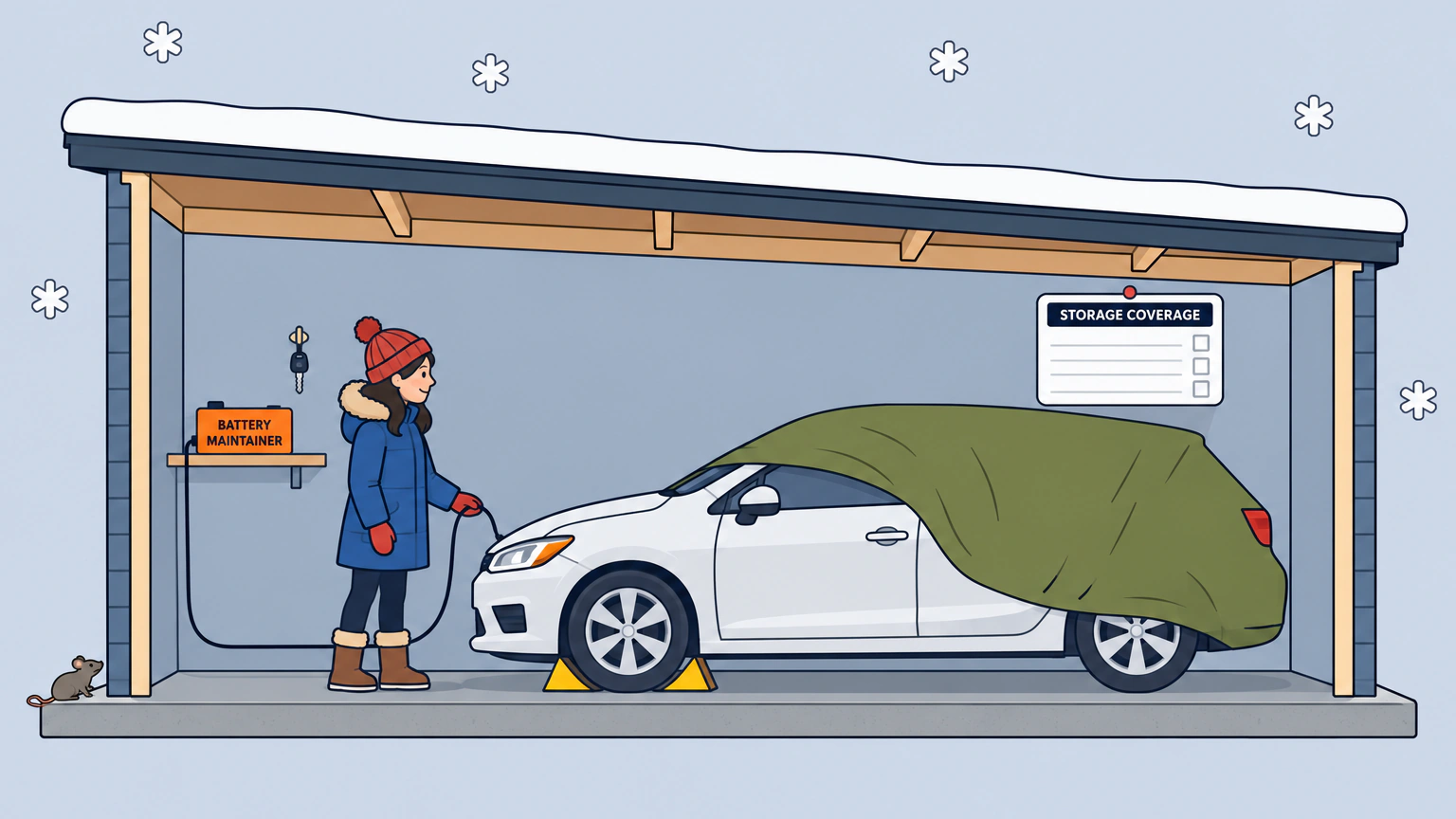
Our short answer: fill the tank, change the oil, put the battery on a maintainer or disconnect it, set the tires to the pressure on the door label, release the parking brake, then leave the car alone. If you start it at all, give it the full run Ford's manual describes: at least 15 minutes every 15 days, never a quick idle. Before you walk away, call your insurer. Each of the seven provinces we checked has a way to stop paying for road coverage on a stored car, as long as it doesn't move on a road until that coverage is back. We'll go province by province, then finish with April.
On this page
- Before you walk away: the fall checklist
- Where the usual advice and the owner's manual disagree
- Keeping the battery alive in an unheated garage
- Indoors, outdoors, and the mice
- Cutting your insurance while it sits, province by province
- Waking it up in spring
- Questions Canadians ask about winter car storage
Before you walk away: the fall checklist
Ford's storage steps are for a car parked 30 days or more, and GM's tire advice starts at a month. So this list is for anything longer than a month.
Before it sits: the fall checklist
- Pick a dry, ventilated spot off the street, indoors if you can.
- Wash it, wheel wells and underside included, then drive a few minutes so the brakes dry before you park it.
- Change the oil and the filter.
- Fill the tank until the pump clicks off the first time. Add a fuel stabilizer if it's sitting all winter.
- Check the antifreeze level and its strength.
- Set all four tires to the cold pressure on the door label.
- Park on level ground, in Park or in gear, with the parking brake released and the wheels chocked.
- Put the battery on a maintainer, or disconnect the negative cable.
- Cover the openings mice use, and take every scrap of food out of the car.
- Call your insurer or broker before the car's last drive, and the SAAQ or SGI if you're in Quebec or Saskatchewan.
Three of those items are where the usual advice splits.
Where the usual advice and the owner's manual disagree
We looked at eleven Canadian guides on how to store a car for winter, and none of them quotes a carmaker. They split on the three questions owners ask most. So we went to the people who built the cars and read Ford's and GM's own storage instructions.
What the manual says against the usual storage advice
| The question | What many guides say | What the carmaker's manual says | What we'd do |
|---|---|---|---|
| Should you start it during storage? | Don't start it at all (2 of the 11 guides we measured) | Ford: every 15 days, at least 15 minutes at fast idle with the defroster on, until the engine reaches normal operating temperature | Ford's full run, outside the garage, or no start at all. Never a five-minute idle. Ask your insurer first if road coverage is suspended |
| When do you change the oil? | Before storage, or in spring instead | Ford: oil and filter before storage, and again before you use the car again | Before storage. Add the spring change if you can |
| How much air goes in the tires? | The maximum, or the sidewall number (6 of 11) | Ford: the cold pressures on the door label, reset in spring. GM: for a month or more, take the weight off the tires | The door label. Check it monthly if you can reach the car |
| Parking brake on or off? | Off, with the wheels chocked | Ford: make sure the brakes and parking brake fully release | Off, in Park or in gear, wheels chocked, on level ground |
| What about the battery? | A maintainer, or take it out | GM: remove the negative cable or use a trickle charger. Ford: disconnect it, or a trickle charger for longer storage | A maintainer if there's an outlet. Otherwise disconnect it, or bring it inside |
| How full should the tank be? | Full, with a fuel stabilizer | Ford: fill with high-quality fuel until the pump nozzle first shuts off | Full to the first click. Add a stabilizer for a long winter, as CAA-Québec advises |
Ford: 2025 Maverick owner's manual, the edition for Canada, the U.S. and Mexico. GM: 2025 Chevrolet Equinox owner manual, U.S. and Canada edition. If your own manual says something different, follow yours.
Should you start it every couple of weeks?
Ford's routine is specific: "Start the engine every 15 days for a minimum of 15 minutes. Run at fast idle with the climate controls set to defrost until the engine reaches normal operating temperature." Fast idle means a little above normal idle speed. With your foot on the brake, you also shift through all the gears. Then a second step: "Move vehicles at least 7.5 m (25 ft) every 15 days to lubricate working parts and prevent corrosion."
Two of the eleven guides say never start it, and Canada Drives warns that "short, infrequent idling can actually do more harm than good." The two camps are closer than they sound. Canada Drives allows the same full warm-up for anyone who does start the car. The habit to kill is the five-minute idle. Repeated cold short runs can leave fuel that dilutes or washes away the oil film on cylinder walls. A monthly drive by a trusted neighbour beats all of it, but that needs road coverage.
The catch is insurance. Once you've switched to storage coverage, Ford's moving step is off the table. ICBC's storage policy covers a car that "will not be driven on a highway, private road, or private property," and MPI says a Lay-Up car "should not be operated at any time." Ask your insurer before you even start it in place.
Our verdict: Ford's full run every 15 days, if your coverage allows it and you'll keep it up. Otherwise, don't start it at all, and keep the battery charged.
Never run it in the garage. GM's manual is blunt: "Never park the vehicle with the engine running in an enclosed area such as a garage or a building that has no fresh air ventilation." If you follow Ford's 15-minute routine, clear any snow from the tailpipe before starting, back the car out, and stay with it.
If your garage is attached to the house, read why the open door isn't enough before you try even a short run.
Change the oil before it sits, and again in spring
Ford wants clean oil going in and coming out. The manual says to change the oil and filter "prior to storage because used engine oil contains contaminants which may cause engine damage." On the way out of storage, it adds: "We recommend that you change the engine oil before you use your vehicle again." CAA-Québec's storage list puts the change in the fall too.
One Canadian hobbyist's guide says skip the fall change and do it in spring. If you'll only pay for one, we'd do the fall. That's the oil the engine sits in for five months, and used oil carries a little fuel that seeped past the piston rings.
When you book the oil change before it sits, our budget estimate is $70 to $90 for conventional oil and filter, or $90 to $120 for full synthetic, up to 5 litres. Here's what an oil change should cost and why.
Tire pressure: the door label, not the sidewall
Six of the eleven guides say to pump the tires to the maximum, or to the sidewall number. Ford says otherwise: to minimize flat spots, inflate all four tires "to the recommended cold pressures" on the Safety Compliance Certification label or Tire Label, found on the driver's door edge or pillar. Reset them to the label in spring. GM goes further for a car stored a month or more: "remove the tires or raise the vehicle to reduce the weight from the tires." Long parking, it says, "can cause flat spots on the tires that may result in vibrations while driving."
We'd follow Ford, and check the pressure monthly if you can reach the car. Raising a car is a job for proper stands, not a pile of blocks. Some enthusiasts say flat spots on modern radials roll out on the highway. Maybe, but the door label costs nothing. Storing a spare set of tires is its own job.
Keeping the battery alive in an unheated garage
It's April, key in hand, and all you get is a click. In a Canadian garage, the worse news is a battery that froze along the way. Battery University says freezing a lead-acid battery "leads to permanent damage," and a run-down one freezes far sooner. Citing the Battery Council, it puts a weak battery's freezing point at about -15°C, against -55°C fully charged. That's the whole case for keeping it charged in a Prairie garage. And it does run down, because a parked car still puts a small load on the battery. Ford suggests disconnecting it for exactly that reason.
A maintainer, a loose cable, or a shelf in the house
GM's line: "Extended Storage: Remove the black, negative (−) cable from the battery or use a battery trickle charger." Ford says disconnect the 12-volt battery or use a trickle charger for longer storage, and expect to reset memory features if you disconnect it.
For a Canadian winter, we'd pick a maintainer if there's an outlet. Use a maintainer matched to your battery type and your manual. Keeping a lead-acid battery charged lowers its risk of freezing. With no outlet, our second choice is to disconnect the negative cable. In a very cold garage, bring the battery inside and top it up once or twice, as CAA-Québec suggests.
In spring, put a charger on any battery that sat, because an alternator may not fully recharge a deeply discharged one. If you think it's done, a battery shop can test it first. Our budget estimate is $150 to $450 installed for a standard flooded battery, or $260 to $650 for an AGM, the sealed type many stop-start cars need. And for the morning it won't start, here's what to do.
Hybrids and electric cars
The 12-volt battery in a hybrid or electric car needs care too. Your manual sets the big battery's storage charge. For an electric car, CAA-Québec says to look it up there, and notes it's often 60% to 80%. Follow your hybrid's manual for any charging or running schedule during storage. For the long view, read what winter does to an EV battery.
Indoors, outdoors, and the mice
Where the car sits decides how much of the rest matters. A dry garage forgives a lot. A driveway forgives less.
If it has to winter outside
Ford's first rule is a "dry, ventilated place." A car stored outside, it adds, needs regular maintenance against rust and weather damage, plus a wash now and then. GM asks for a cool, dry, clean spot out of direct sunlight, to slow tire aging. Use a breathable cover, not a plastic tarp, which traps moisture. BrokerLink gives the same advice.
Keep it away from trees. Leaves clog the sunroof drains and the cowl (the vent panel at the base of the windshield), and that's how parked cars flood. Clear leaves and debris from the sunroof track and the intake area below the windshield.
The driveway is fine. The street usually isn't, because storage coverage tends to end at the curb. Before you park it, get a car wash with an underbody rinse. Here's why the underbody wash matters.
Keeping mice out over the winter
CAA-Québec's advice: cover the engine and air-intake openings with fine mesh, leave no food in the car, and check for nests before you restart it. Ford's spring list says to check under the hood "for any foreign materials such as mice or squirrel nests," and the exhaust too. The insurance reason to bother: MPI's 2025 Guide to Autopac says Lay-Up coverage doesn't cover "claims where the vehicle owner failed to take reasonable precautions to protect the vehicle from rodent damage."
Cutting your insurance while it sits, province by province
On a parked car, you can usually stop paying for road coverage and keep the part that pays for theft, fire and vandalism. How you do it depends on who insures cars where you live: a private insurer using a standard form, or a public insurer with its own rules. We're not your broker. Confirm which coverages and fees apply before you cancel anything.
How to stop paying for road coverage on a stored car, in seven provinces
| Province | What to ask for | What stays covered | Money to know about | The catch |
|---|---|---|---|---|
| Ontario | OPCF 16, Suspension of Coverage, then OPCF 17 to switch it back | Whatever you carry beyond the cancelled coverages, such as comprehensive | No refund if the suspension runs under 45 consecutive days | Don't use the car. Nothing that happens before OPCF 17 is paid under the cancelled coverages |
| Alberta | S.E.F. No. 16, then S.E.F. No. 17 | The same pattern as Ontario. Direct compensation still applies while the car isn't in use | Your insurer writes the minimum number of days on the form | Don't use the car before S.E.F. No. 17 |
| P.E.I. | S.E.F. No. 16, then S.E.F. No. 17 | The same pattern as Ontario | No refund if the suspension runs under 60 consecutive days | Don't use the car before S.E.F. No. 17 |
| B.C. | Cancel your Autoplan and return the plates, then buy ICBC's Vehicle in Storage Policy | What you buy: collision, comprehensive, specified perils or third party liability | The refund on cancelling depends on the time left. A cancellation fee may apply | No driving under storage coverage alone, even on private property, and no highway parking. A breach forfeits later claims under this policy |
| Manitoba | Switch your Autopac to Lay-Up coverage | Fire, theft, vandalism, hail and lightning, up to $70,000 including taxes | Short-rate cancellation fees when you switch. You keep the plate | No collision cover, nothing stored on a public roadway or outside Manitoba, and no cover for claims against you |
| Quebec | Store (remiser) the registration with the SAAQ, and call your insurer | Up to your insurer. CAA-Québec says keep theft, fire and vandalism cover | A partial refund of the registration, depending on the dates | It can't sit on a public road, and the plate stays on the car |
| Saskatchewan | Cancel the registration with SGI, then talk to your broker about any package policy | Up to your package policy | A $25 cancellation fee for the plate classes on SGI's chart, taken from your refund | It can't be driven while it's unregistered |
Each row comes from the insurer's or the regulator's own form or page.
Ontario, Alberta and P.E.I.: a form that pauses road coverage
Ontario's OPCF 16, "Suspension of Coverage," cancels liability, accident benefits (the injury cover), uninsured automobile, direct compensation (which pays for your car's damage when another driver is at fault) and collision. You agree the car stays out of use. Your insurer may refund part of the premium when you sign or when you reinstate, but not if the suspension runs under 45 consecutive days.
OPCF 17 switches the cancelled coverages back on, and its wording rules out backdating. Nothing that happens in between is paid under them. That's "comp only" in practice: comprehensive only, the cover for things like theft, fire and vandalism.
Alberta's 2022 S.E.F. 16 works the same way. Your insurer writes the minimum number of days on the form, and direct compensation still applies to a loss while the car isn't in use. On P.E.I.'s S.E.F. 16, there's no refund if the suspension runs under 60 consecutive days.
B.C. and Manitoba: a storage policy instead of a pause
In B.C., plates and insurance go together, so you cancel your Autoplan by bringing the plates to your broker. The refund depends on the time left, and a cancellation fee may apply. ICBC's Vehicle in Storage Policy then covers the car with whatever you buy: collision, comprehensive, specified perils or third party liability.
Its conditions are strict. The car must be "not currently licensed" and stored on private property in Canada or the U.S. A designated spot at your apartment or condo counts. It also "will not be driven on a highway, private road, or private property, or parked on any highway." The policy has exceptions for garage operators using special plates and for a temporary operation permit. Otherwise, a breach forfeits later claims under this policy.
In Manitoba, you switch your Autopac to Lay-Up coverage. It covers fire, theft, vandalism, hail and lightning, up to $70,000 including taxes. It doesn't cover collision, claims others make against you, or a car stored outside Manitoba or on a public roadway. You keep the plate, but neither it nor the insurance is valid for driving. Short-rate cancellation fees apply when you switch, so the refund comes out below a straight daily share. Switch back, and you may get a credit.
Quebec and Saskatchewan: start with the registration
Quebec splits the job. The SAAQ handles the registration, and your private insurer handles the car. You remiser (store) the vehicle with the SAAQ online through SAAQclic, by phone, at a service point or at a CAA-Québec registration centre. Depending on the storage date, the SAAQ says you may get part of your registration fees back. CAA-Québec adds that the plate stays on, the car stays off public roads, and your dates should match the start or end of a month. Tell your insurer separately, and keep theft, fire and vandalism cover. One more SAAQ rule: a car stored for more than 12 months needs a mechanical inspection before it goes back on the road.
In Saskatchewan, you cancel the registration with SGI at a motor licence issuer, through MySGI, through someone you authorize in writing, or by mail or fax. A $25 fee applies to the plate classes on SGI's chart, taken from your refund. Any package policy (extra coverage bought on top) is cancelled or changed separately through your broker. Owners of seasonal vehicles, such as motorhomes and motorcycles, can keep the plate for next season.
If your province isn't in the table
New Brunswick, Nova Scotia, and Newfoundland and Labrador use private insurers too. Ask yours whether it offers a suspension of coverage endorsement, and how many days it must run before you see a refund.
Don't drive it "just once". Every one of these routes assumes the car stays put. Ontario's form has you agree the car will be "continuously taken out of use", and under ICBC's storage policy one breach voids every claim after it. Get road coverage back first, then drive.
Waking it up in spring
The order matters. Get road coverage restored before you drive.
Waking it up: the spring checklist
- Get road coverage back, and get it confirmed, before the car moves.
- Check under the hood and in the tailpipe for nests.
- Reconnect or charge the battery. If you took it out, clean the cable ends first.
- Set the tires back to the pressure on the door label.
- Check the oil, coolant and washer fluid, and look under the car for fresh drips.
- Check the wiper blades for cracks or stiff rubber.
- Check brake pedal operation before moving. If braking feels normal, drive gently for about 10 minutes, braking lightly and often to clear surface rust.
- Book the oil change Ford recommends before regular driving.
If the brakes grind or feel wrong, a warning light stays on, or there's a fresh puddle under the car, book a mechanic.
Questions Canadians ask about winter car storage
How often should you start a car that's in storage?
Every 15 days, properly, or not at all. Ford's manual asks for at least 15 minutes at fast idle with the defroster on until the engine reaches normal operating temperature, then a shift through all the gears. A five-minute idle is the habit to drop. If your road coverage is suspended, ask your insurer before you start it. If you can't do the full run, leave it alone with the battery on a maintainer.
Should you change the oil before storing a car for winter?
Yes. Ford's manual says to change the oil and filter before storage "because used engine oil contains contaminants which may cause engine damage", and it recommends another change before you drive the car again. One Canadian hobbyist's guide says to wait for spring instead. If you'll only pay for one, do it in the fall. Our budget estimate for up to 5 litres, oil and filter included, is $70 to $90 for conventional oil or $90 to $120 for full synthetic.
Do I need insurance on a car that's in storage?
You can usually stop paying for road coverage, but keep the part that pays if the car is stolen, catches fire or is vandalized. CAA-Québec gives that advice for Quebec cars, and every province we checked offers a way to keep it: what's left after Ontario's OPCF 16, an ICBC storage policy, or Lay-Up coverage in Manitoba. If the car is financed or leased, ask your lender before you change anything.
What does OPCF 16 cover, and is it the same as comp only?
OPCF 16 is how Ontario drivers get to comp only. It cancels liability, accident benefits, uninsured automobile, direct compensation and collision cover while the car is out of use, and leaves the rest of your policy, such as comprehensive, in place. There's no refund if the suspension lasts less than 45 consecutive days. OPCF 17 switches the cancelled coverages back on, and it doesn't reach back to cover anything that happened in between.
Should I disconnect the battery or use a maintainer?
Both work, and both carmakers we read allow either. GM says to remove the negative cable or use a trickle charger. Ford says disconnect it, or use a trickle charger for longer storage. In an unheated garage we'd pick the maintainer, because a battery that runs down can freeze. Battery University, citing the Battery Council, puts a weak battery's freezing point near -15°C, against -55°C fully charged.
Can I store my car outside for the winter?
Yes, on your own driveway or another private spot, with more work. Ford's manual says a car stored outside needs regular care against rust and weather damage, and an occasional wash. Use a breathable cover, not a plastic tarp, and block the openings mice use. What you can't do under ICBC's storage policy or Manitoba's Lay-Up coverage is leave it on a public road.