

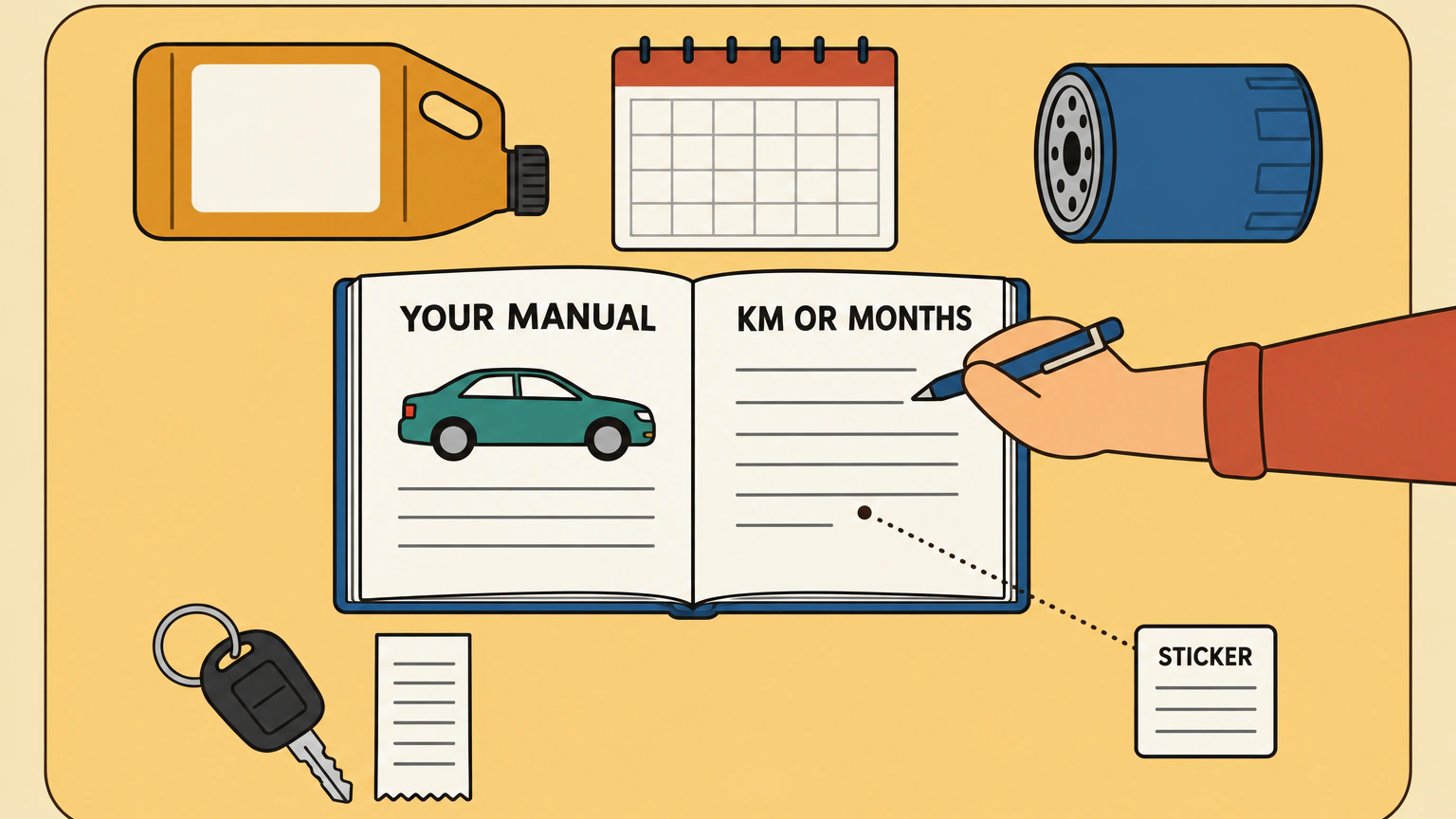
A typical oil change in Canada costs about $44 to $92 in our own quote data, and full synthetic can climb past $100. The bigger number is how often you pay it. The Canadian schedules we checked use 8,000 km or 6 months, 12 months or 16,000 km, or an oil-life monitor. Following a 5,000 km, three-month windshield sticker can mean four oil changes a year where your manual asks for one.
On this page
What an oil change costs in Canada
Start with the number you came for. Our own oil change listings put a typical visit at $44 to $92. The ranges Canadian publishers print for conventional oil sit a little lower than that. Synthetic runs higher: NAPA Canada's Ontario range tops out at $125, and CARFAX Canada's national range reaches $137. So $110 for full synthetic isn't a rip-off on its face, while $110 for conventional oil deserves a question.
NAPA Canada lists what moves a quote: where you live, what you drive, which oil goes in, the shop's labour rate and whether the filter gets changed too.
Your engine's oil sets the price
Conventional oil is the cheapest, full synthetic the priciest, and a synthetic blend mixes the two. You rarely get the final say, though. The owner's manual names the grade, and sometimes a standard the oil has to meet. One Honda owner's manual calls for 0W-20 oil with the API Certification Seal, which in Honda's words shows the oil "meets the American Petroleum Institute's latest requirements." GM Canada tells owners to check the manual for the correct grade, and dexos1 full synthetic is among the oils its dealers offer. As NAPA Canada puts it, "you can't just pour in 5W30 like the old days."
That's where the money sits. On CARFAX Canada's averages, synthetic runs about $40 more a visit than conventional. Before you compare two quotes, ask which oil each one is for.
| Where the figure comes from | What it covers | Price (CAD) | Basis |
|---|---|---|---|
| Our own oil change listings | A typical visit | $44 to $92 | 660 cost profiles |
| NAPA Canada | Conventional oil, Ontario | $35 to $75 | NAPA's published range, 2024 |
| NAPA Canada | Synthetic oil, Ontario | $65 to $125 | NAPA's published range, 2024 |
| CARFAX Canada | Conventional oil, Canada | $42 to $73, about $60 on average | CARFAX Canada, 2024 |
| CARFAX Canada | Synthetic oil, Canada | $66 to $137, about $100 on average | CARFAX Canada, 2024 |
What our own oil change listings show
Our own quote data across 660 cost profiles on our oil change listings puts a typical visit at $44 to $92. That's our aggregate for this one category, priced to a location rather than set as a fixed national line. Use it to check a quote. It isn't a price list. If a shop lands inside it for the oil your manual names, you're looking at a normal price. If it lands well above, ask what's in it. Part of the gap may be the oil. Part may be extras you never asked for. When you're ready to compare, start with oil change shops near you.
How often you really need one
The shop has just stuck a small card on your windshield, with a date three months out and a kilometre reading 5,000 higher than today's. It looks official. It's really a number somebody typed into a little printer at the counter, and it isn't always right for your car.
In 2018, CBC Marketplace took hidden cameras into six Greater Toronto Area dealerships, and four of them advised changing the oil more often than the owner's manual said. Asked about a 2013 Jeep Wrangler whose manual allows up to 12 months or 16,000 km, one adviser said: "We recommend every 5,000 kilometres or three months." That Wrangler had gone eight months and about 1,000 km since its last change, and the oil analysis firm that tested it for CBC said, "I would not change this oil right now."
Two dealerships stood by their staff, calling the carmaker's schedule only "the minimum maintenance required." The mechanic CBC brought in, Mark Whinton, wasn't having it. "This is 25-year-old advice," he said. In his view the owner's manual holds everything the carmaker knows, "and that is king." We agree.
What five carmakers tell Canadian owners
This comes straight from the carmakers' own Canadian manuals and service pages.
| Carmaker, and where it says so | How the schedule works | When the oil and filter get changed | The limit if no light comes on |
|---|---|---|---|
| Mazda, 2024 CX-5 manual | Canada residents follow the severe schedule | Every 8,000 km or 6 months | Whichever comes first |
| Toyota Canada, service schedule | A visit every 6 months or 8,000 km | At the 12 month or 16,000 km visit | Whichever comes first |
| Honda Canada, Maintenance Minder | The car estimates oil life | When the 15% oil life alert appears | Once a year |
| GM Canada, Chevrolet and GMC | Engine Oil Life System | Within 965 km of the change message | At least once a year |
| Ford, 2020 Mustang manual | Intelligent Oil-Life Monitor | When the monitor calls for it | One year or 16,000 km |
The spread is twofold between two mainstream brands. Mazda's Canadian schedule changes the oil every 8,000 km or 6 months, and Toyota Canada's changes it at the 12 month or 16,000 km visit. The other three let the car decide, then cap the wait at a year.
Toyota's is the schedule people misread. Toyota Canada asks you in every 6 months or 8,000 km, but its own service page puts the oil and filter change at the 12 month visit, and the 6 and 18 month visits are check-ups. At least one Canadian cost page reads that 8,000 km visit as the oil interval. It isn't.
Schedules also change between model years. Mazda's service page says its models with condition-based maintenance can go up to 12 months or 16,000 km, so look up your exact car, then find scheduled maintenance shops that will service to it.
Severe service, and why so much Canadian driving counts
Carmakers that publish a severe schedule also say what puts you on it, and that's where the Canadian argument lives.
Mazda doesn't leave it to you. Its 2024 CX-5 manual lists the conditions, from repeated short trips to long stretches in the cold, then adds: "(Canada residents follow Schedule 2.)" Hyundai's general-market manual for the 2025 Tucson counts repeated trips under 16 km in freezing temperatures as severe, along with "salt-spread roads" and "very cold weather." In a 2019 statement to CBC, Hyundai Canada went further: "Broadly speaking, most Canadians fall under severe conditions simply due to weather and temperature." Small, milder pockets such as Vancouver Island may be exempt, it said.
George Iny of the Automobile Protection Association told CBC that winter driving "probably is a severe usage situation because of the cold, because most of us live in a highly urbanized setting where we do a lot of short trips." Whinton says the cold-weather argument no longer holds water, because cars are "all thermostatically controlled."
Our ruling: your manual decides. Where it gives you a choice, base it on how and where you drive. If most of your winter driving is short trips in freezing weather, on salted roads or with long idling, follow the severe schedule your manual gives. For drivers in those conditions, NAPA Canada suggests a change "every 6,000 km in the winter instead of 12,000 km." The same cold starts and short hops decide whether you need a block heater.
Oil life monitors and the once a year limit
Honda, GM and Ford hand the timing to the car. Honda's Maintenance Minder estimates oil life from engine sensors, speed, temperature and time spent in harder conditions, and alerts you at 15%. GM wants the change within 965 km of the "Change Engine Oil Soon" message, and Ford's monitor sets the interval from how you use the car. Because Honda's system counts temperature, a winter of short, cold trips can bring its alert on early.
All three cap the wait. Honda says to "Replace oil 1 x per year if oil life has not expired after 12 months," GM says the oil and filter "must be changed at least once a year," and Ford says never more than one year or 16,000 km. A low-kilometre driver hits that calendar limit long before the monitor speaks up.
A monitor can't tell you how much oil is in the engine, either. Honda says its system "doesn't have sensors to monitor engine oil level" and tells owners to check it regularly, so pull the dipstick now and then. Mazda's condition-based models flag a due change with a wrench light, and if the yellow wrench on your dashboard has you wondering, we decode it with the other yellow symbols.
What the interval costs you in a year
The sticker, Mazda's schedule and Toyota's each set two limits, kilometres and months, and whichever you reach first triggers the change. That one rule sets your yearly bill.
| You drive a year | 5,000 km or 3 months | 8,000 km or 6 months | 16,000 km or 12 months |
|---|---|---|---|
| 8,000 km | 4 | 2 | 1 |
| 16,000 km | 4 | 2 | 1 |
| 24,000 km | 4.8 | 3 | 1.5 |
The 5,000 km column is the schedule a dealership adviser gave on CBC's hidden camera. The 8,000 km column is Mazda's Canadian schedule, and the 16,000 km column is Toyota Canada's oil interval and Ford's cap.
Start with how far you drive. At 8,000 km a year, the calendar decides on every schedule, because the months run out long before the kilometres do. At 24,000 km, the odometer decides instead. That's why fractions appear: 4.8 on the sticker schedule means four visits in some years and five in most. At 16,000 km, the kilometre and month limits arrive together on both carmaker schedules, while the sticker's three months still come first.
Now put a price on it. Say your car takes full synthetic and your shop charges $90 a visit. That's an example, not a quote, but it sits inside our own range and both published synthetic ranges. A 16,000 km driver on the three-month sticker pays $360 a year. On Mazda's Canadian schedule, it's $180. On a once-a-year schedule, it's $90. At 24,000 km a year, the annualized costs are $432, $270 and $135.
At 16,000 km a year, that's a $270 gap between the sticker and a once-a-year schedule, for the same car and the same oil. When the shop prints your next sticker, ask for your manual's interval, not the shop's default.
What's on the bill besides oil and a filter
Look down the receipt and you'll find the oil, the filter, the labour and the tax. Then there's the line people ask about more than the rest: an environmental or recycling charge. Part of that can reflect provincial recycling-program costs. Part may be the shop's own fee under a similar name. The program rates below show the official portion, but retailers decide whether to pass it on as a separate line.
The provincial recycling rates behind your oil change
Provincial programs use fees on new oil, filters or containers to cover collection and recycling. Alberta's recycling authority says it plainly: "Environmental fees help fund the recycling system." Here are the program rates for new oil and filters under the Used Oil Management Associations' schedule in force since August 1, 2026.
| Province | On each litre of oil | On each oil filter under 8 inches | Oil and one filter, five litres |
|---|---|---|---|
| British Columbia | $0.08 | $0.65 | $1.05 |
| Alberta, Saskatchewan, Manitoba | $0.06 | $0.55 | $0.85 |
| Ontario | No charge on the oil | $0.50 | $0.50 |
| Quebec | $0.07 | $0.45 | $0.80 |
| New Brunswick, Nova Scotia, Prince Edward Island | $0.07 | $0.50 | $0.85 |
| Newfoundland and Labrador | $0.17 | $1.00 | $1.85 |
The program rates are small. For five litres and one ordinary filter, they run from $0.50 in Ontario to $1.85 in Newfoundland and Labrador. Ontario has no charge on the oil itself, because its program collects fees from the producers of filters and containers instead. A longer filter, 8 inches and up, carries more: $0.80 to $1.45, depending on the province.
Red flag: The published recycling rates are small. Ask what a bigger line covers. The program rates on five litres and one small filter total $0.50 to $1.85, depending on the province. The fee may sit inside the product price instead of appearing as its own line. If an environmental, disposal or shop-supplies fee is several dollars, the official oil-and-filter rates explain only part of it. Ask what else it covers before you pay.
The extras offered at the counter
While the car is up, you may be offered an engine air filter, a cabin air filter, wiper blades, an engine flush or a fuel injection cleaning. Some of that is real maintenance. The test is whether your manual's schedule calls for it now.
Honda's schedule codes list engine and cabin air filter replacement as their own service items, shown by the Maintenance Minder when they're due. Toyota Canada recommends its combustion and fuel injection cleaning service about every 80,000 km, not at every oil change. We didn't find an engine flush anywhere in the Mazda, Toyota, Honda or Hyundai schedules we read. As for why the pitch comes so often, a former service adviser told CBC that frequent visits are "an opportunity for us to find things on the vehicle that may be wrong."
For work outside the schedule, ask what the shop found and why it is needed before you agree.
What your oil change receipt should show
- The date and the odometer reading when the work was done, so your next interval counts from a real starting point
- The oil's grade, matching the one your manual names, such as 0W-20, and whether it's conventional, blend or full synthetic
- A new oil filter, listed as its own line, so you can see what was billed
- The oil life monitor reset, if your car has one, noted on the bill so the next alert comes at the right time
- The next change due at your manual's kilometres and months, not a shop default, written on the receipt and the sticker
Doing it yourself, and where the old oil goes
On paper, the saving is real. NAPA Canada says a five-litre jug of motor oil typically costs $30 to $60, and you'll need a filter on top.
The part people forget is the old oil and filter. Alberta's recycling authority warns that used oil can cause "significant damage to land and water if inappropriately discarded," and provincial program fees on new oil and filters help pay for the collection sites that take them back. Each has its limits. Quebec's program wants oil in its original container, closed with its cap, and says: "The maximum drop-off quantity is 20 litres." Alberta's sites often take up to 20 litres of oil or 20 filters. The provincial programs also set container rates from $0.12 to $0.30 per litre of jug size, so the rate on a five-litre jug is $0.60 to $1.50.
Know where to stop. If the car has to go up on a hoist to reach the drain plug, or the filter sits behind a plastic undertray, the shop price starts to look fair. That's the moment to find a mechanic you trust.
Frequently asked questions
How much should a full synthetic oil change cost in Canada?
Expect roughly $65 to $137. NAPA Canada's Ontario range for synthetic is $65 to $125, and CARFAX Canada's national range is $66 to $137, with an average around $100. Our own listings' typical visit tops out at $92. A synthetic quote well above those ranges deserves a line-by-line explanation before you pay.
Do I really need an oil change every 5,000 km?
Probably not as a fixed default. Mazda and Toyota use longer fixed intervals, while Honda, GM and Ford use oil-life monitors. Ford's 2020 Mustang manual says extreme use can bring its expected range down to 4,800 to 7,999 km. In 2018, CBC Marketplace reported that many vehicles built in the previous five years needed a change only once a year, up to 16,000 km. Your manual's interval is the answer, not the sticker's.
How often should I change my oil if I don't drive much?
Go by the calendar, because the time limit arrives first. Honda, GM and Ford all say to change the oil at least once a year, even if the monitor still shows oil life left. Mazda's Canadian schedule sets 6 months, and Toyota Canada changes the oil at the 12 month visit. Unless the monitor calls for it sooner, that's one visit a year on those three monitor brands.
Do I have to get my oil changed at the dealer to keep my warranty?
Carmakers word this differently, so read your own warranty booklet and keep every receipt. Honda's manual accepts Genuine Honda oil "or another commercial engine oil of suitable viscosity," and synthetic oil with the API Certification Seal in the right grade. Mazda Canada says failing to perform scheduled maintenance and use Mazda parts as specified "may jeopardize your warranty coverage." Your own warranty booklet is the document that decides, not us.
What is the environmental fee on my oil change bill?
It can include provincial recycling-program costs and a shop fee. The published program rates on five litres of oil and one small filter total $0.50 to $1.85, depending on the province. The fee may sit inside the product price instead of appearing as a separate line. If the line is several dollars, ask what else it covers.
Should I follow the severe schedule in winter?
Yes, if your winter driving matches the severe conditions in your manual. Follow the interval for your own car. The 2024 Mazda CX-5 manual puts Canadian owners on Schedule 2 all year.