

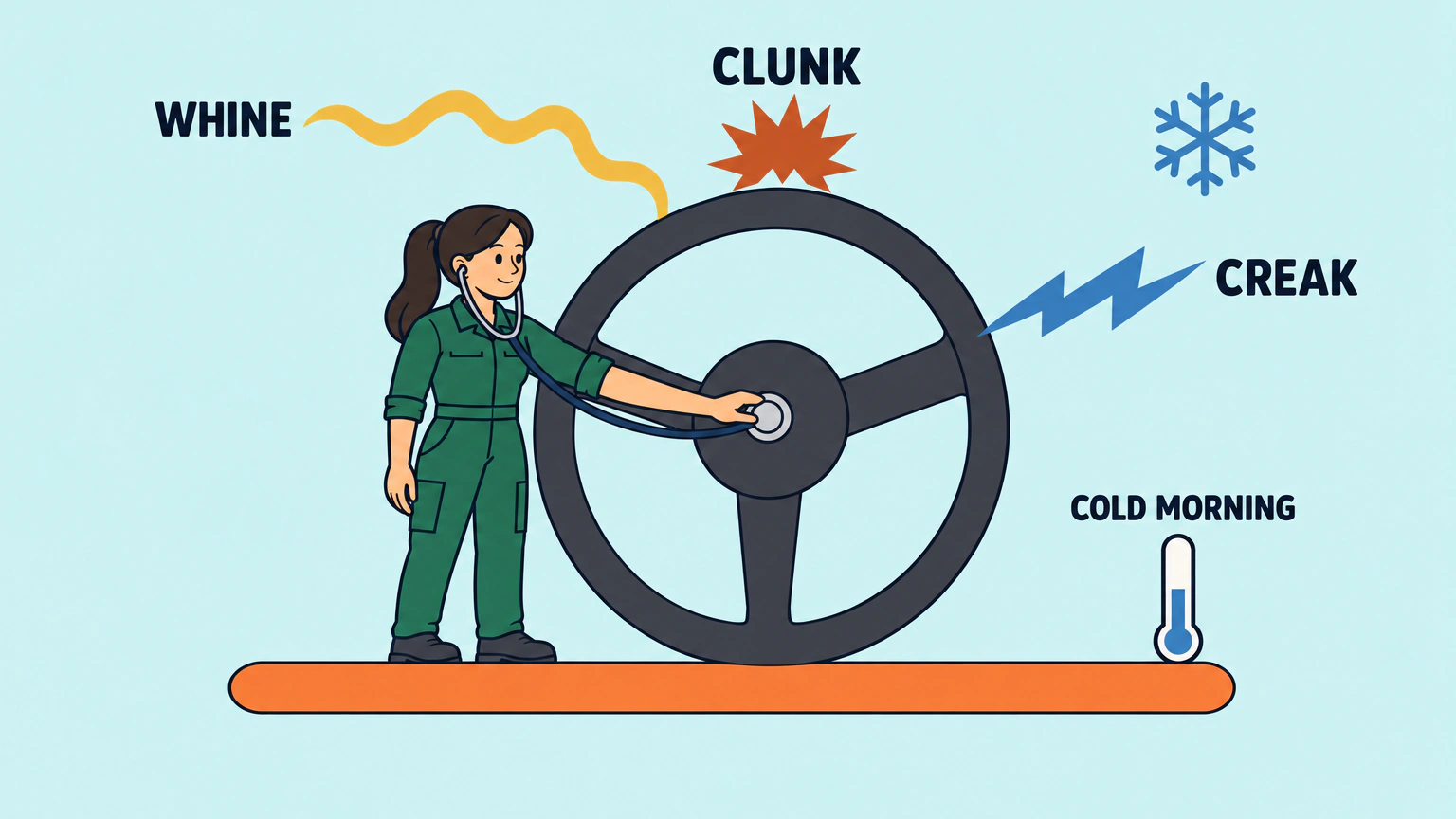
A whine or groan usually comes from the power steering, a clunk from a worn joint or link in the front suspension, a creak at parking-lot speed from the bearing at the top of a strut, and a click on tight turns from a drive axle's CV joint. Book a look this week if it's new or unfamiliar, or still there once the car has warmed up. Pull over if the steering also feels loose, binds or suddenly goes heavy.
Not every sound is a bill. Hyundai's Canadian owner's manuals say electric steering can get noisy in the cold, and that the noise goes away as it warms.
On this page
Match the sound to the part
When the steering wheel makes noise when turning, two questions narrow it down fast. What kind of sound is it, and when does it happen? Parked, at low speed, over bumps and only in the cold all point somewhere different.
What the sound usually points to
| The sound | When it shows up | Usually coming from | How soon |
|---|---|---|---|
| A whine or groan that rises as you turn | Engine running, worst parked or at low speed, often loudest on a cold start | The power steering. On hydraulic systems, low fluid, air in the fluid or a worn pump. On electric systems, some motor noise at a stop is normal | Noise your owner's manual identifies as normal: mention it at your next visit. New or unfamiliar noise, or still there when warm: book it this week |
| A squeal or chirp from under the hood | Turning hard on a cold engine, on conventional hydraulic systems | The drive belt slipping on the power steering pump | Book it this week |
| A clunk or knock | Over bumps while you turn, or as the wheel changes direction | A worn sway bar link, tie rod end, ball joint or strut mount | Book it this week. If the steering also feels loose, stop driving |
| A creak, groan or pop | Turning slowly in a parking lot, often worse in the cold | The bearing in the strut mount at the top of the strut, or a dry ball joint | Book it this week |
| A click, tick or rub from the wheel itself | Turning the wheel, moving or parked | The clock spring area behind the wheel, a column bearing, or trim or wiring rubbing | At your next service, and ask about a bulletin first |
| A click or pop from a front wheel | Accelerating through a tight turn or a U-turn | The outer CV joint on the front drive axle | Book it this week |
| Grinding, binding, or a wheel that suddenly goes heavy | Any time, sometimes with a warning light | A seized strut mount bearing, a failing rack or pump, or lost power assist | Pull over somewhere safe and have it inspected before you drive on |
Two different parts can make the same sound. A technician confirms which one before anything gets replaced.
The outer CV joint is the flexible joint at the wheel end of a front axle, so its click is a job for driveshaft and axle repair shops. A vibration through the wheel at speed, rather than a sound, is a shake at highway speed and has its own fixes.
Three of these sounds get worse in a Canadian winter.
Why a cold morning makes it louder
A noise when turning the steering wheel in cold weather usually starts in one of three places: the fluid, the electric assist or the bearings.
Thick fluid in a hydraulic system
On a conventional hydraulic system, a pump driven by the engine pushes fluid to help you steer, and deep cold thickens it. GM's bulletin 12-02-32-002B, for its 2014 and older cars and light trucks, says that at -30 °C or lower the fluid "may thicken and the power steering system pressures may rise, potentially causing noise or damage to various components." The fix is to replace damaged parts, flush the system and refill with GM's cold-climate fluid, which has its own Canadian part numbers.
A later bulletin, 13-02-32-001H, sets the line at -35 °C, "usually in the -40°C/F or less range," and calls for a different fluid. Its list includes 2007 to 2014 Silverado 1500s and Tahoes with hydraulic steering, 2010 to 2017 V6 Equinoxes, and 2011 to 2025 Silverado and Sierra 2500 and 3500 pickups.
Air in the fluid makes the same whine, as GM found on the 2007 to 2011 Impala. Foam in the reservoir is the tell.
Our rule: a whine that fades as the car warms can be cold-related. One that stays, or a new leak after a deep-cold night, needs a look.
Electric steering can groan in the cold too
Many newer cars have no hydraulic pump at all. An electric motor does the work, and Hyundai's 2026 Canadian owner's manuals say what's normal for it. "Motor noise may be heard when the vehicle is at a stop or driving at low speeds." And: "When you operate the steering wheel in low temperatures, abnormal noise may occur. When the temperature rises, the noise disappears."
You may hear a relay as you switch the car on or off, and steering can feel heavy just after start-up while the system checks itself. A low battery also makes steering heavier until it's recharged, so a heavy wheel on a frigid morning can mean a battery that's struggling in the cold.
With the steering warning light on, you can still steer, with more effort, and Hyundai wants the system inspected as soon as possible. If the assist cuts out with an error, Hyundai says to drive to a safe location as soon as possible.
Salt, slush and the bearing at the top of the strut
A front strut is a shock absorber and coil spring in one unit, with a bearing on top that lets it swivel as you steer. Water and grit get in, and the bearing rusts and can seize. Master Mechanic, a Canadian repair chain, says rusted upper strut bearings cause "clunking noises" and can make low-speed parking harder. Professional Motor Mechanic, a trade magazine, lists creaking at low speed from lock to lock as a symptom of a failing top mount. So a creaking sound when turning the steering wheel in a parking lot usually points here.
The magazine also blames jet-washing under the wheel arches, which drives water into the bearing, and freezing, which damages a bearing that's already wet. Left alone, a worn mount will "deteriorate very quickly," and the shocks and tires can start wearing unevenly too.
So rinse the salt off without blasting the arches. GM's Equinox manual says to flush the underbody with plain water at least twice a year, spring and fall, and to keep a pressure washer at least 30 cm from the vehicle. A strut bearing that binds or has excessive side play fails Ontario's safety inspection.
Find out which kind of power steering you have
Before anyone reaches for a bottle of fluid, check whether your car takes any. GM's 2025 Equinox manual is blunt about its electric steering: "It does not have power steering fluid. Regular maintenance is not required." Hyundai calls its version Motor Driven Power Steering. The power steering section of your owner's manual settles it in a minute, and a mechanic can tell at a glance: a hydraulic rack has fluid lines running to it, and an electric one has none.
On a hydraulic car, check the reservoir the way the manual shows and use only the fluid it names, because fluids aren't interchangeable. GM's cold-weather fluid for one list of models "cannot be used in any other products power steering system." A low level means fluid is going somewhere, and rack leaks can hide behind the rubber boots at each end. Ontario's inspection fails a leak big enough to form drops.
On electric steering, a good shop reads the steering module's fault codes and checks its wiring before it condemns the motor.
Pin it down before you call the shop
Diagnosis is billed by the hour, and describing the sound and when it happens helps the shop decide what to test. Listen once cold and again after a drive. Our warm-up guide explains why the steering only warms up once you're moving.
Before you call the shop
- Parked with the engine running, turn the wheel slowly from one stop to the other. Don't hold it hard against the stop.
- Listen for where the sound seems to come from: the wheel itself, under the hood, or one front corner.
- Drive slowly in a tight circle each way, then over a speed bump with the wheel turned.
- Note the outside temperature, and whether the noise is still there after about five kilometres of driving.
- Feel the wheel for play, binding or extra effort. Any of those makes the noise more urgent.
- On hydraulic steering, check the reservoir level the way your owner's manual shows.
- Record a short phone video with the sound on, and note any warning light on the dash.
- Check your VIN for open recalls on the carmaker's site, which Transport Canada links by make.
How urgent is it?
It depends on what comes with the noise, more than on the noise itself. A cold-only sound your owner's manual identifies as normal can wait for your next visit. Book a new or unfamiliar sound this week, even if it fades as things warm. A sound that comes with play, binding, heavy steering or a leak is a reason to stop.
We can't diagnose a car from a description, and nobody honest will. Use the sound to brief the shop, not to skip the inspection.
Red flag: Stop and get it checked before you drive on if:
- the wheel suddenly takes far more effort, or a steering warning light comes on
- the steering feels loose, or there's play you can feel at the wheel
- the wheel grinds or binds as you turn it
- fluid is dripping near a front wheel or under the front of the engine
- a new clunk comes with a wheel that sits off centre when you drive straight
What fails a safety inspection in Ontario
Ontario doesn't fail a car for making a noise. It fails the looseness, binding, leaks and lost assist that noises warn about. The rulebook is the Passenger/Light-Duty Vehicle Inspection Standard, which DriveON inspection centres must use for a safety standards certificate. In plain words, a car fails if:
- a strut bearing binds or has excessive side play
- a tie rod end or another ball-and-socket joint is loose, or worn past the carmaker's or industry limit
- a control-arm ball joint is worn past its wear indicator
- the sliding joint in the steering shaft has too much rotational play
- power steering fluid is below the minimum mark or contaminated
- the drive belt slips
- the pump or a hose leaks enough to form drops
- the power assist is noticeably reduced
- a CV joint clicks on the road test while the wheel binds or the steering is affected, or its boot is torn
Free play is held to the carmaker's spec. Without one, the limits run from 45 mm for wheels under 350 mm across to 70 mm for wheels 500 mm or larger. For rack-and-pinion steering, rejection also requires excessive free play in the mechanism.
Ontario requires that certificate to register an out-of-province or rebuilt vehicle, or transfer a used car to someone other than your spouse. It isn't an annual test. Other provinces write their own rules.
When a noise becomes something to report
Transport Canada draws the same line from the other side. It doesn't investigate "squeaks, rattles and noises that warn the driver before a component fails," or "ordinary wear and tear on a vehicle's parts." It does investigate "steering components that fail suddenly, causing loss of vehicle control."
So a noise is a booking, and a sudden steering failure is a report. Use Transport Canada's online defect complaint form, or call 1-800-333-0510 toll free. Before either, check for an open recall by VIN. Transport Canada lists each carmaker's recall lookup by make.
Some steering noises already have a known fix
Carmakers publish service bulletins for noises they've already traced, and several cure a steering noise without a big part.
Mitsubishi's TSB-16-37-001, for 2014 and 2015 Outlander Sport and RVR models built by Mitsubishi Motors North America, traces a click, creak or rub to the wheel rubbing the clock spring, the coiled connector behind it. A thin layer of grease fixes it. "Parts replacement is not necessary."
GM's PIT5452C, for 2015 to 2018 Escalades, Suburbans, Tahoes and Yukons, blames a low-speed click on airbag wiring touching a damper plate inside the wheel.
Audi's May 2024 bulletin, for every 2012 to 2025 Audi, pins grinding or ticking from the column on tolerances and "temperature fluctuation." Technicians check the trim first and replace the steering-wheel electronics only if adjusting them doesn't work.
GM's Impala bulletin says it in capitals: "DO NOT REPLACE THE POWER STEERING PUMP OR RACK/GEAR." Bleed the air out instead.
Toyota's T-SB-0106-20 fixes a click when accelerating through a full-lock U-turn in 2015 to 2021 Corollas with a new front drive shaft.
These are the U.S. versions, filed with the U.S. safety regulator. Ask a Canadian dealer whether one applies to your car before you approve a pump, a rack or a column.
What the repair costs in Canada
The cheap fixes, like a sway bar link or an hour of diagnosis, have a range you can budget against. The big jobs (racks, struts and tie rods) depend so much on the car that our own budget estimates say "Get an itemized quote." Our mechanic-shop estimates put labour at $90 to $170 per billed hour at independent shops and $130 to $190 at dealers.
If you can't tell which system is making the noise, start with a diagnosis at a mechanic shop. Our steering estimates assume an ordinary passenger car with conventional suspension. The sway bar range comes from PartsBlue, a Canadian online parts retailer.
What steering and suspension repairs cost
| Repair | Budget, CAD | Ask before you approve it |
|---|---|---|
| Fault diagnosis | $100 to $200 per authorized hour of testing | How many hours you're approving. Repairs are billed separately |
| Sway bar links, both sides of one axle | $150 to $400 | Whether rusted hardware will add labour time |
| Control arm with its ball joint and bushings | $300 to $800 per arm | One side or both, and the alignment total |
| Tie rod end | Itemized quote for each end | Inner or outer end, and the alignment total |
| Front struts with mounts and bearings | Itemized quote per axle pair | Whether the mount and bearing come with the strut |
| CV axle | Itemized quote per side | New or remanufactured, and which side |
| Steering rack | Itemized quote | Programming and alignment in the same total |
| Four-wheel alignment | $130 to $180 per vehicle | The results report from before and after |
The sway bar figure comes from one Canadian parts retailer's 2026 guide. Every other figure is our own budget estimate. Ask whether tax is included.
Why an alignment ends up on the bill
Replacing a tie rod, control arm, strut or rack can shift the wheel's angles, so our budget estimates for those jobs list the alignment as extra or quote it with the job. A standard four-wheel alignment runs $130 to $180 in our estimates for wheel alignment shops. It doesn't work in reverse. A car with worn or seized parts may need repairs before it can be aligned at all, as our guide to what an alignment costs and when you need one explains.
Get the price in writing first
Ontario spells out your repair rights. The shop must give you a written estimate before it can charge you, unless you declined one and set a maximum. The final bill can't run more than 10% over it. A shop must tell you any estimate fee first. It normally can't charge that fee if you authorize the repair and it does the work. Replaced parts come back to you if you want them, with limited exceptions. Parts and labour generally carry a warranty of at least 90 days or 5,000 km, whichever comes first.
So ask for the old tie rod end or strut mount back. Other provinces differ, and our brake guide covers how far over the estimate a shop can bill in other provinces.
Questions drivers ask about steering noise
Is it normal for power steering to whine when it's cold?
Some cold-start noise is normal, but fading as the car warms doesn't prove it's harmless. Hyundai's Canadian manuals say electric steering can make "abnormal noise" in low temperatures that goes away as it warms. GM says hydraulic fluid can thicken at -30 °C or lower. A whine that's still there once the car is warm needs a look.
Is it safe to drive with a noise when I turn the wheel?
A new noise is a reason to book an inspection. Transport Canada treats squeaks and noises as signs that come before a part fails. Looseness, binding, a leak or suddenly heavy steering change the answer: stop and have it checked. So does a steering warning light, and our guide explains what the other dashboard lights mean.
Why does my steering wheel make a noise when I turn it while parked?
It's usually one of three things, sorted by sound. An electric steering motor can be heard at a stop, and Hyundai says so in its manuals. A rusty strut-mount bearing creaks or clunks at parking speed. A hydraulic system gets noisy when it runs low on fluid, and it whines when the fluid is full of air, the problem GM traced on the Impala.
Does my car even have power steering fluid?
Many newer cars don't. An electric system like the one in GM's 2025 Equinox "does not have power steering fluid," in GM's words. The power steering section of your owner's manual tells you which system you have. If it's hydraulic, the manual names the fluid it takes, and some fluids are made for a short list of models only.
Can a bad alignment cause a noise when turning?
The two can share a cause, and an alignment alone won't fix it. In a GM bulletin for its 2007 pickups and SUVs, a clunk while turning and a steering wheel sitting off centre were both traced to a loosening inner tie rod joint. An alignment sets angles. It can't fix a worn part, and worn or seized parts may need repairs before a car can be aligned at all.
Is it bad to turn the steering wheel all the way when parked?
No. Turning to the stop is normal, and Ontario's safety inspection turns the wheel from full right lock to full left lock with the engine running. What to avoid is holding it hard against the stop. GM's Equinox manual says power assist may be reduced if you turn the wheel as far as it goes and hold it there with force for an extended time.
How much does it cost to diagnose a steering noise?
Our budget estimates put fault diagnosis at $100 to $200 per authorized hour of testing, with repairs billed separately. Ask how many hours you're approving before the shop starts. In Ontario, ask about any estimate fee first. The shop normally can't charge it if you authorize the repair and it does the work.
Take your notes and the phone video to one of the steering and suspension shops near you. Describe the sound the way you heard it, and ask for the diagnosis time in writing before anyone lifts the car.