

Tire balancing evens out the weight around each wheel and tire so they spin without shaking. You need it whenever a tire goes onto a wheel or a wheel weight falls off. If a highway-speed shake remains after you clear snow from the wheels, a balance check can tell you whether uneven weight is the cause. The shops we found that publish a standalone price charge $12.50 to $20 a wheel, before tax where stated. For Costco members, the installation package includes lifetime balancing for the tires it covers, while Kal Tire includes balancing with new tires.
On this page
What balancing does, and what it can't fix
No tire and wheel come out perfectly even. Michelin Canada says it plainly: "Tires and wheels are not perfectly uniform by nature." So the shop mounts each wheel on a balancing machine, spins it, finds the heavy spot and clips or sticks small weights to the rim to cancel it out. That's all wheel balancing is.
Transport Canada's tire guide spells out what happens if you skip it. An out-of-balance wheel shows up as "a pounding or shaking through the steering wheel or your seat." The department warns that the pounding can shorten the life of suspension parts, wear bald spots into your tires and push up your fuel use. A shake you ignore all winter costs you somewhere.
Balancing fixes weight. It doesn't fix everything that shakes.
Static, dynamic and road force in plain words
Costco's tire guide gives the cleanest version of the two basic jobs. Weights go on the outside and inside of the wheel to stop "vertical bouncing (static balance)" and "side-to-side wobble (dynamic balance)."
Road force is a different test. A roller presses on the spinning tire the way the road does, and the machine measures what a free spin can't see. GM's service bulletin calls it "a measurement of both sidewall stiffness and how much the assembly is 'Egg Shaped.'" The bulletin borrows a picture from Hunter, the machine's maker: imagine the tire as "a collection of springs between the rim and the tire tread." If those springs aren't equally stiff, the axle gets a push on every turn, and you feel it as a vibration. An ordinary balance spins the wheel with nothing pressing on it, so that push never shows up.
GM takes this seriously. It has required a Hunter Road Force balancer at its Canadian dealers since May 2017, and says no other balancer is an acceptable substitute.
A balance isn't an alignment, and it won't straighten a bent wheel
Balance is about weight, and you feel it as a shake. Alignment is about the angles your wheels point at, and you see it: the car pulls to one side, the steering wheel sits off-centre on a straight road, or one edge of a tire wears faster than the other. Michelin Canada sums up the difference in one line: "A vehicle can be perfectly aligned but still vibrate due to imbalance."
If your problem is a pull, you want alignment shops, and our guide on whether you need an alignment covers that one.
The third job people mix up with both is a bent rim. A wheel knocked out of round by a pothole can be balanced perfectly and still shake, because its problem is shape, not weight. That one goes to wheel repair shops.
Is it balance? Read the shake before you book
The classic balance shake has a pattern. It comes in somewhere past 90 km/h and, as Prince Tires in Calgary puts it, "smooths out when you slow down." Michelin Canada gives the usual band as about 90 to 120 km/h, and Prince says about 90 to 110. That's the tell: the shake lives in one speed range and fades above and below it.
Most of the reading happens from the driver's seat and the curb, before anyone lifts the car. Of the six common patterns, two aren't a balance problem at all, and two more clear up without a shop.
Where you feel it, and what it usually means
| Where and when you feel it | Most likely cause | What to do first |
|---|---|---|
| Steering wheel shakes at highway speed and smooths out when you slow down | A front wheel out of balance | Check the front wheels for packed snow or ice, then book a balance |
| Seat or floor shakes at highway speed | A rear wheel out of balance | Same check on the rear wheels, then book a balance |
| Shake started right after snow, slush or getting stuck | Ice packed inside a wheel | Clear the wheels and drive again before booking anything |
| Shake on the first stretch after the car sat for weeks, easing as you drive | A tire flat-spotted from sitting | Drive at highway speed for a while before judging it |
| Shake that started right after a pothole hit, or keeps getting worse | A bent wheel or a damaged tire | Have the wheel and tire inspected, not just rebalanced |
| Shake or pulsing only when you brake | A brake problem, possibly the rotors | Book a brake inspection |
Steering wheel or seat tells you which end to check
Where you feel it narrows things down fast. Firestone's guidance is simple: a vibrating steering wheel points to the front tires, and vibration in the seat points to the back ones. It's a rule of thumb, and a good one.
There's a free way to confirm it. At your next rotation, have the front and rear wheels swapped. If the shake moves from the steering wheel to the seat, or the other way round, the problem travelled with the wheel and tire, and now you know which pair to look at.
That matters at the counter, because shops in Calgary and Victoriaville price balancing by the wheel. If the shake is clearly up front, ask what the front pair alone would cost.
The shake that starts after a snowstorm
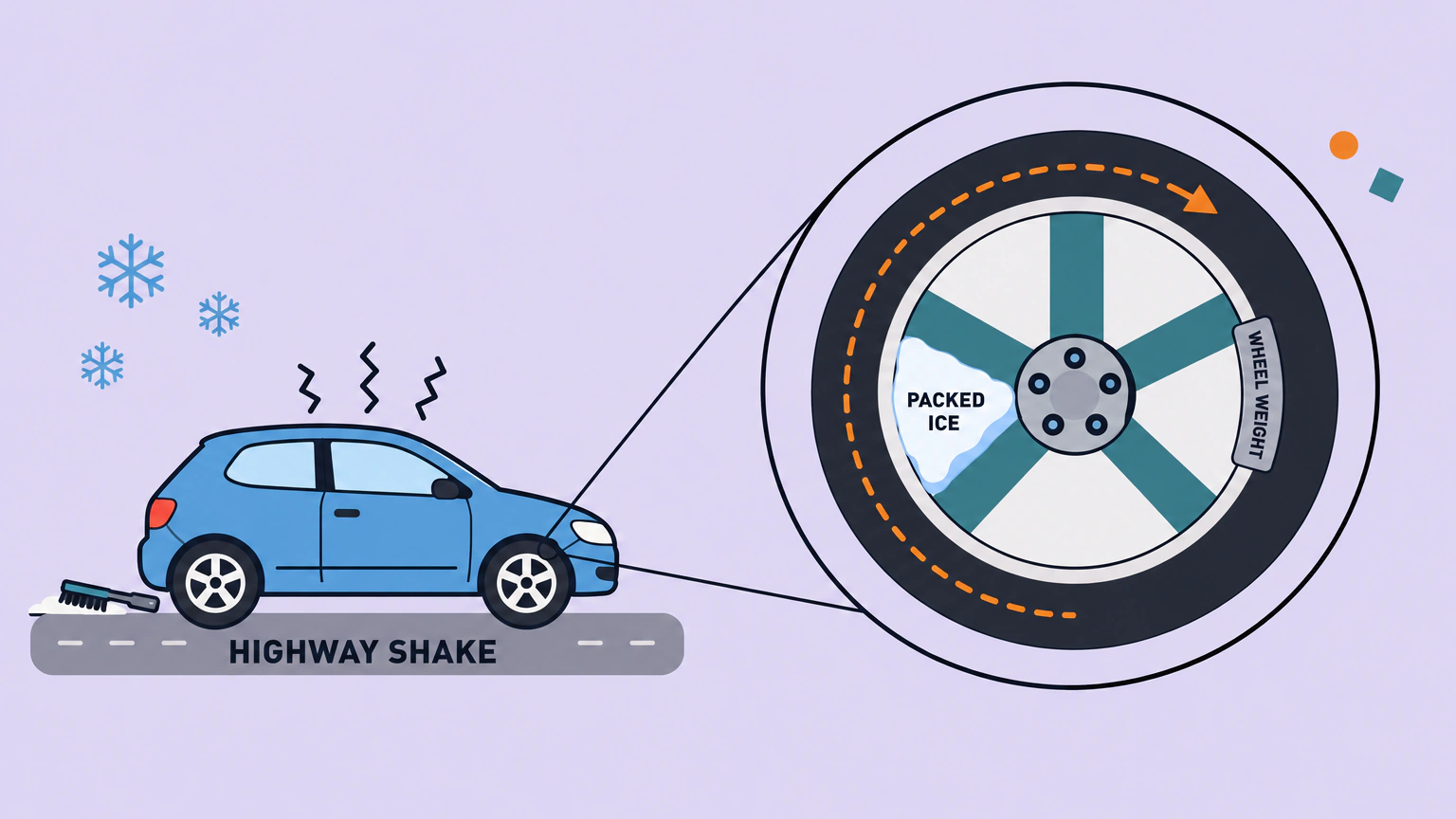
This is the Canadian one. You drive through slush, or rock the car back and forth to get out of a snowbank, and the next time you hit the highway the steering wheel shakes. Slush got thrown into the inside of the wheel, packed between the spokes and froze there. That chunk is extra weight nobody put on the balancer.
Kingston Heritage described exactly this after an Ontario storm in 2016: "This solid clump of ice causes a steering-wheel shake because the added mass rotating with the wheel throws off the wheel balance." The Mufflerman, a shop in London, Ontario, puts the shake at 90 to 110 km/h.
The fix is free, but how you do it matters. The Mufflerman warns against hitting the wheel with anything metal or sharp, because you can damage the rim or knock a wheel weight off, and then you really do need a balance. For the stubborn stuff, Kingston Heritage sent its readers to a self-serve wand-wash bay for hot water rather than a drive-through or touchless wash, and suggested parking somewhere heated afterward so the water dries instead of refreezing. Kal Tire lists pressure-washing the rims as one way to lose wheel weights, so keep the wand on the ice and off the little weights clipped to the rim.
If the shake is gone, you're done until the next storm. If it isn't, balance moves to the top of the list.
Pro tip: Clear the wheels before you pay for anything. A shake that showed up after a storm is often ice in a wheel, and clearing it costs nothing. Look inside each wheel first. Knock the ice out by hand or with a soft brush, then rinse the rest with hot water at a wand wash, keeping the spray off the small weights on the rim. Drive again before you book.
When the shake isn't balance at all
Three look-alikes send people to the wrong counter.
A tire that sat for weeks can flat-spot for a while, and Kal Tire lists long parking as a cause of imbalance. GM tells its own technicians to drive at least 24 km at 89 km/h or more before measuring, for exactly that reason. If the shake eases as you drive, give it time.
A pothole can bend a rim or damage a tire from the inside. A shake that started right after the hit is a wheel and tire inspection, not a balance. So is one that shows up at every higher speed and feels lumpy when you drive slowly, which points to a bent wheel.
A shake or pulse only when you brake points to a brake problem, possibly the rotors. Kal Tire's page on warped rotors describes the steering wheel or brake pedal "wobbling when you brake, especially on the highway." That's work for a brake shop, and our guide to what a brake job should cost covers the bill.
Red flag: A thump, a bulge or a pull isn't a balance job. If the shake turns severe or keeps getting worse, comes with a thumping sound, or the car starts pulling hard to one side, slow down, leave the highway where it's safe and look at the tire. Transport Canada says tires with bulges "are potentially dangerous and should be replaced." We can't inspect your car from here, so treat a thump or a bulge as a tire to look at before any more highway driving.
When you really need a balance
Ask three sellers how often to balance and you'll get three answers. Firestone, a US chain, says every 5,000 to 6,000 miles, which is about 8,000 to 9,700 km, or as the manufacturer recommends. NAPA Canada's blog says "once or twice per year." Cansumer, a Canadian consumer site, says every one to two years. Transport Canada gives no interval at all. It names the symptoms and leaves it there.
We side with the two sellers that tie it to events instead, Costco and Prince Tires. A date on the calendar doesn't change the balance by itself. Mounting a tire, losing a weight, hitting a pothole, uneven tread wear or feeling a new vibration are better reasons to check it.
Any time a tire goes onto a wheel
New tires, a tire taken off its wheel for a repair, or a used tire mounted on your rims: each one is a new assembly, and it gets balanced. Prince Tires is blunt about it: "Tires are balanced every time they're mounted." Costco's rule is to balance "whenever a tire is replaced, when a balance weight is moved or removed, and whenever you purchase new tires." Michelin Canada lists putting on new tires first among the times to check.
Prince Tires and Kal Tire include a new-tire balance. Costco's installation package includes lifetime balancing. So before you pay to balance tires you just bought, find out what the install already covered.
Seasonal swaps: on their own rims or not
This is the autumn question, and it comes down to rims.
If your summer and winter tires share one set of rims, every swap means pulling each tire off its wheel, mounting the other one and balancing it again. That rebalance isn't optional, and our guide to what an off-rim changeover costs prices the whole job.
If your winter tires live on their own wheels, the tire stays on the rim, so the swap does not disturb the weights. A rebalance is not automatic. Check the balance after a shake, uneven wear, a missing weight or a hard hit. If the car sat for weeks, drive until the tires warm up before judging the shake. Offered road force at a routine swap? Level Auto, a Toronto shop that sells it, says: "For a routine tire swap on a car that drives smoothly, standard balancing is fine."
Michelin Canada lists changing tires for the season among the times to check balance, and Prince Tires says a lot of Calgary drivers have it checked then. A check is fair advice. It isn't the same as paying to rebalance. Centre du Pneu S. Bourque's 2026 rate card in Victoriaville lists the on-rim swap and the balance as separate lines, so you can buy one without the other.
After a pothole, a lost weight or a pressure wash
A good balance can go bad between seasons. Kal Tire's and Prince Tires' own lists name the usual causes: a hard pothole hit, a wheel weight that came off or was fitted badly, a pressure washer aimed at the rim, and a car that sat parked long enough to flat-spot its tires. Michelin Canada adds curbs and road debris. On lost weights, Kal Tire doesn't hedge: "you'll soon notice the vibrations."
Spring pothole season is when most of these land at once. That's when we'd pay the closest attention to a new shake.
Before you say yes to a balance
- Look inside each wheel for packed snow or ice and clear it before you book.
- Ask whether the price is per wheel or for all four.
- If you bought the tires there, ask whether balancing is already included.
- On an on-rim swap, tell the shop whether the car shook last season. If it didn't, ask whether the balance is needed.
- If a balance didn't cure the shake, ask for a road force test and the printout for each wheel.
- Ask the shop to show you any missing weight or damaged tire it found, not just to say the wheels were balanced.
What tire balancing costs in Canada
At the two shops we found that publish a standalone price, balancing tires already on the car runs $12.50 to $20 a wheel, so about $50 to $80 for four before tax where stated. A mobile service that comes to you starts at $120 for four, and a road force balance starts at $120 plus HST for four in Toronto. Costco's installation package includes lifetime balancing for members' covered tires, and Kal Tire includes balancing with new tires, which makes the cheapest balance the one you've already paid for.
The Victoriaville card also lists $6.50 a wheel for rebalancing tires already mounted, without saying when that line applies. Ask which one you're paying.
What Canadian shops publish for balancing
| Who | What it covers | Published price | Note |
|---|---|---|---|
| Centre du Pneu S. Bourque, Victoriaville, Que. | Balancing a wheel that already has its tire on, 13 inches and up | $12.50 a wheel | 2026 rate card. A $2.50 fee a wheel may apply with a pressure sensor |
| Prince Tires, Calgary | Rebalancing tires already on your car | $20 a wheel, or $80 for four | Included when the shop installs new tires |
| Level Auto, Toronto | Road force balance on all four wheels, sedans and SUVs | From $120, plus HST | $150 for trucks and cargo vans |
| Mobile Tire Services Edmonton | Balancing all four wheels at your home or work | From $120 | One wheel from $40, plus an $80 call fee |
| Costco tire centres | Lifetime balancing for tires covered by its installation package | Included | For members. Costco says some limits may apply |
| Kal Tire | Balancing with new tires bought there | Included | From Kal Tire's own balancing page |
Prices are as each business publishes them. Prince adds GST at checkout, Level Auto adds HST, and Bourque does not say whether tax is included. A starting price is the lowest the business lists, not a quote for your car.
Road force balancing, and when it's worth the extra money
Road force balancing earns its price in two cases: a standard balance didn't cure the shake, or a brand-new set vibrates from the first drive. Level Auto's version includes a road force measurement on all four wheels, match-mounting where it helps, and a wheel and tire condition report. Match-mounting means turning the tire on the rim so its stiffest point lines up with the wheel's low spot, and the two cancel out. The report is the part you're paying for.
Owning the machine isn't the same as running the test. Hunter, which makes it, describes shops that balance on an "older generation Road Force® with the roller turned off." So ask for the printout with each wheel's road force reading.
GM's bulletin draws the line in both directions. When matching a tire to a good wheel still leaves the reading too high, "tire replacement may be necessary." Replacing tires below GM's limits "will probably mean good tires are being condemned." So a new tire that can't be brought into range is a conversation with whoever sold it to you. And a shop that wants to replace a tire on a road force reading should be able to show you the number. If a new set was balanced twice and still shakes, go back to the same shop and ask whether its machine has been calibrated.
Check your receipt before you pay for it twice
Costco's installation package includes balancing for the life of tires bought there, with the note that "some limits may apply." Kal Tire includes balancing with new tires bought there, and Prince Tires balances every tire it installs. If your Costco tires came with the installation package, a rebalance after a pothole may already be covered, so bring the receipt.
If you're buying a set this month, ask for balancing to be included in the price before you agree to it. Our guide to what a set of winter tires costs shows what else to check on that quote. If a wheel needs a rebalance later, call the seller before you call a shop.
Questions drivers ask about tire balancing
How much does it cost to balance four tires in Canada?
About $50 to $80 before tax where stated for four wheels already on the car: $12.50 a wheel in Victoriaville and $20 a wheel in Calgary. A road force balance starts at $120 plus HST for four in Toronto. For Costco members, the installation package includes lifetime balancing for the tires it covers, and Kal Tire includes balancing with new tires.
Do winter tires need to be balanced every year?
Not automatically. If your winter tires stay on their own rims, the swap does not disturb the weights. Have the balance checked if the car shook last winter, a weight is missing, the tires wore unevenly or the wheels took a hard hit. If one set of rims carries both sets of tires, then yes, every time, because each tire comes off and gets mounted again.
How do I know if I need a balance or an alignment?
Think feel versus see. A shake at highway speed is usually balance. A car that pulls to one side, a steering wheel that sits off-centre on a straight road, or one edge of a tire wearing faster than the other is usually alignment. They're separate jobs on separate machines, so you can ask for one without the other.
Can snow packed in the wheels really make my car shake?
Yes. Frozen slush inside a wheel acts like a weight nobody meant to put there, and it shows up as a shake at highway speed. Clear what you can by hand or with a soft brush, rinse the rest with hot water at a wand wash, then drive again. If the shake stays, book a balance.
How long does a tire balance take?
About 20 minutes for all four wheels at Prince Tires in Calgary. NAPA AUTOPRO says 15 to 45 minutes for all four. A road force balance with match-mounting takes longer, because every wheel is measured under load, and some tires get turned on their rims.
Is balancing free when you buy new tires?
Often, yes, because it's built into the install. Prince Tires balances every tire it installs, and Kal Tire includes balancing with new tires. For Costco members, the installation package includes lifetime balancing for the tires it covers, with some limits. Ask what your install covers before you pay to balance tires you just bought.
If it snowed, clear the wheels and drive again before anything else. Note whether you feel the shake in the steering wheel or the seat. Check what your tire receipt already covers. Then book with one of our tire service shops that balance wheels, and walk in knowing exactly what to ask for.