

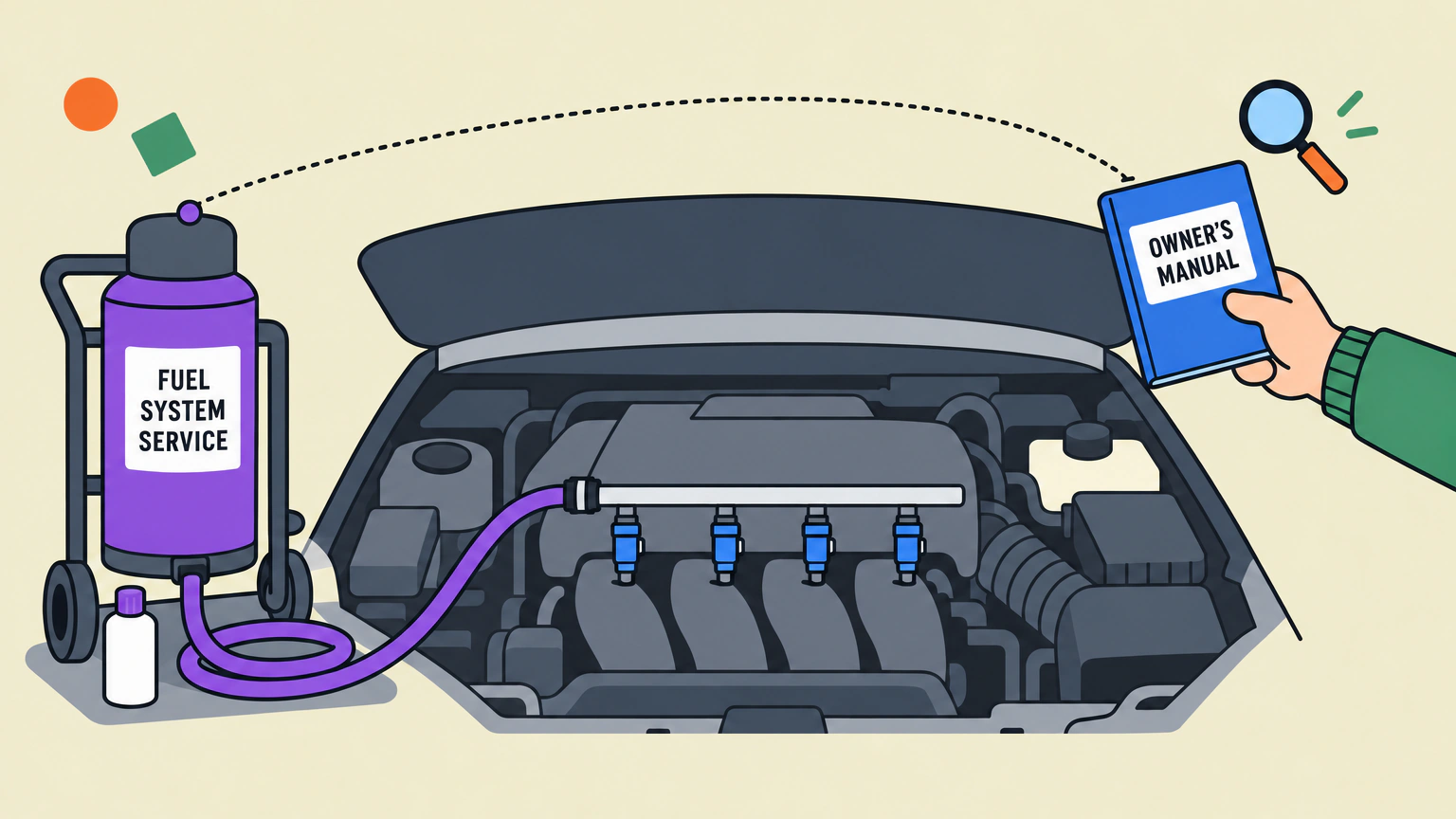
If your car runs well and its maintenance schedule does not list the service, it is not worth the money. Honda Canada says fuel injector cleaners aren't part of its maintenance schedule. GM doesn't recognize injector cleaning as preventive maintenance. Hyundai asks only for a bottle of its own cleaner in the tank when Top Tier gas isn't available. Pay for a cleaning when there's a symptom, such as a misfire code, rough idle or lost power. And if a direct injection engine has carbon on its intake valves, make sure you're buying intake valve cleaning, because fuel-side cleaner does not reach it.
On this page
- Four different jobs go by the same name
- What your carmaker actually says
- Port or direct injection: what a cleaning can reach
- When a cleaning is worth paying for
- What it costs in Canada
- Top Tier gas, the habit GM and Hyundai point to
- How to say no at the counter, or yes on your terms
- Questions drivers ask about fuel injection cleaning
Four different jobs go by the same name
"Fuel injection cleaning" on a quote can mean four different jobs, and what you pay and what your car gets out of it depend on which one you're buying.
One version is a bottle of detergent cleaner poured into the tank, often at an oil change. GM's dealer bulletin says its own bottle is for preventing and removing deposits, "particularly from the intake valves, fuel injectors, and the combustion chamber."
Next is a fuel system service done on the car, with cleaner run through the engine's fuel side. Ken Shaw Toyota in Toronto says its version "cleans your Toyota's fuel injectors, removes deposits from intake valves and parts." Toyota Canada calls its own "a two-step 360° fuel system cleaning process." Airport Ford in Hamilton has advertised a cousin of it as a "Fuel Induction Service."
Third, the injectors come out and go to a specialist. Canadian Fuel Injection Service in Steinbach, Man., cleans each one, tests its flow, spray pattern and leaks, and fits new O-rings and filters.
Fourth is intake valve carbon cleaning on a direct injection engine, often sold as walnut blasting. The intake manifold comes off for that one.
So ask which of the four your quote means.
What your carmaker actually says
The interval on the counter's sheet came from whoever sells the service. The schedule in your glovebox came from the people who designed the engine. On fuel cleaning, those two rarely agree.
The carmakers we checked split three ways. Honda, GM and Mazda don't count injector cleaning as maintenance at all. Hyundai's answer is a bottle in the tank. Toyota recommends a dealer service. If you'd rather follow the carmaker than the sales sheet, look for a shop that services to your carmaker's schedule.
What each carmaker says about fuel injection cleaning
| Carmaker | What its own documents say | What that means at the counter |
|---|---|---|
| Honda | Honda Canada's 2022 Warranty Guide says fuel additives and injector cleaners are "not part of the recommended maintenance schedule." American Honda calls injector cleaning "an unnecessary maintenance procedure." | Nothing to book on a schedule. A faulty injector gets replaced, not cleaned. |
| GM (Chevrolet, Buick, GMC, Cadillac) | GM's dealer bulletin says it does not "acknowledge the need for fuel injector cleaning as a preventative maintenance procedure." | Cleaning only when a GM diagnosis calls for it. A bottle of GM's own cleaner is for a diagnosed deposit problem, or where Top Tier gas isn't consistently available. |
| Mazda | Mazda's North American service alert says cleaning injectors "without an actual power related complaint" doesn't improve performance. | Not part of Mazda's scheduled maintenance. A faulty injector gets replaced. |
| Hyundai | The 2026 Elantra and Palisade manuals for Canada add a bottle of Hyundai fuel injector cleaner every 16,000 km or 12 months if Top Tier gas isn't available. | A bottle in the tank, not a machine service. Hyundai says not to use other cleaners. |
| Toyota | Toyota Canada recommends its Combustion and EFI System Cleaner Service "every 80,000 km or if performance issues exist." Its own schedules for a 2022 RAV4 and Corolla list no such service. | A dealer recommendation, not a scheduled item. Saying no doesn't skip scheduled maintenance. |
| Mr. Lube + Tires (a quick-lube chain) | Recommends cleaning your fuel system "on an annual basis." | A seller's interval, not a carmaker's. Check it against your manual. |
Honda, GM and Mazda: not as routine maintenance
Honda Canada's 2022 Warranty Guide is plain: "The use of fuel additives, or fuel injector cleaners is not part of the recommended maintenance schedule and is not required." American Honda's 2019 position statement, written for the US, goes further. It calls injector cleaning "an unnecessary maintenance procedure and improper repair procedure." A faulty injector, it says, "should be replaced."
GM's 2024 dealer bulletin says GM "does not endorse, support, or acknowledge the need for fuel injector cleaning as a preventative maintenance procedure." It approves a cleaning only "when performed as directed by a published GM drivability or DTC diagnostic service procedure." A DTC is a diagnostic trouble code. So in plain words, only when a diagnosis calls for it.
Mazda's 2026 alert to its dealers says cleaning injectors "without an actual power related complaint from the customer, does not improve engine performance." A bad injector gets replaced. Services outside the schedule, Mazda adds, "create unneeded expenses for your customers." Both the GM and the Mazda papers are dealer bulletins for North America, not pages from a Canadian owner's manual.
When the carmaker's answer is a bottle in the tank
Hyundai's 2026 Canadian manuals for the Elantra and Palisade list "Fuel Injector Cleaner" as an add item every 16,000 km or 12 months. The footnote sets the condition: "If TOP TIER Detergent Gasoline is not available, one bottle of Fuel Injector Cleaner is recommended." Hyundai also says never to add "any fuel system cleaning agents or other additives to the fuel tank other than HYUNDAI fuel additives." Its other rule is short: "Do not mix other Fuel Injector Cleaners."
GM's line on the bottle has moved. Its 2024 bulletin endorsed ACDelco Fuel System Cleaner 44K "added to a tank of fuel at each oil change." Its May 2026 guidance to technicians opens differently: "Fuel additives are not routine maintenance items." Now the same cleaner is for a problem that points to deposits. It's also for places where good gas is hard to find, "when preventive maintenance is needed because TOP TIER gasoline is not consistently available." A bottle with every oil change is the older advice.
Toyota Canada's blog suggests its bottled cleaner every 10,000 km or six months. So where a carmaker asks for something routine in the tank, it's a bottle, not a machine.
Toyota recommends it, but the schedules we checked don't list it
Toyota Canada's 2022 spring maintenance article recommends its Combustion and EFI System Cleaner Service (EFI means electronic fuel injection). It says the service cleans deposits "in the combustion chambers and on intake and exhaust valves." The sentence that matters comes next: "We recommend this service every 80,000 km or if performance issues exist."
So we pulled Toyota Canada's own maintenance schedules for a 2022 RAV4 XLE AWD and a 2022 Corolla LE, ten visits each from 72,000 to 144,000 km. Neither lists a fuel or combustion cleaning at any visit, the 80,000 km one included. The only fuel item is a check for leaks or damage. The schedule's note says some driving habits and climates "may necessitate additional Dealer Recommended Services."
That makes it a dealer recommendation, not a scheduled item. You can decline it without skipping either schedule we checked. Ken Shaw Toyota in Toronto listed $179.95 plus HST for its fuel system service on a gas engine in its March 16, 2026 archived page.
Port or direct injection: what a cleaning can reach
One engine fact decides what any cleaning can reach. In a port-injected engine, the injector sprays into the intake port just ahead of the intake valve. On the way in, says Delphi, a parts and equipment maker, "fuel washes over the intake valves." That helps keep them clean.
In a direct injection engine, the injector sprays straight into the cylinder. The catch, in Delphi's words, "is that fuel no longer reaches and cleans the valves, causing a build-up of deposits." Some engines have both. Toyota's D-4S system pairs direct injection with port injectors that "come into play during light- and medium-load conditions," Toyota Canada says.
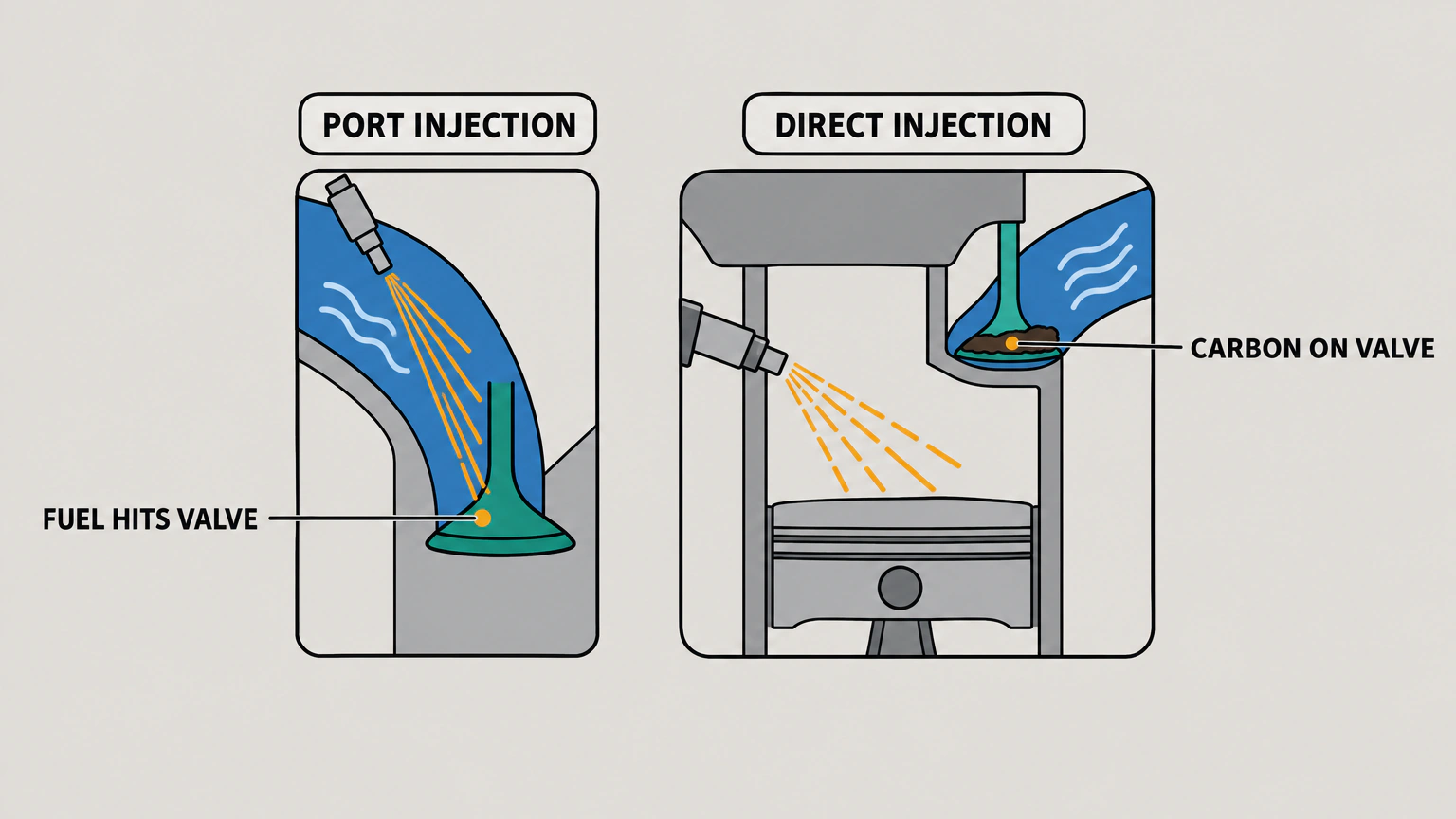
At the counter, that means a bottle or fuel-side service follows the fuel path through the injectors, but it reaches the intake valves only on a port-injected engine. On a direct injection engine with no port injectors, nothing that travels with the fuel touches the carbon on those valves. Your owner's manual or brochure names the engine's injection type. Or ask the shop to tell you before it quotes.
When a cleaning is worth paying for
The carmakers' own papers point to symptoms before most cleaning procedures. Hyundai's conditional bottle schedule and Toyota's dealer recommendation are the distance-based exceptions in this set.
The symptoms that justify one
Pool the carmakers' own words and you get a short list. GM's 2026 guidance names "loss of power, stalling, hard starting, or reduced fuel economy." Mazda wants "an actual power related complaint," and Toyota says "if performance issues exist." Subaru's carbon cleaning bulletins add misfire trouble codes, black smoke from the exhaust, knocking and rough idle.
Then comes the order of operations, because a misfire code isn't a fuel diagnosis. Subaru's procedure tells its technicians to check for other trouble codes and fix any "spark plug / ignition coil concerns" before trying a carbon cleaning. GM says those symptoms "still require normal diagnosis first." Honda and Mazda both say a faulty injector gets replaced, not cleaned.
So the first thing to pay for is a diagnosis, from a mechanic who'll diagnose it first. A misfire code usually shows up as a warning lamp on the dash, and we've written up what the check engine light is telling you.
Injector deposits can build up faster during shorter, more frequent trips.
Carbon on direct injection valves is a separate repair
This is carbon baked onto the back of the intake valves in a direct injection engine. Removing it means taking off the intake manifold, which is work for engine repair shops, not a quick-lube bay. Subaru bulletin 02-193-24R applies to 2020 to 2024 Legacy and Outback models with the naturally aspirated 2.5-litre engine. It approves a walnut blasting machine for misfire codes, black smoke, lack of power, knocking or rough idle.
The shops that sell it disagree on timing. Lakeview Automotive in Calgary lists the interval as "If symptoms are present." Rivercity Motors in Edmonton recommends "a carbon cleaning every 80-100,000 km as a preventive maintenance service." It isn't on any carmaker schedule we read. With no symptom, we'd wait.
What it costs in Canada
A Burnaby independent publishes $120 to $200 for its fuel injector service. A Toronto Toyota dealer's March 2026 archived page listed $179.95 plus HST for its gas-engine fuel system service.
What fuel cleaning costs, from prices Canadian businesses publish
| What you're buying | Published price | Who publishes it |
|---|---|---|
| Fuel system service at a dealer, with cleaner run through the engine | $179.95 for a gas engine, $229.95 for a hybrid, plus HST | Ken Shaw Toyota, Toronto |
| Fuel injector service at an independent shop | $120 to $200, depending on make and model | theGarage.ca, Burnaby, B.C. |
| Injectors removed and sent away to be cleaned and flow tested | $35 per port injector, $45 per direct injector | Canadian Fuel Injection Service, Steinbach, Man. |
| The same, from a Quebec specialist | $45 per port injector, $50 per direct injector, when you send two or more | Fuel Injector Precision, Sainte-Julie, Que. |
| Intake valve carbon cleaning on a direct injection Volkswagen | From $750, plus fees and taxes | Lakeview Automotive, Calgary |
| Intake valve carbon cleaning, priced per cylinder | $40 to $65 per cylinder, plus the labour to remove and refit the intake manifold | Rivercity Motors, Edmonton |
Prices are as each business publishes them. A per-injector price does not include your shop's labour to take the injectors out and put them back. Fuel Injector Precision also says return delivery and small spare parts cost extra.
Sending injectors away is simple math. A four-cylinder engine's port injectors cost 4 × $35 = $140 in Steinbach, or 4 × $45 = $180 in Sainte-Julie. A direct injection V6 has six, so 6 × $45 = $270 or 6 × $50 = $300, plus your shop's labour.
The Edmonton shop publishes roughly $160 to $260 for a four-cylinder, plus manifold labour. The Calgary shop starts at $750 plus fees and taxes. Mr. Lube + Tires recommends cleaning your fuel system "on an annual basis" and posts no price, so ask before you agree.
The bottle in the tank uses no cleaning machine, but the sources here do not establish an all-in bottle price.
Top Tier gas, the habit GM and Hyundai point to
GM's 2026 guidance calls quality fuel the "first step." It says Top Tier gas "helps maintain injector cleanliness and reduce intake valve deposits." Hyundai recommends gasoline "treated with detergent additives such as TOP TIER Detergent Gasoline."
Top Tier is a fuel standard written by carmakers, with sponsors including GM, Honda, Toyota and Ford. Its rule for drivers is simple: if the brand on the pump isn't on its list, "the fuel is not TOP TIER™."
When we checked the list's Canadian rows, Shell, Chevron, Ultramar, Co-op Fuel and Costco were on it, among others. Esso and Petro-Canada weren't. Some people will tell you otherwise. Go by the list. Top Tier also says approved stations sell it in every octane "with no added cost at the pump."
For a Hyundai owner, that decides whether the bottle line on the schedule applies. For a GM owner without a diagnosed deposit-related problem, it decides whether the bottle is needed as preventive maintenance.
How to say no at the counter, or yes on your terms
The advisor has explained the service, and you've got a few seconds to decide. In Ontario, the Consumer Protection Act, 2002 gives you firmer footing than that.
A shop can't charge you without a written estimate, unless you turned one down and set a ceiling on what you'll pay. The province is blunt: "Never sign a blank work order," because it lets the shop "make any repairs they think are necessary for your vehicle and charge you for the work, even if you disagree." If you okay work by phone, the shop "must make a written record of your permission." And the shop's posted sign has to say whether the people working on your car "receive any commissions for parts sold."
The repair shop rules we quote are Ontario's, and other provinces write their own. Our brake job guide compares how far above an estimate a shop can bill you in Ontario, Alberta and Quebec, and our oil change guide covers the other extras offered with an oil change.
Five questions to ask before you approve a fuel system cleaning
- Where is this service in my owner's manual or maintenance schedule?
- What symptom or trouble code is it meant to fix?
- Is it a bottle in the tank, a machine on the fuel system, or the injectors coming out?
- Is my engine port injection, direct injection, or both?
- Can you put the job and its price on the written estimate before you start?
Red flag: a cleaning sold by the calendar. A fuel system cleaning recommended by distance or by date, on a car that runs fine, when your carmaker's schedule doesn't list it, is a sales interval, not maintenance. Ask which document it comes from. If nobody can show you, you can say no without skipping anything your carmaker asks for.
If your car runs fine and your manual doesn't list the service, decline it and keep the receipt for the work you did approve. If it doesn't run fine, book a diagnosis first.
Questions drivers ask about fuel injection cleaning
Does fuel injector cleaner actually work?
It can, within limits. An approved detergent cleaner can help keep injectors clean and remove deposits. On a port-injected engine, fuel also reaches the intake valves. GM sells its own cleaner and points it at deposit problems like lost power or worse fuel economy. It can't reach the intake valves of a direct injection engine, though. And it won't fix a failed injector, which Honda and Mazda say gets replaced.
How often should fuel injectors be cleaned?
Only as often as your carmaker says, and for Honda, GM and Mazda that's never as routine maintenance. Hyundai's 2026 Canadian manuals ask for a bottle every 16,000 km or 12 months if Top Tier gas isn't available. GM's 2026 guidance allows a bottle where Top Tier gas is hard to find. Toyota Canada recommends its dealer service every 80,000 km, or when there's a performance problem.
Can fuel injector cleaner fix a misfire?
Sometimes, when deposits are behind it. But a misfire code has other causes to rule out first. Subaru's own procedure tells technicians to fix spark plug and ignition coil problems, and check for other trouble codes, before any carbon cleaning. Pay for a diagnosis before a cleaning, and expect a failed injector to be replaced rather than cleaned.
Will skipping a fuel system cleaning affect my warranty?
Honda and GM say these cleaners or additives are not warranty requirements. Honda calls injector cleaner "not required". GM says additives are not "required to maintain warranty coverage". Hyundai schedules a bottle when Top Tier gas is not available and tells owners to keep receipts for emission services. Those passages do not say that skipping one bottle automatically voids warranty coverage.
Does a Hyundai need a fuel system service?
Not a machine service. Hyundai's 2026 Canadian manuals for the Elantra and Palisade ask for a bottle of Hyundai fuel injector cleaner in the tank every 16,000 km or 12 months. That's only if Top Tier gas isn't available. Hyundai says to use only its own additive and not to mix in other cleaners. Fill up at a Top Tier brand and the schedule doesn't ask for the bottle.
Does Top Tier gas cost more?
Top Tier says no. Its approved stations sell it in every octane "with no added cost at the pump." Check the brand on the pump against Top Tier's list, because a brand that isn't on it isn't Top Tier. Shell, Chevron, Ultramar, Co-op Fuel and Costco were on the Canadian list when we checked.
Whatever you drive, the next move is the same. Find the maintenance schedule for your car and look for the service. Write down any symptom and when it shows up. Then take that page to the counter, or book a diagnosis if the car is telling you something.