

On this page
- The short answer, in one minute
- What windshield work costs in Canada right now
- Can this chip still be repaired?
- Will it pass a safety inspection?
- Who pays, and your province decides that
- Why the replacement quote came back so much higher
- Booking the work, and what to ask before you hand over the keys
- Frequently asked questions
- What to do this week
The short answer, in one minute
Ontario and Saskatchewan reject a chip larger than 13 mm, or a crack extending more than 50 mm, when the damage reaches the area your wipers sweep. Those are inspection limits, not repair limits. The published prices we found run from $60 to $150 for one chip repair. Replacement quotes start near $250 and can pass $1,000 when camera calibration is required. A glass shop still has to inspect the damage itself, so measure across the longest legs, not the pit in the middle.
So it is not just a price question. Where the mark sits and which province registered your plate affect inspection and insurance. The shop still decides whether the damage can be repaired.
What windshield work costs in Canada right now
All prices are in Canadian dollars. The pages do not consistently say whether tax is included. These are published examples, so ask each shop for its quote.
| The job | Published price examples (CAD) | What decides where you land |
|---|---|---|
| One chip repair | $60 to $150 | Chip type and insurance coverage |
| A second or third chip at the same visit | $20 to $50 more per chip | The setup is already done, so extra chips are discounted |
| Replacement | $250 to $600 and up | Glass supply, aftermarket or original part, and the shop's labour rate |
| Replacement, mid-size SUV or heated glass | $500 to $700 | The part itself, and how many features are bonded to the glass |
| Replacement with a forward camera to recalibrate | $800 to $1,000 and up | The calibration procedure, static or dynamic, and the vehicle |
Collect two or three quotes from our windshield repair and replacement shops list.
Chip repair, and why the second chip costs less than the first
A chip repair takes about half an hour. The technician pulls the air out of the break under vacuum, pushes resin into the space it leaves, and cures it hard. You're buying strength back, not looks. The mark stays faintly visible, and a shop promising it will vanish is overselling.
Extra chips are cheap once the technician is set up. Wind Auto Glass in Toronto publishes $30 to $50 for a second chip at the same appointment and $20 to $40 for a third. Book them together. Our auto glass shops near you listings show who works mobile.
Replacement, and the three things that move the number
The glass comes first. An original part from the manufacturer can cost more than aftermarket glass. Then come the features bonded to it, such as heating elements, a rain sensor or a camera.
Star Windshield publishes it as three tiers: $300 to $400 for a standard sedan on basic glass, $500 to $700 for a mid-size SUV or heated glass, and $800 to $1,000 and up once a camera needs recalibrating. It's one shop's card rather than a market rate, but the shape holds.
What our own cost profiles show
We keep quote and review data on the shops in our listings. Across 636 cost profiles in our windshield repair and replacement category, the typical price range is $198 to $426, between a $150 minimum and a $956 maximum. Across 847 cost profiles in our auto glass repair category, the fair price range is $86 to $164.
Our windshield figure sits below the shop bands above. The panel covers a broad service category rather than one repair or replacement tier, so treat it as a comparison rather than a quote.
Can this chip still be repaired?
Ontario and Saskatchewan publish the same windshield damage limits for inspections. Those rules tell you whether the glass passes that inspection, not whether a shop can repair it.
What the 13 mm and 50 mm inspection limits mean
Ontario's Passenger/Light-Duty Vehicle Inspection Standard is the handbook the province tells inspectors to use. It rejects "a chip larger than 13 mm in diameter within the area swept by OEM windshield wipers." It rejects "a crack of any length" that "extends more than 50 mm within the area swept by OEM windshield wipers." And a crack through both layers fails wherever it sits.
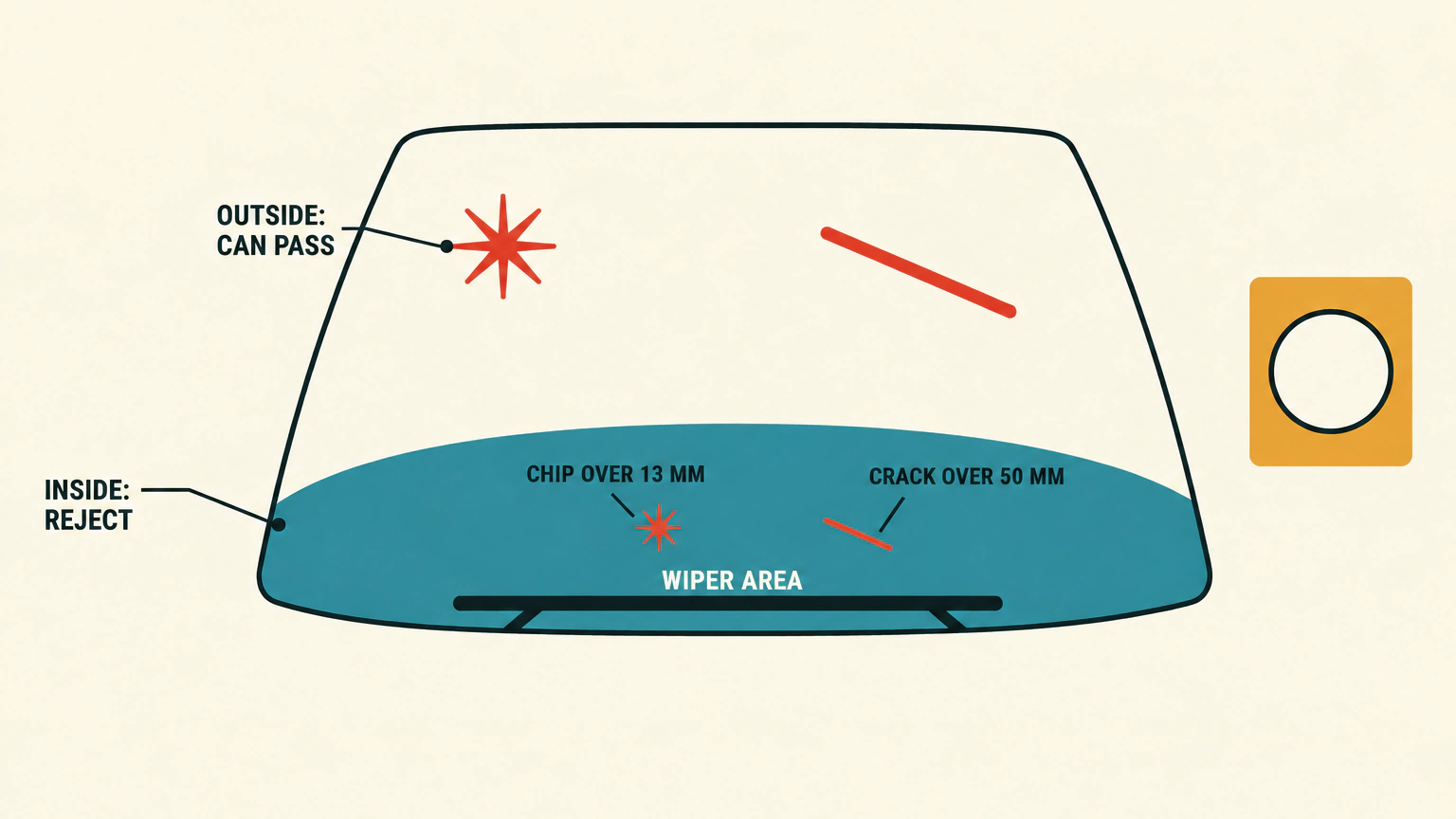
SGI publishes the same two numbers in Saskatchewan, with imperial equivalents beside them: half an inch and two inches. Both standards show the same oversized damage outside the wiper arc as a pass. A one-layer 60 mm crack in the corner passes that check. A 15 mm star where the blade sweeps fails it.
How to measure it the way an inspector does
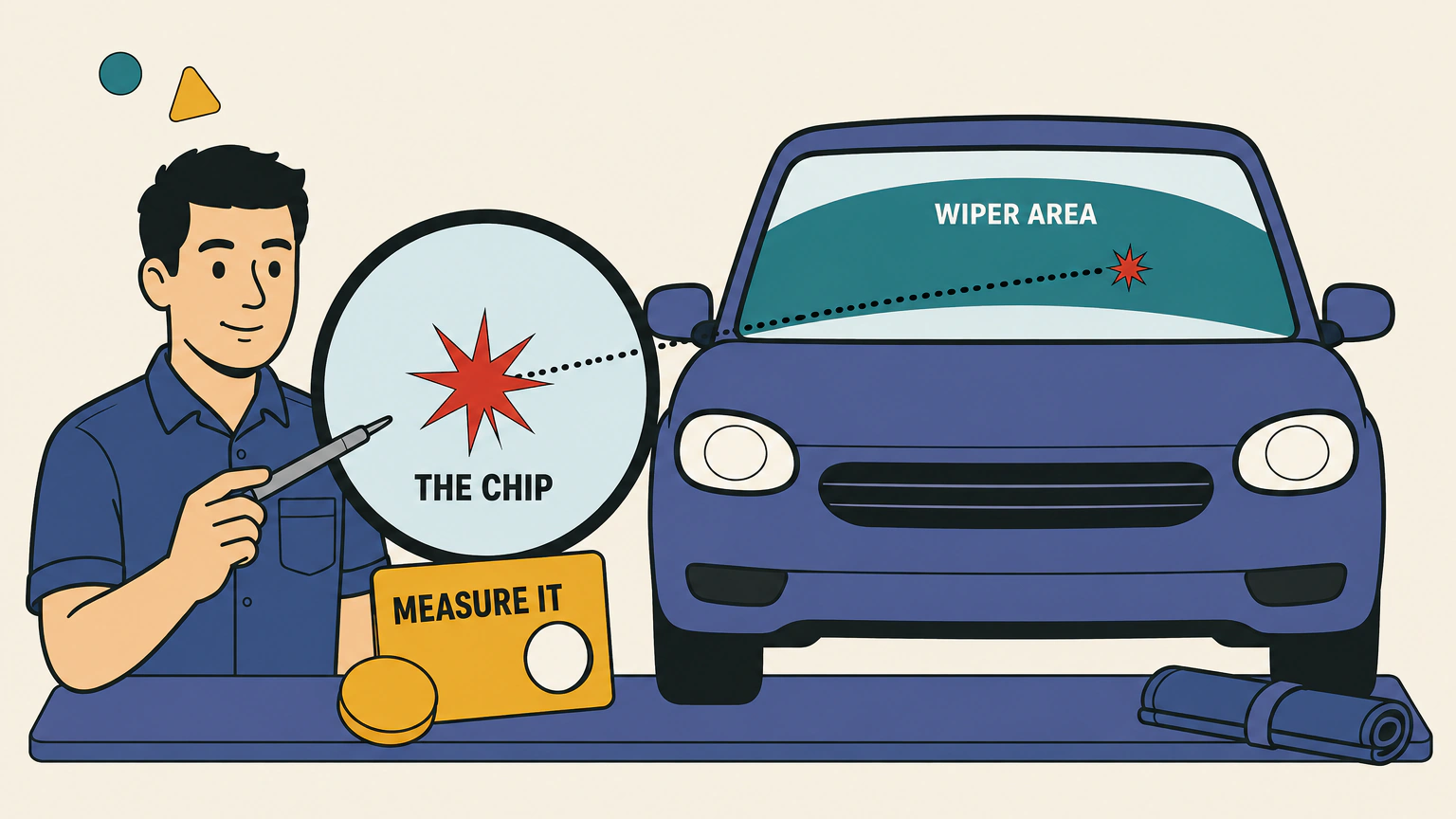
Measure across the two largest extending cracks or ring. That is SGI's instruction. A stone strike throws legs and rings out from the impact, so the damage is wider than the crater in the middle. Measure the crater and you get a comfortable number. Measure the legs and a chip that looked toonie-sized is well past 13 mm. There's no rounding room, either: Ontario holds measurements in that range to the nearest millimetre. Photograph yours beside a coin before it spreads.
Four reasons a shop may reject a repair
Damage through both layers. Ontario rejects it at inspection, and MPI does not authorize it for repair. Ask the shop to check the depth.
Damage that reaches the edge. MPI authorizes a crack repair only when the crack does not meet the windshield edge. Ask whether yours reaches it.
Damage in your line of sight. A filled chip leaves slight distortion. ICBC won't call a repair qualifying unless it leaves "no residual damage greater than ¼ inch in the driver's line of vision."
An older, dirty chip. Glass shops warn that water, salt and grime inside a break can make resin bonding less reliable. A fresh chip gives the technician a better chance.
ICBC makes the broader point clearly. It calls its criteria "general guidelines only" and tells drivers to consult their chosen glass facility. The shop looking at your glass makes the final call.
Will it pass a safety inspection?
For most drivers a chip is an annoyance. It becomes a transaction problem the day you sell the car or move provinces, because that's when somebody gets paid to look hard at your glass. Our inspection stations listings cover who does that near you.
Ontario: what a vehicle inspection centre rejects
Ontario ties the certificate to the handbook. You need one to transfer a used vehicle to a new owner, unless that owner is your spouse. You need one to register a vehicle from another province or country, a rebuilt vehicle, or a vehicle moving from unfit to fit. And you can't put a plate on a vehicle without one.
The inspection happens at a DriveON vehicle inspection centre licensed by the Ministry of Transportation, and the certificate lasts 36 calendar days. Glass fails on those two limits, on a crack through both layers, and on any decal or device other than a camera safety device that obscures vision in the swept arc. If a move or a private sale put you here, what a provincial inspection actually checks covers the rest.
Saskatchewan: the same two numbers, published as pictures
SGI's pass and fail sheet runs two pages of drawings with six numbered conditions. It's the clearest thing any Canadian authority publishes. Fails: a crack through one layer running more than 50 mm into the wiper area, and a star chip over 13 mm across inside it. Passes: the short crack, the small chip, and both oversized versions outside the arc.
Two more rules ride along. Discolouration over 10 per cent of total glass area fails, and so does sandblasting that impairs vision. The Saskatchewan inspection standard also rejects aftermarket tinting, sunscreen and reflective material on the windshield and front side windows.
Who pays, and your province decides that
The system changes by province. Rock-chip coverage sits under optional comprehensive coverage in British Columbia, Alberta and Ontario. Saskatchewan and Manitoba include physical damage in public basic insurance, but deductibles and glass-specific rules still decide what you pay.
| Where you are | Who covers the damage | A chip repair | A replacement |
|---|---|---|---|
| British Columbia | ICBC, but glass sits in optional Comprehensive, not Basic Autoplan | Free, no deductible, at an ICBC approved glass repair facility, if the damage is smaller than a loonie and is not a long crack | Your comprehensive deductible, reduced to $200 if you bought the $300 deductible and a flying object caused the damage |
| Saskatchewan | SGI basic plate insurance, which covers vehicle damage subject to a deductible | With extension coverage, take the policy information to a glass shop and have the shop file the repair | Class LV passenger vehicles carry a $700 deductible, so most replacements are paid out of pocket |
| Manitoba | MPI Basic Autopac covers accidental damage to most registered vehicles, subject to a deductible | The $1,000 Basic deductible applies, but any lower passenger-vehicle deductible option reduces glass repair to $0 | Glass replacement carries the deductible you chose, from $200 to $1,000 |
| Ontario | Your own insurer, and only if you bought comprehensive or all perils | Ask whether your policy waives the deductible on a repair, before you book | Your comprehensive deductible applies |
| Alberta, Quebec and the Atlantic provinces | Your own insurer, on the same private market structure as Ontario | Ask your insurer whether a repair is deductible-free | Your comprehensive deductible applies |
Manitoba also uses a public insurer. MPI's current guide puts glass repair behind the $1,000 Basic deductible, but every lower passenger-vehicle deductible option reduces a repair claim to $0. Replacement keeps the deductible you chose, from $200 to $1,000.
British Columbia: when a repair is free and the deductible is $200
Glass isn't in Basic Autoplan. ICBC puts it under Comprehensive, which is optional and covers "falling or flying objects such as a rock or gravel hitting your windshield."
If you have it, a qualifying chip repair costs you nothing. The conditions include damage smaller than a loonie, no long crack and no old nonqualifying damage. The remaining mark cannot exceed a quarter inch in the driver's line of vision. The facility also checks that the damage is new and does not cross a heating element or cover a sensor or camera. It must be repaired at an ICBC-approved glass repair program facility, and vehicles under 8,800 kg are eligible.
Replacement is different. You pay only a $200 deductible if you bought the $300 comprehensive deductible and a missile or flying object caused the damage. ICBC's minimum is $300, so any higher deductible takes you out of the rule. A different cause does too, and a falling tree is one of the named exceptions. ICBC also says flatly that a comprehensive claim won't affect your premium.
Saskatchewan: covered on your plates, behind a $700 deductible
Your plate insurance does cover damage to your vehicle, subject to a deductible, and Class LV passenger vehicles carry $700 of it.
For a replacement below the deductible, you pay the whole bill. On a $400 windshield, SGI pays nothing. A $600 replacement is still $100 below the deductible. The loss has to clear $700 before a dollar moves, and then only the part above it gets paid. SGI's own example: a $1,000 repair costs you $700 and SGI $300. Deductibles on basic plate insurance also rise on 1 January 2027.
If you have extension coverage, SGI tells you not to file a road-hazard windshield repair online. Take the extension-policy information to an auto glass shop, and the shop files the repair with SGI.
Ontario and the private market: only if you bought comprehensive
Ontario's regulator files comprehensive under "Extra coverage for loss or damage to your vehicle." FSRA says it "can pay for losses, other than those covered by collision or upset coverage, including perils listed under specified perils coverage, falling or flying objects, missiles and vandalism." A deductible and certain exclusions apply. Alberta puts it more bluntly: collision and comprehensive are "not required by law."
Before you phone a shop, find your declaration page. Look for comprehensive or all perils and read the deductible beside it. Then ask whether the deductible is waived for a repair and whether a claim changes your premium. A waiver can make the repair cost you nothing, but the policy decides. Ask before you book, not after.
Why the replacement quote came back so much higher
If a camera sits behind your windshield, replacement may require recalibration. SGI says computerized recalibration is often necessary after windshield replacement. ICBC requires proof of successful ADAS calibration when a non-supplier asks for reimbursement and bills for that work. Ask the shop to follow the procedure for your vehicle.
Ask for the quote itemized, with glass, labour and calibration on separate lines. MPI says ADAS calibration may be static, dynamic or both. Ask which procedure your vehicle requires and who will perform it. If the glass shop sends the work out, our collision repair centres list can help you check the provider.
Booking the work, and what to ask before you hand over the keys
Mobile service is convenient, but moisture can interfere with resin bonding and cold glass needs temperature control. Ask how the technician will keep the break dry and warm. Ask about the warranty too. An SGI Accredited shop in Saskatchewan carries a minimum two-year labour warranty.
- Measure the damage across its two longest cracks or rings, not across the pit in the middle.
- Sit in the driver's seat and work out whether the damage sits inside the arc your wipers sweep.
- Photograph it beside a coin, so you have the size on record before anything spreads.
- Find any glass or comprehensive deductible on your policy before you phone anybody.
- In British Columbia, check the shop is on ICBC's approved glass repair list, because that is the only way a repair is free.
- Ask whether the quote includes recalibrating the camera behind the glass, itemized on its own line.
- Ask what the shop warrants if the repair spreads later, and for how long.
Red flag: These five things are worth a second question.
- A quote that will not separate glass, labour and calibration into their own lines.
- An offer to make your deductible disappear without explaining what the insurer will be billed.
- A mobile technician who will inject resin in rain or hard cold without saying how they are controlling for it.
- Anyone who says a chip smaller than a toonie will pass every provincial inspection.
- A replacement booked without anybody asking whether your car has a camera behind the glass.
Pro tip: Keep the invoice and any calibration record with your vehicle papers. They give the next shop or buyer a clear record of what was done.
Frequently asked questions
How much does windshield chip repair cost in Canada?
The published prices we found run from $60 to $150 for one chip. One Toronto shop lists another $20 to $50 per chip at the same appointment. In British Columbia, a qualifying repair is free with ICBC Comprehensive at an approved glass repair program facility. Elsewhere, ask what your policy charges for a repair.
Can a windshield crack be repaired, or does the whole windshield have to go?
Some cracks can be repaired, but inspection and repair use different tests. Ontario rejects a crack extending more than 50 mm into the swept area, or through both glass layers. One Ontario shop lists $100 to $250 for a repairable crack under six inches. Longer or deeper damage still needs a shop assessment and may require replacement.
Can you drive in Ontario with a cracked windshield?
Only while the glass still gives you a clear view. The Highway Traffic Act says you can't drive unless the windshield and the windows beside you give a clear view to the front and side. It sets no crack length, so an officer decides. A conviction carries a fine of $60 to $1,000.
Will a chipped windshield pass a safety inspection in Ontario?
Ontario rejects a chip larger than 13 mm only when it sits inside the area swept by the OEM wipers. The same oversized chip outside that area passes this part of the Passenger/Light-Duty Vehicle Inspection Standard used by DriveON centres.
Does insurance cover a windshield chip repair, and will it put my premium up?
Coverage depends on your province and policy. ICBC requires optional Comprehensive, while Saskatchewan and Manitoba include physical damage in public basic insurance. ICBC says a Comprehensive claim will not affect your premium. MPI says a windshield repair claim will not affect future premiums or deductibles. Ask a private insurer before filing.
How quickly should I get a chip fixed?
Book it promptly and keep the break clean and dry. Glass shops warn that moisture and grime can make resin bonding less reliable. Sharp temperature changes can also help a chip spread. A longer crack may still be repairable, but it needs an assessment before the damage grows.
What to do this week
Measure it across the longest legs, photograph it beside a coin and work out whether it sits inside the wiper arc. Then check your policy for any glass or comprehensive deductible, so you know what to ask before booking.
Book it soon. If you are already booking your winter tire changeover, ask whether the shop also handles glass. Do not wait for that visit if the damage is spreading.