

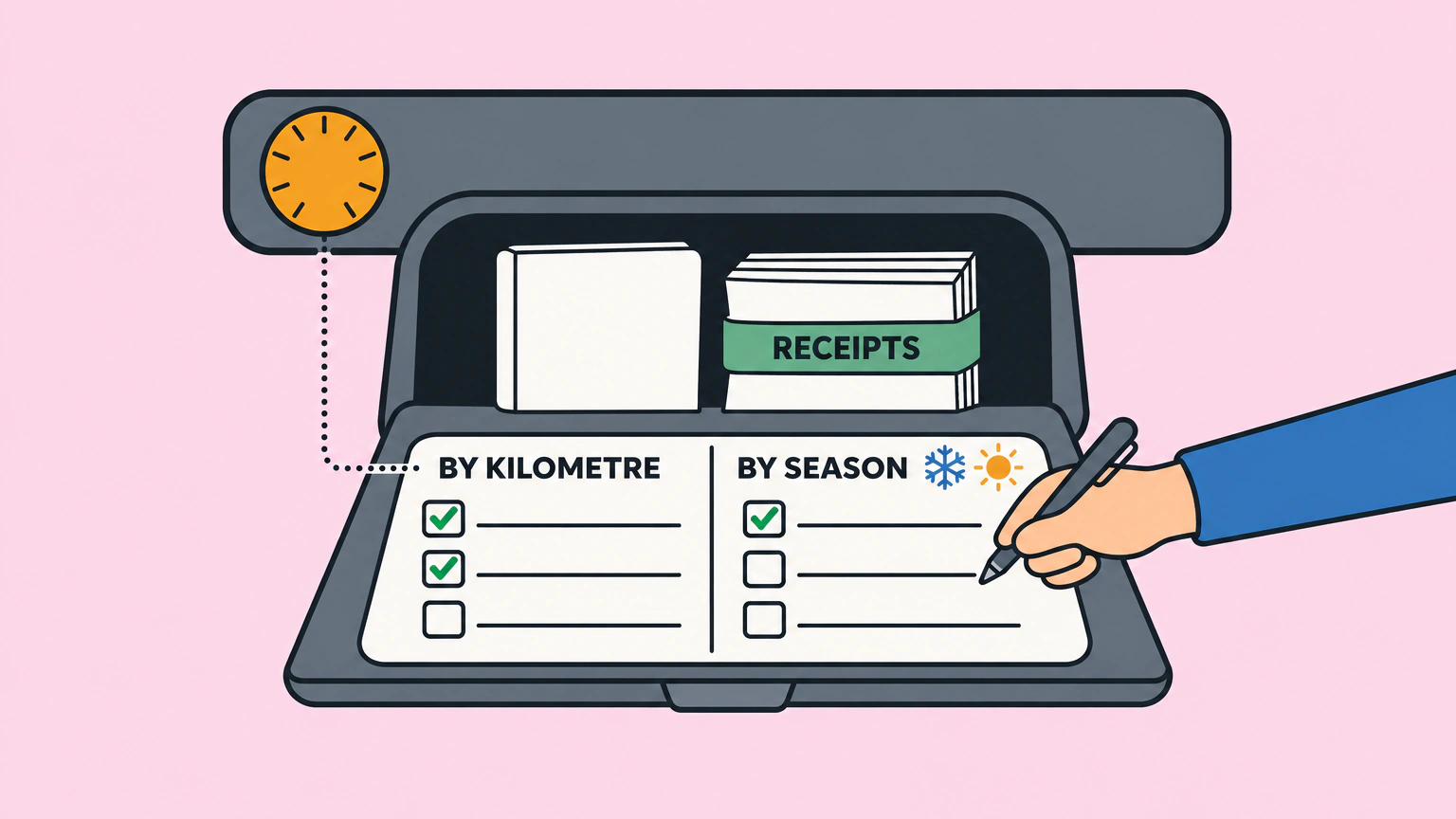
Most cars need less than a generic chart says. The carmakers' own schedules we read call for a service visit about every 8,000 to 12,000 km. Fresh brake fluid comes due somewhere between 48,000 km and five years, and we found no schedule that changes the coolant before 160,000 km. A time limit can come first. Find your own schedule first, then hold every job on a quote against it.
On this page
Start with your car's own schedule
The real list lives with the carmaker, and in Canada it's easy to find. Toyota Canada's website builds a car maintenance schedule for your model and your kilometres. Mazda Canada's digital owner's manual has a table marked "Canada residents". Honda Canada publishes its Maintenance Minder sheet, and Hyundai and Chevrolet put theirs in the owner's manual. Bought a used car with an empty glovebox? That's not a dead end, because the carmaker's Canadian site usually has the manual.
Model year, engine and driveline can all change the numbers. Some manuals also carry a second, harder schedule for short trips, towing or dust. For oil, our guide to how often your oil really needs changing covers it.
We read five schedules, not yours. Your manual wins every time.
Inspect doesn't mean replace
Most lines on a schedule tell a technician to look, not to buy. Mazda's chart key spells it out: "I: Inspect: Inspect and clean, repair, adjust, fill up, or replace if necessary" and "R: Replace". Hyundai's key draws the same line. Toyota's basic visit runs to twelve lines. Ten say check, inspect or record, and the other two are a tire rotation and a reminder reset.
So a shop that inspects your brake pads has done the job on the list. A shop that sells you pads because the list says inspect, and not because the pads are worn, hasn't read it. A menu printed from the odometer can even flag a filter you changed last weekend.
Read the replace lines first. Those are the ones that cost money.
What's due by kilometre, carmaker by carmaker
We read five maintenance schedules: Toyota Canada's schedule data for the 2022 RAV4 and Corolla, Hyundai's Canadian manual for the 2025 Tucson, Mazda's "Canada residents" table for the 2024 CX-5, Honda Canada's Maintenance Minder sheet and Chevrolet's 2025 Equinox manual. We left oil off, since it has its own guide.
When five carmakers' schedules call for each job
| Job | Toyota Canada (2022 RAV4, Corolla) | Hyundai (2025 Tucson) | Mazda Canada (2024 CX-5) | Honda Canada (Maintenance Minder) | Chevrolet (2025 Equinox) |
|---|---|---|---|---|---|
| Tire rotation | Every 8,000 km | Every 13,000 km or 12 months | Every 8,000 km | Code 1 | Every 12,000 km |
| Engine air filter | Inspected every 8,000 km, no set change | Every 32,000 km or 24 months | Every 56,000 km or 3 years | Code 2 | When the car's filter-life display says so |
| Cabin air filter | Inspected every 8,000 km, no set change | Every 16,000 km or 12 months | Every 32,000 km or 24 months | Code 2 | Every 36,000 km or 24 months |
| Brake fluid | Every 48,000 km | Every 48,000 km or 36 months | Level check only, no change listed | Code 7, or every 3 years | Every 5 years |
| Spark plugs | Every 192,000 km | Every 160,000 km | Every 120,000 km, or 64,000 km on the 2.5 turbo | Code 4 | Every 96,000 km |
| Coolant | 160,000 km, then every 80,000 km | 192,000 km or 120 months, then every 40,000 km or 24 months | 192,000 km or 10 years, then every 96,000 km or 5 years | Code 5 | 240,000 km or 6 years |
| Automatic transmission fluid | No change listed | "No check, No service required" | No change listed | Code 3 | No change on the normal schedule, every 72,000 km on the severe one |
Read from each carmaker's schedule for the model named. Your model year, engine and driveline can change any line. Honda sets no fixed kilometres: the car's Maintenance Minder shows the code when the job is due.
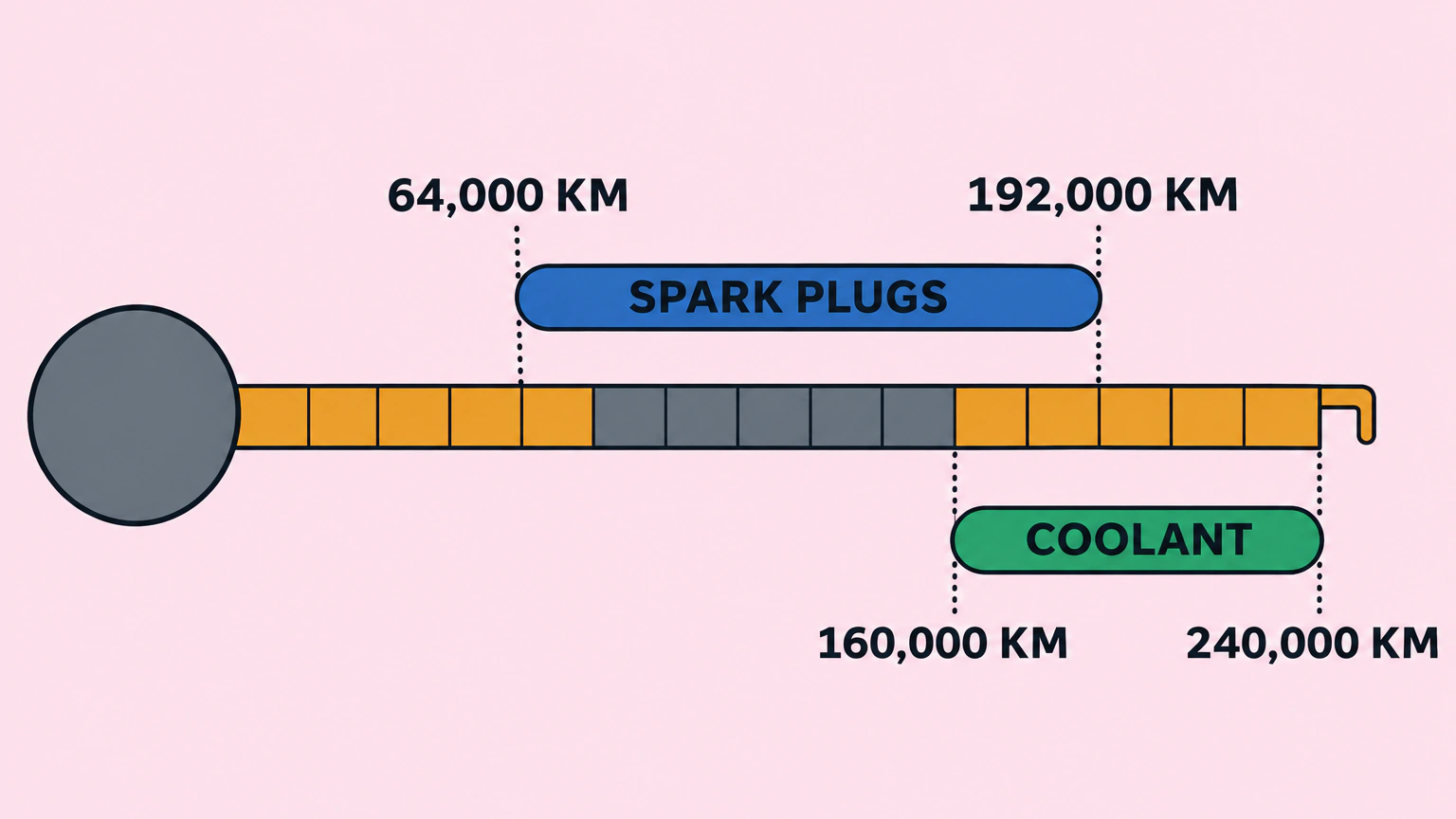
Side by side, the spread jumps out. Spark plugs run from 64,000 km on Mazda's turbo engine to 192,000 km on the Toyotas. The first coolant change runs from 160,000 km to 240,000 km or six years. Brake fluid comes at 48,000 km, three years or five years, and Mazda's Canadian table lists no change at all. Whichever carmaker is right, one chart can't cover all five.
Where the generic charts go wrong
One Canadian chart lists a coolant flush at 50,000 km. All four schedules that give a kilometre figure put the first change at 160,000 km or later. The same chart puts a brake fluid flush in its 100,000 km tier, while Toyota and Hyundai change the fluid at 48,000 km. It saves the battery test for 100,000 km or three years, even though CAA says most batteries last three to five years and Toyota's schedule runs a 12-volt battery check every 32,000 km. Another checklist says to replace the engine air filter every year, where Mazda's Canadian table goes 56,000 km or three years.
So the chart errs both ways. This isn't shops asking too much. It's one list trying to fit cars that were never built to one list. George Iny of the Automobile Protection Association gave the Globe and Mail the fix back in 2016: "Stick with the schedule in the owner's manual which provides a reliable baseline for maintenance."
Transmission fluid: where the manual and the mechanic disagree
This is the one honest fight on the list. Hyundai's 2025 Tucson schedule says "No check, No service required". Toyota's visit list and Mazda's table show no change, and neither does Chevrolet's normal schedule. Honda lists a change under code 3, and the other exceptions are about hard work. Chevrolet's severe schedule changes the fluid every 72,000 km. Honda's sheet says every 40,000 km if you regularly pull a trailer or drive slow, steep mountain roads.
Many veteran mechanics won't accept "lifetime" fluid at all, and a schedule can run too light as well as too heavy.
Our call: unless your schedule lists it, it isn't required, so no advisor gets to tell you it is. But if you tow, climb mountain grades or plan to keep the car until it dies, a drain and refill is cheap next to a transmission. Confirm the exact fluid and the method before you book transmission fluid service, because CVT and fluid exchange jobs each have their own procedure. Chevrolet's manual is blunt about the rest: "Do not have chemical flushes that are not approved by GM performed on the vehicle."
What's really on a 100,000 km service
None of the five schedules has a 100,000 km visit. Toyota and Hyundai step every 8,000 km, so they land on 96,000 and 104,000. Mazda's Canadian table ends at 96,000, and Chevrolet's nearest stops are 96,000 and 108,000.
Near that mark, Toyota adds brake fluid at 96,000 km to a regular visit, plus transfer case fluid on the all-wheel-drive RAV4. Hyundai's 96,000 km column replaces the oil, the air filter, the cabin filter and the brake fluid, and it inspects the drive belts for the first time. Mazda's replaces the oil and the cabin filter. Chevrolet's replaces the spark plugs. So a fixed "100,000 km package" is someone's menu, not a schedule. If fuel system cleaning shows up on the same menu, we've looked at whether fuel injection cleaning is worth it separately.
Then ask better questions. Dustin Gagnon, academic chair of the automotive service technician programs at NAIT in Edmonton, told the Globe and Mail: "A lot of customers will ask, 'Do I need to get this done?'" And in his words, "that's not a great question." He suggests asking why they're recommending the work and what could happen if you wait.
Slow down at two words, flush and cleaning, and at any list of work printed before anyone has looked at the car. Iny adds that often "people at the service counter are commission-based and they are not mechanics." That's a reason to ask, and no knock on the person across the counter.
What each job should cost
Our own category pages list a budget estimate for each job, as each page defines it. Taxes are extra where we say so. Bigger scheduled items such as timing-drive work get no flat figure, and for those our scheduled maintenance page says to get an itemized quote against the exact list of work that's due. We don't price engine or cabin air filters, so ask for the part price and the fitting time before you agree.
What each job costs
| Job | Budget estimate | What it covers |
|---|---|---|
| Entry service | $90 to $130 starting price, taxes extra | Oil, filter and scheduled checks on a gasoline vehicle |
| Broader service | $200 to $225 starting price, taxes extra | Oil, filter, rotation and additional checks, itemized |
| Tire rotation | $30 to $50 for four | Balancing is separate |
| Seasonal swap, tires on wheels | $40 to $80 for four | Wheel change and torque check |
| Brake fluid flush | $100 to $160 | Fluid replacement and bleeding |
| Routine coolant replacement | $120 to $220 | Specified coolant and refill |
| Spark plugs, four-cylinder | $120 to $450 | Four plugs and installation, coils and diagnosis extra |
| Spark plugs, six-cylinder | $180 to $700 | Six plugs and installation, intake removal can add labour |
| Automatic drain and refill | $120 to $300 | Partial fluid replacement, filter service not assumed |
| CVT fluid service | $200 to $450 | Correct CVT fluid, confirm the filter and level-setting procedure |
| Standard battery, installed | $150 to $450 | Flooded 12-volt battery and routine fitting |
| AGM battery, installed | $260 to $650 | Confirm any registration or coding |
From our own category pages. These are budget figures for the job as described, not a quote for your car.
What a normal year adds up to
Here's a worked year at 16,000 km, for a gasoline car past its first big jobs with winter tires on their own rims.
A year of upkeep, added up
| Line | How often | Budget |
|---|---|---|
| Entry service | Once a year | $90 to $130 |
| Broader service | Once a year | $200 to $225 |
| Seasonal swap, tires on wheels | Twice a year | $80 to $160 |
| Brake fluid flush | One year in three | $33 to $53 |
| Routine year | $403 to $568 | |
| Front brake pads and a standard battery | A heavy year | $300 to $750 |
| Heavy year | $703 to $1,318 |
Built from the rows above plus our brake pads row of $150 to $300 an axle. Tires, repairs and tax aren't included.
A routine year comes to about $403 to $568 before tax. A year when front brake pads and a battery land together reaches about $703 to $1,318. Pads have their own guide on what a brake job should cost.
We'd set aside about $60 a month, which covers a routine year and banks the rest for the year when the pads and the battery come due at once. CAA put routine scheduled maintenance at $500 to $700 a year back in 2018, a figure that left out tires.
Your Canadian maintenance calendar
The schedules care about kilometres. The country cares about weather. So the calendar is mostly what the schedules leave out.
Where you live does change a few lines, though. On dusty gravel roads, Honda replaces both the engine and cabin air filters every 24,000 km. On V6 models used often below -30°C, it replaces the timing belt every 100,000 km. Mazda files salt, cold and short trips under its severe conditions, and it tells Canadian owners to follow that harder schedule. Toyota's schedule even checks the block heater and its cord every 16,000 km, so if you're still deciding about one, start with whether you need a block heater. You won't find these lines on a generic car maintenance checklist.
Every month, in your own driveway
Hyundai's Tucson manual lists the first three as monthly owner checks, and the leak check as one to make whenever you drive.
- Check the coolant level in the reservoir with the engine cold.
- Check every exterior light, including brake lights and signals.
- Check the pressure in all tires, and the spare too.
- Look under the car for leaks. Water from the air conditioning is normal.
Before the first hard frost
None of the autumn jobs needs a package, and the tire swap has its own guide on what the swap costs and when to book.
- Have the 12-volt battery tested, especially once it's three years old.
- Book your winter tire swap. Quebec requires winter tires from December 1 on cars registered there.
- On most BC routes, your car needs winter tires from October 1.
- Have the block heater and its cord checked if you plug in.
- Fill up with washer fluid rated to -40°C, and keep a spare jug.
- Replace wiper blades that streak or smear.
Those two dates are law. Quebec's requirements for winter tires run from December 1 to March 15. BC's designated winter tire and chain routes keep the rule until April 30 on most roads.
Once the salt is off the roads
Spring is when winter's damage shows up. The rinse is Chevrolet's advice, and the tire lines are Iny's.
- Rinse the underbody with plain water, and keep a pressure wand off the axle seals.
- Have the battery tested again if the car sat through the winter.
- Ask for the tires to be checked for uneven wear at the swap.
- Book an alignment only if the car pulls or the tires wear unevenly.
Keep the receipts, wherever you get the work done
Gagnon told the Globe and Mail that a dealership isn't required, and that "the only real requirement is that you can demonstrate a service history." The risk runs the other way. He says a missed service that causes a serious problem may not be covered. The Globe quotes Hyundai's 2024 Kona manual, which excludes "repairs and adjustments required as a result of improper maintenance or a lack of required maintenance."
So keep the paper. Chevrolet's manual asks you to record the date, the odometer reading, who did the work and what was done. Then it says: "Retain all maintenance receipts." Make sure every invoice names the fluid or part specification, too. That line is what proves the job was done to the manual, whoever did it.
Check for recalls while you're at it
Transport Canada keeps a list of carmakers' recall look-ups by vehicle identification number (VIN), and its own recalls database searches by make, model and year. It says the manufacturer "will almost always make these repairs free of charge." Run the check twice a year at the tire swap. It takes a minute.
Car maintenance questions we hear most
How often should a car be serviced?
Usually every six months or 8,000 km, whichever comes first. Toyota, Mazda and Hyundai work in those steps, Chevrolet works in 12,000 km steps, and a Honda tells you itself. Time counts as much as distance. "Whichever comes first" means a car that sits a lot can hit its deadline on the calendar long before the odometer.
Does a car that's barely driven still need servicing?
Yes. Gagnon told the Globe: "that doesn't mean that if you're only driving 1,000 kilometres a year, you should wait eight years to change your oil." Honda and Chevrolet both ask for an oil change at least once a year, whatever the oil-life reading says. Chevrolet's coolant limit is six years, however few kilometres the car has done.
Is a coolant flush necessary?
Not as a routine job. Replacing old coolant is on every schedule we read, but a chemical flush isn't on any of them. Our routine coolant replacement price covers specified coolant and a refill, and our coolant page saves repeated flushing for contaminated systems. Iny told the Globe that dealers sometimes upsell replacing coolant that, on many vehicles, can last up to 10 years. If a menu says flush, ask what fault it's meant to fix.
Does my car need a fuel filter change?
Probably not as a routine job on a recent car. We found no fuel filter line on any of the five schedules, and Hyundai's Tucson manual says the fuel filter "is considered to be maintenance free". One checklist online says to change it yearly anyway. Hyundai's exception matters, though. Fuel flow restriction, surging, loss of power or hard starting calls for a new filter right away, whatever the schedule says.
Is a winterizing package worth paying for?
We wouldn't buy one as a bundle. Not one of the five carmakers lists a winterizing service. What winter does need is short: a battery test, the right tires, washer fluid and wipers. Book only the ones your car needs, and ask for each line to be priced on its own.
What maintenance does an electric car need?
Fewer jobs than a gas car, but it still needs a schedule. There's no engine oil and fewer routine fluids. Tires, brakes and checks come due all the same. Our scheduled maintenance page puts a basic visit for a battery-electric car at $130 to $135, covering listed checks and a tire rotation, with fluid replacement and brake servicing extra. Ask whether taxes are included. For the big-ticket question, see our EV battery warranty guide.
Can I do the maintenance myself and keep my warranty?
Yes, if you can prove it. Gagnon told the Globe: "You can even do it yourself, as long as you keep the receipts and can prove that you've been doing the maintenance." Keep the parts receipts, write down the date and odometer reading for each job, and use the exact fluid your manual names.
Book the one job that's actually due
Open your schedule and find the next replace line your kilometres or months have reached. That's the job to book. Anything else on the menu is a question, not an order.
Then find a shop that services to your carmaker's schedule, hand over the list, and book that one job.